
Reviewed by Rebecca Wigandt
There’s a phenomenon in experiencing video games that I like to refer to as the “Holy Crap Factor”. It’s a particular kind of first impression usually induced by an exciting attract video or opening cutscene, typically accompanied by a really groovy piece of music, and an engaging first play sequence, often an in media res situation dropping you right into some crucial piece of action. Simply put, the right combination of initial contact with a game – when you’re going in with an open mind and relatively few concrete expectations – will make you blurt, “holy crap”.
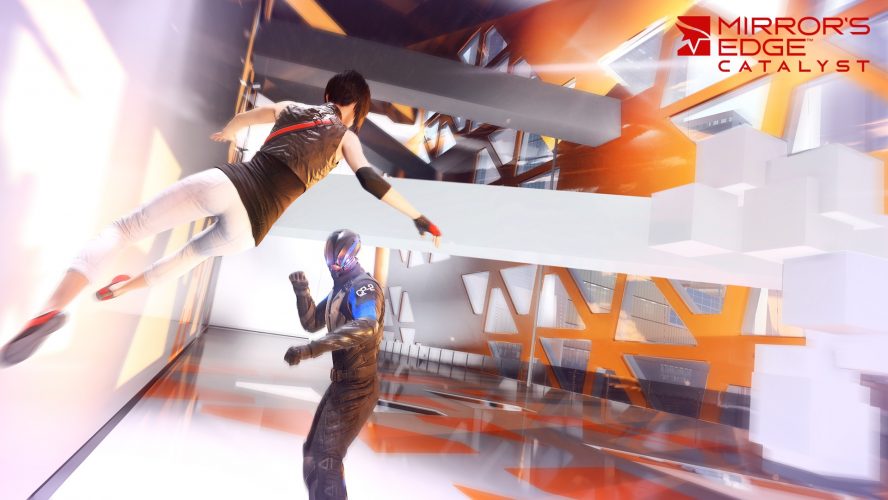
Which brings us to Mirror’s Edge, having just hit the PC shelf this past weekend. Mirror’s Edge uses the Unreal game engine coupled with some really nice use of PhysX graphics acceleration in texturing to bring us a game centered on running around like a madwoman jumping off buildings. The spirit of the game is rooted strongly in parkour, the noncompetitive French sport of trespassing and making a public nuisance of yourself. In Mirror’s Edge, you assume the role of Faith Connors, one of a community of “Runners” – fast-moving couriers operating a sort of grey-market communications network in a dystopian near-future city covered with every possible sort of surveillance. A populist mayoral candidate who may bring about a change in the oppressive culture is murdered, your estranged cop sister Kate is framed, and your Runner skills are put to new use as Public Enemy Number One of pretty much everything with a gun and uniform in the entire city.
 Playing Mirror’s Edge is a lot like when I try to get out the door in the morning, get out of work in the evening before I get slapped with any ‘surprises,’ or try to get from one end of a Manhattan subway station to the other. It brought back warm memories, ha he ho, of running through people’s backyards after school to get away from someone bent on dismembering me for something or other and, more positively, reminded me of the ‘sump,’ a disused drainage system in our neighborhood that nearly everyone under the age of eighteen would break into to skate, run, jump, and climb in and around all the huge pipes, concrete structures, ladders to nowhere, and water conduits. In other words, Mirror’s Edge is about being in a huge freaking rush all the time and trying to maneuver through an environment as gracefully, seamlessly, and above all quickly as you can.
 Said maneuvering is accomplished by an array of fancy techniques Faith has at her disposal – wall-running, double-jumping, ‘ziplining’ down cables and wire, tightrope walking, and so on. The whole of Mirror’s Edge is about getting from one end of an area – a series of rooftops, the ascending scaffolding of a skyscraper, a network of train tunnels – to another, either while being pursued by very heavily armed men who would like a word with you or negotiating dizzying heights or natural hazards that invite a loud, splattery death. Happily, these maneuvers are executed relatively simply and intuitively via mouse and keyboard, which is a handy thing as Mirror’s Edge doesn’t give you the option of using a gamepad or similar peripheral. The levels are semi-intelligent regarding your interactive movements with them – that is, pressing the space bar whilst running across open terrain will make you jump, but pressing it while running immediately parallel to a wall will cause you to wall -run up the side of it, and pressing it while dropping (or falling) will cause you to grab whatever ledge or grabbable protrusion comes to hand. Think Prince of Persia, only 3D, first person, faster, routinely involving paths of travel that no remotely sane person would take, and gravity being your absolute worst enemy instead of cunning traps.
On second thought, don’t think Prince of Persia. Maybe think Oni, Take Two’s 2001 anime action outing. Cute, spunky, incredibly athletic protagonist, lots and lots of running, lots of frenetic timing-based martial arts, cyberpunk mythos. Actually, maybe not. Where Oni had direct combat galore, Mirror’s Edge takes its sensibilities in precisely the opposite direction. Direct, head-on slugfests will get you killed in mere seconds- your opponents are much better armed (which is to say they’re armed at all), much more durable, and much more numerous. If you can, you’re always better running at top speed, leaping off the nearest rooftop or concrete pylon, and leaving those nasty cops in the dust. When you must fight, combat is frantic and moving, always moving- hitting your enemies on the run, aiming a nasty elbow or sliding kick on the way past, mastering a timing game to wrest guns from your enemies’ hands, and so on. Even in the satisfying moments when you seize a piece of hardware from a foe and rain down sweet retribution in the name of the underdog, standing still and blasting away is a recipe for a fast, merciless death. In any case, weapons are short on ammo (since it’s not like you’re carrying any around) and weigh you down, making them decidedly non rigueur for this season’s wall-jumping maniac. Mirror’s Edge is not a shooter. Repeat, Mirror’s Edge is not a shooter. It’s a thinker.
 Since I’ve already ranked Mirror’s Edge high on “Holy Crap”, I’ll start my critique by saying that first of all, it’s absolutely gorgeous. Mirror’s Edge demands in no uncertain terms a high-performance PC but rewards the (no pun intended) faithful with crisp, beautiful landscape, character design, and some really impressively natural movement routines. This is a game whose visuals are designed to really celebrate graceful movement – birds fly, feet and legs pump, human bodies (player and otherwise) negotiate terrain with wholly believable coordination. Everyone is gorgeous to look at (though there are admittedly only a handful of characters with visible faces, as opposed to the hordes of masked city police) from head to toe – if you’re enjoying Mirror’s Edge with PhysX enhancement, you’ll see lifelike, persistent textures on skin and clothing even at a distance. An upbeat, pulsing soundtrack of house, New Age and trance music captures the moods of situations well and is pleasing and complementary rather than distracting. Level layouts put the great visuals to good use. I’ve got a growing list of friends who have approached nausea and dizziness watching me look over the edge of a virtual rooftop or leap across a precipice at nerve-racking heights.
Which is a good thing, because one of the downsides of Mirror’s Edge is that you’ll be seeing these levels a LOT. As gorgeous as it is, Mirror’s Edge is basically a jumping puzzle game with combat thrown in for garnish and by necessity of the plot. There’s really only ever a small handful of ways to get from one end of a level to another, and most of the path is a series of environmental chokepoints with really only one solution (a wall-jump at a precise location, a double-jump off of a specific piece of landscape, etc.). Despite the huge, wide-open world you see so often while running like a madwoman, you’re mostly herded through a relatively small section of the visible surroundings. The solutions to these chokepoint puzzlers- and indeed your ultimate destination- isn’t always clear. Expect to run to a ledge, see your (presumably) intended destination a seemingly unreachable distance away, try something, spend ten seconds watching Faith plummet to her death, and try again twenty times. Gameplay in Mirror’s Edge is very linear, and the game basically grinds to a halt when you find yourself stumped by a puzzle of the terrain. Attacking the puzzle over and over breeds a frustration loop as you wait through the protracted “waaaaaah-SPLAT” sequence and then often have to negotiate the now-tedious obstacles preceding the stumper AGAIN, and in your annoyed rush to get to the stumper puzzle make a careless mistake, fall for ten seconds, and have to start AGAIN.
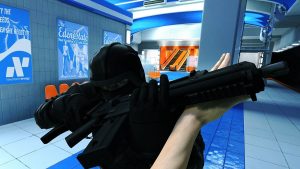 You get the idea. Consumers of a strict shooter or fighter diet probably won’t be attracted to Mirror’s Edge, and won’t get enough of what they’re looking for to be satisfied. It’s not a stealth game either, really, so while Thief fans might appreciate the climbing around aspect, the parkour sensibilities will probably confound a more moderately paced, methodical type. These sorts of difficulties in comparison are the double-edged payout of the unique concept of Mirror’s Edge – there isn’t anything out there exactly like it.
Despite this relative genre-busting, there unfortunately isn’t much to the gameplay, either. I finished the Story Mode in a diligent three days, and most of what took so long were one or two of the aforementioned ‘grind to a halt’ puzzles that took a half hour or so of abortive wall-jumps and prolonged falls from great heights. Playing the game through unlocks ‘Hard’ mode, which predictably makes the antagonists more difficult but also turns off the ‘Runner Vision’ that tints useful environment objects red, but frankly this doesn’t do much to the experience- once you know how to do all the puzzles and where to go, your replays can get whittled down to three hours or less, and frankly there’s nothing to encourage much of it- nothing expansive to explore, no changes to the puzzles, no different routes through the environment.
Unfortunately, other than a ‘race mode’ where you can time trial the various maps from the story mode and unlock a handful of short ‘checkpoint’ races, there isn’t much else to do.
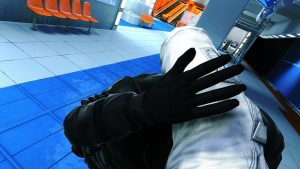 However revolutionary the visual style and gameplay sensibilities of Mirror’s Edge are, the story itself is nothing terribly novel- pretty now-standard ‘rage against the machine’ cyberpunk fare, with an extremely predictable plot arc of murder-conspiracy-betrayal-denouement. The cutscenes are all done in Flash animations that I swear are made by the exact same artists that did the Esurance commercials, and the resemblance was sufficiently unmistakable that I interrupted a very dramatic Mexican-standoff scene by blurting out “Quote Buy Print!” at the screen and causing my assembled audience to collapse in a peal of giggles, ruining the dramatic moment. EA-DICE has made a statement that Mirror’s Edge is the first in a three-part series chronicling the adventures of Faith and her sister. While I’m certainly intrigued, sequels are going to need to have further innovation in gameplay and just plain more variety and substance to be seen as anything other than “Mirror’s Edge 2: The Map Pack” or a similar overmilking of the same cat.
The Female Perspective:
For what it is, Mirror’s Edge is girl-friendly, that’s for sure. A believable and interesting protagonist (who admittedly I’d have liked to have seen developed further), male and female antagonists, and voice acting and character design that come across as neither trite nor objectifying. The fact that this isn’t a testosterone-pumped killfest with an unrealistically-hardy tank of a big-chinned hero helps, too- this is a game that encourages creative problem-solving and abstract thinking (the first time through, anyway) and a decidedly indirect style of conflict resolution. Female gamers who don’t enjoy the ‘locker room’ atmosphere of most FPS games may find the hopeful, dynamic, upbeat flavour of Mirror’s Edge more their style.
Summing Up:
Mirror’s Edge is gorgeous, exciting, clever, and sufficiently engaging to compel you to see it through. It’s also very short, repetitive, frustrating at turns, and offers little replay value. I probably wouldn’t buy Mirror’s Edge off the shelf, but I’d definitely rent it from my local video store and enjoy a long weekend of running, jumping, twisting, kicking, and otherwise being a badass dystopian chick for a little while.
Oh, and if anyone knows where I can get the tabi sneakers that Faith wears in real life, email me. We’re talking BFF potential here.
Special thanks to EA for providing a copy of this title.