
Reviewed by Brandy Shaul
You remember those old “choose-your-own-adventure” storybooks? The ones normally concerning some monster, demon or evil scientist ready to take over the world – those books that placed you in the role of the main character with the unique ability of controlling how the story turned out? “Turn to page 63 if you want Jimmy to enter the secret underground lair, or turn to page 89 if you want Jimmy to hightail it and run!” I was obsessed with them as a kid, so it’s quite fitting that Miami Law ended up on my radar.
Miami Law plays very much like a choose-your-own-adventure story through a fairly basic point-and-click landscape. Short mini-games are introduced at story-specific intervals throughout the game’s five cases (each of which lasts around an hour), with each case becoming progressively harder than the last.
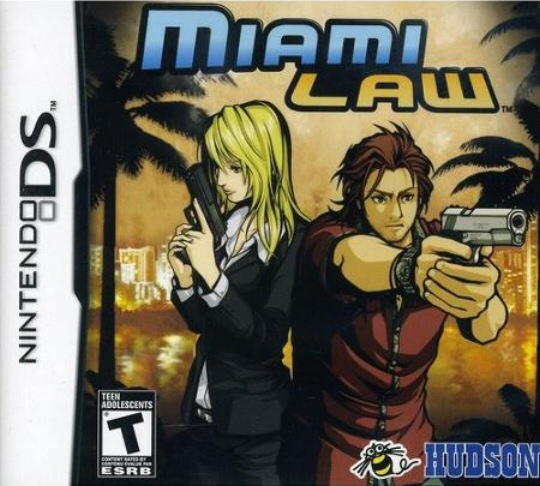
The game follows Miami PD officer Law Martin on his quest for revenge against the leaders of Miami’s largest drug cartel, appropriately named the Miami Syndicate, who are responsible for the death of his partner Sam. The Miami Syndicate, or MS for short, has been smuggling cocaine from South America into Miami through Cuba for months, becoming a powerful organization with ties both to other worldwide criminal organizations, and with DEA rats, making them quite the force to be reckoned with.




As you will quickly learn, these ties lead to something much more sinister, as a bio-terrorism plot is eventually uncovered, shifting Law’s focus from solely revenge to the salvation of the southeastern United States.
Law isn’t alone on his mission, however, as the FBI quickly takes over Law’s case and assigns Agent Sara Starling to keep a short leash on the even shorter tempered Law.
The majority of the gameplay here is quite basic. A set of icons located on the touch screen let you talk to surrounding characters, investigate your environment (search for evidence or observe questionable behavior), travel to any location you’ve previously visited and keep track of your current tasks via Law’s PDA.
More often than not, you’ll find yourself simply tapping on the talk button and choosing someone to interact with, only to be instructed to talk to someone else and repeat the process, until you are eventually ordered to a new geographical location (“Let’s test these samples back at the lab,” or “Let’s find the informant at Miami Beach.”).
There are instances where you are left on your own to investigate your current location, but don’t feel the need to bust out your analytical thinking cap just yet. Even though a sense of freedom is implied within the title, the game is entirely linear, and stops you from progressing if you haven’t completed every action “just so.” That is, you may be ready to bust into the Miami Syndicate’s secret facility and kill some baddies, but if you haven’t taken the time to exhaust all conversational options first, you won’t be allowed to do so. So much for the renegade persona the title tries to set up for Law – “I’ll do as I damn well please… but only after I ask mommy and daddy if that’s ok first.”


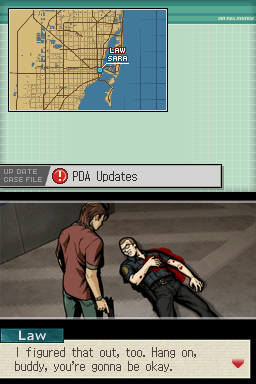
The concept of player choice comes into play after critical elements in the story, when you are given the option of playing as either Law or Sara for the next section. Sara is more reserved and relies on forethought, so her sections deal more with concern over the political fallout of her actions and playing by the book than flying by the seat of her pants, whereas Law is hotheaded and will take every opportunity to kill someone that Sara allows. Depending on who you choose, the story can and will change, but only those who are engrossed in the game’s shallow, predictable storyline will want to play the game a second time to see the how the opposite choice would have panned out.
Stopping the game from being nothing more than an interactive novel are the mini-game action sequences that typically come in the form of car chases and shootouts, with car chases tasking you with tapping left or right on the touch screen to dodge traffic, and shootouts asking you to rapidly tap on enemies to fire your weapon, with shots doing more or less damage depending on whether you hit their torso or an appendage.
Visually, the 3D action sequences are quite blocky and full of clipping, while the storyline portions are drawn in your basic digital comic book style. Characters have strong features while backgrounds are muted, with the only real animation coming from changes in facial expressions. The soundtrack is also quite standard, with a slight jazz undertone reminiscent of most TV cop dramas.
While the selection of these interactive novels (or comics, if you prefer) on the DS has steadily increased over the years, the quality thereof has been fairly hit or miss. Titles like Lux-Pain are, as the name conveniently implies, painful, whereas options like Unsolved Crimes and, to a lesser extent, even Miami Law are much more polished, and therefore engaging in many respects. In the end, Miami Law can easily be completed in just a few sessions, making it a quick rental, but worth a purchase only for cop drama fanatics.
Special thanks to Laura Klang Glienna and Hudson for providing a copy of this title.