
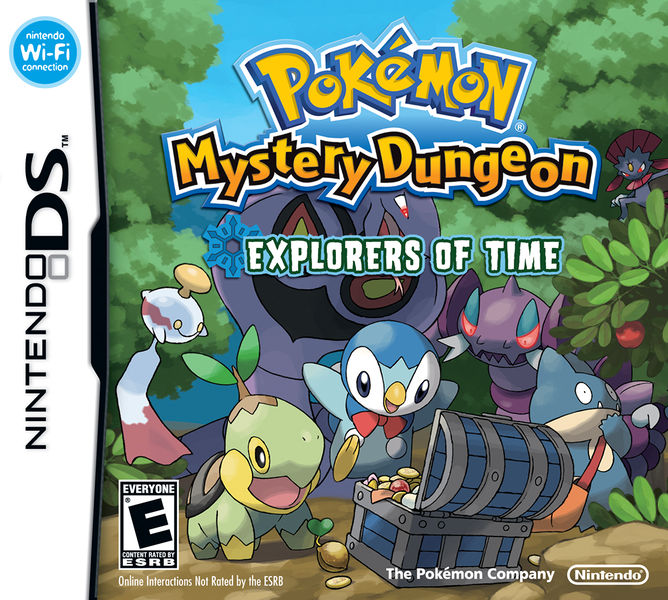
Reviewed by Brandy Shaul
Back in 2006, Pokemon fanatics worldwide rejoiced at the thought of being able to leave their trainer days behind and enter the real world of Pokemon in the first set of Mystery Dungeon titles. Upon its release, I reviewed Blue Rescue Team, but was disappointed in the overall gameplay mechanics as compared to other titles in the Pokemon universe.
With the release of this new set of sequels, Explorers of Time and Explorers of Darkness, I am happy to say that many of my complaints from the first game have been addressed here, even if some smaller problems do take their place.
 Continuing in the theme of the last set of titles, Explorers of Time begins with a set of personality questions that allows the game to ascertain which pokemon you are most comparable to. The game then reads your aura in a clever “place your fingertip on the touch screen” mechanic and assigns the appropriate pokemon to you. At first, I was assigned Meowth, a disappointing outcome, so I reset the game and was happy to see that the set of personality questions had changed, leaving me with a much more positive ending when assigned to be Squirtle, a turtle.
After being assigned your playable character, you can choose your partner from a short list of other characters. This time around, I chose Pikachu, the very mascot of the series. As in the last set of titles, the pokemon type you choose to be your partner is just as important as the pokemon type that you are assigned to be. For instance, I wouldn’t have wanted to choose another water type pokemon as my ally, as Squirtle can handle that job with ease. Instead, I chose an electric type famous for his Thundershock ability that can paralyze most enemies in their tracks.
The story finally begins when you are found passed out on a beach by your ally pokemon. You discover that you were actually a human that has been transformed into a pokemon in a process that is not yet clear. Your ally pokemon will be thrilled to find you alive, and will eventually proposition you to join him/her in an Exploration Team.
Housed by Wigglytuff’s Guild, Exploration Teams are groups of pokemon that travel through the land’s various mystery dungeons answering calls for help from lost pokemon or simply to find money and items. After naming your team, you will be assigned different jobs by the guild, most of which are involuntary.
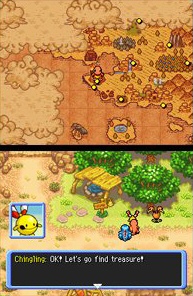 This guild mechanic is one of the bigger changes from the original Mystery Dungeon. Now, instead of being able to do whatever you want whenever you want, you are at first under the control of Wigglytuff’s Guild, making gameplay pretty linear for the first few hours. Also, by being under control of a guild, any money you may receive during your outings goes straight to the guild, with you receiving a mere 10% of the total earnings.
On the flip side of that coin, however, the guild also breaks up the monotony of simple dungeon crawling by adding in mini-games not found in the previous titles. For instance, early on you will be assigned sentry duty, guarding the entrance of the guild. You stand underground, looking up through a large grate on the surface that allows pokemon to stand on it without falling through. While they stand on the grate, you will be shown their footprints and must identify the pokemon by its print, by tapping on one of four choices on the touch screen. You will be graded accordingly based on how long it took you to identify each poke?mon and if you actually identified them correctly.As you progress, the overall story of the game shifts, when the world’s time gears start coming up missing. When time gears are stolen, time in each area literally stops, and it’ll be up to you to find the culprit and set things right.
The affect on the flow of time has also resulted in an increase in “bad” pokemon found throughout the region. Adding yet another new and positive feature to the game is the ability to track down these bad pokemon and bring them to justice.
While the overall gameplay may seem very linear, after a few hours you’ll be given the task of checking the notice boards for jobs and wanted notices, and can actually take on multiple jobs without continuing the main storyline. You are not told, however, that you can let your story missions wait, so this is something most players will have to find out for on their own.
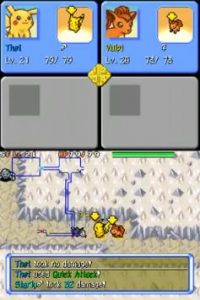
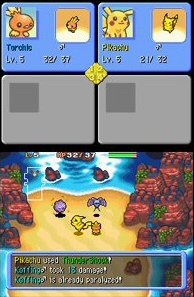 Battling is achieved through a basic dungeon-crawling mechanic. Each dungeon is a new, randomly generated experience at every entry, keeping the game from being too predictable, but still not breaking away from this oft-seen system. Battle is as turned based as a dungeon crawler can be, with you and your allies taking turns attacking whatever pokemon you may have just wandered into. Items and money are randomly scattered through the floors of each dungeon, but can be lost just as quickly as they are gained if you happen to be defeated on a level.
As fainting results in a loss of all money and up to half of your items, you will want to quickly memorize the location of the bank in town. Since money is pretty easy to come by in the dungeons, I often found myself entering dungeons with a zero balance, just so I didn’t risk losing what I had worked for so long to earn.
Another aspect that returns in this sequel is the tummy meter, which shows how full your pokemon are at any one point in time. By picking up apples and gummies, you can fill your tummy easily, but, as in most other dungeon crawlers, having to keep track of such a thing is a waste of time, in my opinion.
One of the biggest positive changes found in this sequel is the fact that your treasure bag is an ever-expanding item. Whereas in the previous game you were stuck with a set amount of item slots (that seemed to fill far too quickly), you will now be given extra space at random intervals throughout the game. Even so, the item storage shop in town will still remain a large friend of yours, since you will often come across items that you don’t want to risk losing by fainting in the dungeons. You will also want to take note of the item shop itself, which offers items like HP healers and apples that keep both your life bar and tummy filled, respectively.
Other returning features include the ability to randomly recruit pokemon that you defeat in the dungeons, and the ability to take part in Wi-Fi rescue missions, where you can go and rescue a friend who happened to pass out in a dungeon by answering their wireless call for help.
Speaking of Wi-Fi, you can also use the system to trade jobs posted on the boards, and to trade items and teams themselves. In this way, you will have a chance to receive the other game’s exclusive pokemon and rare items that may be quite common in the other game.
On the more technical side of things, the graphics here are almost identical to the previous set of titles, which is nice in that it provides a lot of continuity from one title to the next. The pokemon are quite small, so intricate details are lacking, but the bright colors and shapes found in the various environments add a bit of whimsy to the overall experience.
The sound department also receives little in terms of an upgrade. Catchy little tunes do play throughout the game, along with various pokemon sound effects, but they don’t add anything absolutely necessary to the title. Furthermore, since dialogue takes place through text boxes, it’s just as easy to play with the sound off as it is to play with it on.
In the end, while the incredibly repetitive nature of the game might be enough to scare away older players, the improvements seen in this sequel far outweigh the negatives that remain. And while the Mystery Dungeon series is still not up to par with its Diamond and Pearl counterparts, this set of titles does provide some nice filler in between releases of other trainer-filled outings. As a whole, when choosing dungeon crawlers, you could do much worse.
Special thanks to Allison Guillen and Nintendo for providing a copy of this title.