
Get some tips from our HexaLex Strategy Guide: https://beta.gamersintuition.com/game-guides/hexalex-strategy-guide.htm
If you’re a word-game fanatic, you will have fun playing HexaLex. I found it to be an interesting twist on the classic Scrabble game, except with hexagon-shaped tiles, and a honeycomb board of hexagons. This gives the game another dimension, as instead of words just going up and down, you have 3 directions to which you can form words.
The nicer parts of this game are certainly in the user interface. I was pleased to find that little details such as the glow of the tiles when choosing letters, and the additional guides that assist you in forming words made for a richer game experience. Another example, in addition to the obvious touch-screen capabilities of dragging and dropping tiles, is a little button that returns all your tiles to your rack with just a tap. Saves dragging all those tiles back manually! The sounds are cute, and not unpleasant to listen to or too obnoxious for anyone else around you to overhear.
Otherwise, the basics of the game are pretty simple to understand. If you are familiar with Scrabble, then it’s basically the same concept. You form words with the tiles in your rack, using the tiles on the board to connect them. There are letter bonus tiles, word bonus tiles, but the tricky thing is getting your words to go in the right directions towards those bonuses. I have to admit it sometimes took me a few tries to get a word correct, because I would accidentally overlap with something that wasn’t a word. The superimposed guides highlighting your letters and the direction of play helped a lot in getting the words down.
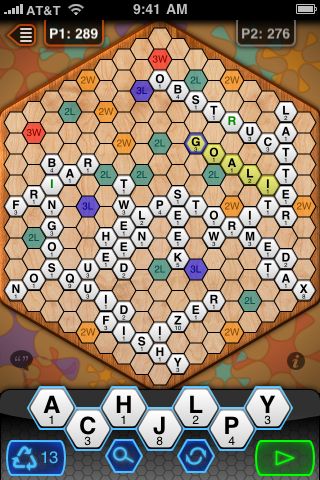
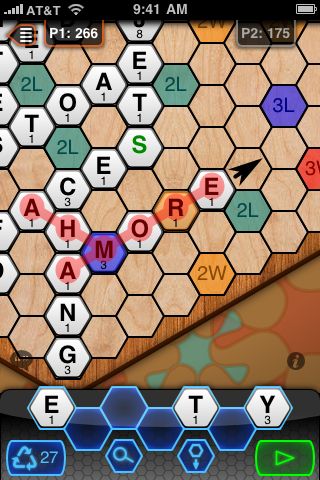
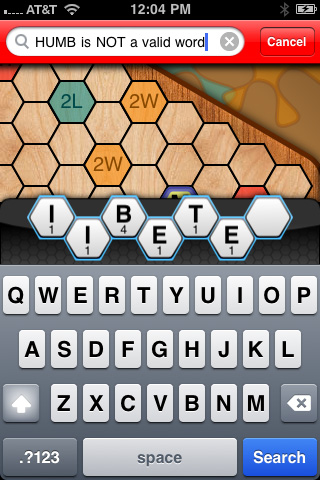
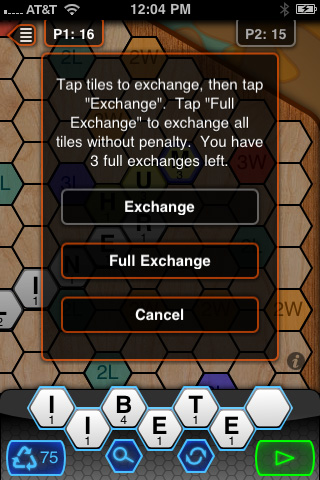
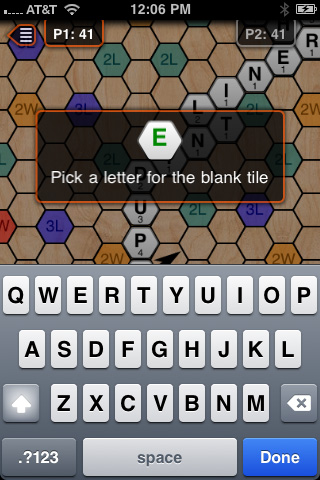
HexaLex is more forgiving than Scrabble, in that it allows you to have 2-letter “junk” words which you can form and have them not count, up to two of them. This makes it a lot easier to play the game, though I wonder if this feature wasn’t there, if it would really make the game that unplayable. I mean I felt like I was cheating half the time. I suppose that enough beta testing proved that the game wouldn’t be too enjoyable without these “junk” words. You can change this in the options, get rid of them altogether or even make it easier by allowing more junk words (or even 3-letter junk words… which I think is probably making it excessively easy).
The middle tile is also not a double word bonus tile, instead it’s been replaced with a triple letter bonus, tile so that it’s not so easy to get too far ahead in scoring if you go first. Otherwise, scoring and gameplay is familiar enough that you can catch on quickly, Scrabble and non-Scrabble players alike.
Another fun feature is getting achievement badges for things like playing 5 or more tiles in a turn, scoring a certain number of points for a word, or playing one of the computer players. It’s always nice to hear a cheer and a window popping up to show you that you did something cool.
When I first fired up the game, I was a little annoyed to see a signup for an account. But that’s just me… personally I don’t like having to sign up for anything to play a game on my phone. But thankfully I discovered that you can play a local game without having to sign up, and your medals/games get saved locally. It’s kind of nice to see your statistics too, like your best play, best game, and average points per turn or game. And then if you do want to play with other friends who have the game, you can sign up with an account then. Stuff like sharing achievements on Facebook will also require an account. You can also play with random people with the “Shuffle Match” feature. This game is positioned towards more social gaming, which is definitely a big trend these days!
The game’s developer, Nathan Gray, has supplied us with a mini-strategy guide for new players to get started. By the way, people should be impressed that Nathan is the ONLY developer on this game. It’s a blast, you should check it out!
Special thanks to Sam Dalsimer at TriplePoint PR for providing a copy of this game for review.