
Need some help with the game? Check out our Guild Wars Pre-Searing Ascalon guide!
I was intrigued by Guild Wars as a new MMORPG – what, no monthly subscription fees? Just buy the game and play online? I had to try it out. The box art was appealing enough for me to be interested.
At first I thought well it’s probably just a PVP game (and I hate PVP, or maybe I’m just bad at it). But I was pleasantly surprised. Basically you have a choice upon character creation to have a role-playing character or a PVP character. However, they are linked in the sense that any items or spells you discover as your RP character get “unlocked” and may be accessed with your PVP character. I’ll talk more about that in a future article, because I haven’t really explored this side of the game yet.
The first thing you will do in the game is create a character, where you pick your profession and gender. Here is where you choose an RP or a PVP player. You should pick RP to start, especially since the game tells you that the PVP mode is “advanced.” You’ll probably spend a good deal of time on the appearance of your character than anything else at this point. The interesting thing is that there don’t seem to be any real “ugly” faces. Everyone gets to be beautiful! There are six professions: warrior, ranger, monk, mesmer, elementalist, and necromancer. After a few levels, you will have a quest that allows you to take on a secondary profession which will eventually give you access to all the skills and spells of that secondary profession.
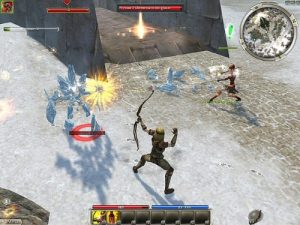 Let’s start with the background story – you begin in beautiful Ascalon City, and if you paid attention to the opening cinematic you know that something pretty cataclysmic is going to happen soon, probably having to do with the growing threat of the evil Charr from the north (you’ll hear this referred to as the “searing”). The king wants to recruit some adept heroes to help combat the Charr – thus begins your training.
You will notice that when you start the game as your new character, you will see a lot of tips that appear to help you learn how to navigate the interface, interact with your character, etc. I highly recommend keeping these tips on until you become familiar enough with the game. They will go away eventually.
Pull up the “Hero” screen from the menu, and you will see that your character has attributes according to your profession. When you get a secondary profession, you also take on most of the attributes, except for one attribute that is only available if it is your primary. This attribute tends to be the defining attribute for that profession.
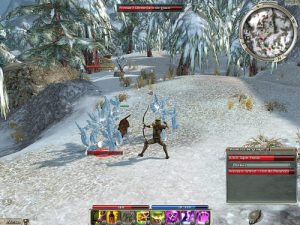 The interface in general is pretty easy and self-explanatory. For those who like to mess with their interface design, there are actually some in-game interface options that allow a lot of flexibility in the interface. You can pretty much move anything around, change the size of interface elements, etc. I don’t really feel like the interface gets in the way at all though, and I’ve not had a problem with the default setup.
Like most games of this type, you progress your character by gaining experience through quests and killing monsters. NPCs that have a green “!” over their heads have available quests, or they are NPCs you talk to to turn in your quest. The icon is slightly different in the NPC’s dialogue window to let you know whether it is a start for a quest or a turn-in. Sometimes NPCs will also give you other tips about the world that you might find useful.
You will notice in your quest window that there are some quests labeled as “Primary” quests. These are quests that progress the storyline. I recommend not doing only Primary quests – you will progress too quickly and not be able to handle the next “chapter” of the game, which is after Ascalon City is basically destroyed. And at this point, there’s no going back! This next chapter in the story takes place two years in the future, in the ruins of Ascalon City that is trying to rebuild itself amongst the growing hordes of monsters and the Charr. The best part about being in a new chapter is that you will not run into Level 1 characters, or anyone just beginning the game. The “pre-searing” Ascalon as they call it is almost meant to be a really long tutorial to acclimate you to the different commands and tactics. There is plenty to do in pre-searing Ascalon however to keep yourself occupied for quite a while before moving to the next stage.
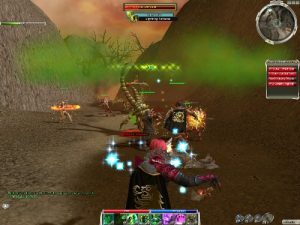 This new stage also brings a different kind of quest to the game – they are missions that are essentially Primary quests that progress you through the game, but unlike regular quests if you fail (i.e. everyone in your party dies) or leave the mission in the middle you will have to start it from the beginning. Also you will find that missions have a “bonus” task that will give you extra experience if completed (they must be completed before the main tasks of the mission). There are some neat cinematics during the missions that play out the story, and your character even speaks in them if you’re the party leader! Missions will generally take you to a new city/mission area, where things get progressively harder and higher level, so be aware at the pace you are going and slow down if it feels like things are getting too difficult.
The game doesn’t appear to be as gear-centric as many other MMOs out there. In fact, there is a finite set of gear that is unique for each class. There are six slots on the body for armor: head/facepiece, chestpiece, gloves, leggings, and boots. Basically the only way to get armor is by crafting it at an Armor merchant at the cost of materials and some gold. The materials used for crafting are either dropped by creatures, or salvaged from certain “armor kits” that drop from creatures and will be labeled as salvageable. Weapons are generally quite prolific and there’s never a shortage of good weaponry. You can also craft them at a “crafter” merchant, and customize them at the weapon merchant, which adds a 20% damage bonus but doesn’t allow any other character to use the weapon ever again. Although armor doesn’t seem all that unique, there are ways to modify pieces with enhancements. These enhancements come through upgrade items, some of which are purchasable, but most may be salvaged from rare items. You can also salvage an armor piece with an enhancement, and get that upgrade item back (but lose the piece). You can also dye your armor if you want, with vials of dye, but I find that it’s not really necessary.
 In Guild Wars, for a majority of the game, you’re only playing and chatting with your own party (though you can still send private messages to anyone online). Think of it as the entire world is instanced, but the cities/settlements are where you find the rest of the players. There’s no competition for camps, gear, quest mobs, etc., because it’s all there just for you and your party. This is a great advantage if you have a group of friends who like to play games together. It’s almost like logging into a BattleNet type environment, where you can gather your players for your party but then the actual game is played just with the party you chose. You can only change group members when in towns – however, you can leave a group at any time by pulling up your map and traveling to a town. You will notice that when you do this, you may be in different districts than your friends – but you can easily select the district from a pulldown menu. You can think of that as being on different servers, though I’m not sure if is actually structured that way physically. If you zone into a town with your party without leaving it, you will all be in the same district.
If you’re completely antisocial online, all is not lost for you as it might be in other MMOs. You can hire henchmen to fill out your group. In pre-searing Ascalon you don’t have this option, as the maximum number of party members you can have at that point is two. However this number grows as you progress through post-searing Ascalon and the missions, so it’s really helpful to be able to have a full group sometimes. You can pick and choose from different classes to round out your abilities. The only drawback is that these henchmen also take their share of loot and experience. I’ve found that it’s definitely worth it to hire them for the tougher quests and missions, because enough good stuff drops that it’s not as big of a deal. They also do their jobs well enough and don’t talk back 🙂
Fighting mobs in the game is somewhat different, and battle management is not real straightforward when in a group, so you might find that frustrating at first, but you learn to compensate for it, as every class is capable of taking hits, recovering from hits (whether it’s direct healing or hit point regeneration through spells and skills), and generally have the same amount of hit points and energy based on level, though some gear allows caster-types to have more energy and energy recovery. Mobs here actually seem to be somewhat smart, as they tend to concentrate on the weakest in the party (casters with less armor, lower-levels). Your spells and skills are accessed with an 8-slot bar at the bottom of the screen, which means you can only have 8 spells/skills available to you. You can only change your setup when in a town, so you will need to actually think about what you want to use while out adventuring, based on the types of mobs and their abilities, or the professions of your party members and finding a good complement to their abilities.
Dying isn’t so terrible either. It’s especially not terrible in pre-searing Ascalon, where there is no penalty except that you get teleported back to one of those sparkling shrines that you might see near zone entrances. In post-searing Ascalon, you get a 15% reduction to your hitpoints and energy, which lessens as you start killing again, but also stacks every time you die (to a maximum of 60% reduction). However this all goes away when you zone back to a settlement/city. There’s no damage to your gear or loss of experience.
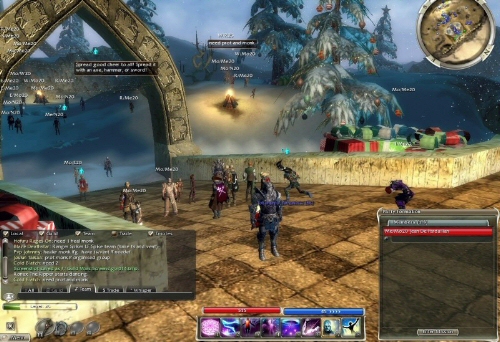
The one thing that was kind of annoying was that there didn’t seem to be much of a name filter, with the exception of obvious swear words and inappropriate terms, though to be honest this lack of filter became more entertaining than frustrating. Here are some prize examples of names I’ve seen:
Oreo Of Death
Jiggle Me Wiggles
Cheese And Rice
Teh Scary Guy (with his buddy, Teh Normal Guy)
Har Har Moo Moo Cow
Fire Chicken
Dwight D Eisenhower (!!!)
Belonging to a guild is a pretty big part of the game as the name suggests, though not entirely a necessity. Being in a guild can give you your own cape design, a guild hall (with enough money) and of course guild-chat capability. Also, guilds can compete with each other, and the guild’s rank is reflected in a guild ladder on the Guild War’s web site (http://ladder.guildwars.com).
There are many parts of the game that I haven’t personally explored, but if you are into PVP, this is a great opportunity to show off your skills! Since the game’s name is Guild Wars, you figure there are some guild wars going on, and they take place as tournaments between guilds. You’ll often see global messages talking about a country having the “favor of the gods”… don’t worry about this when you begin the game so much, it will come into play much later as you reach the maximum level (right now it is level 20). Also remember when you create a character you have the option of making a PVP-only character… you will want to do this only after you’ve played the game quite a bit, and unlocked enough special gear, spells/skills, and runes (augment items which enhance/adjust various attributes based on your class), because these will all be available to your PVP character who starts out at level 20.
I am generally pleased with Guild Wars as an MMO – I don’t feel like there is pressure of competition among players, at least in the RP version, and I feel like I can enjoy the game even if I’m not a fan of PVP type games. The graphics are very nicely done, especially with player combat and spellcasting effects. I also don’t sense a lot of server lag issues, every now and then I will get a little hiccup but that’s it. It is definitely worth looking into, especially with the prospect of not having to pay a monthly fee. Game updates come through patches, and major expansions purchased through retail stores. You can read a good FAQ on the Guild Wars web site, http://www.guildwars.com/faq/default.html.