
Reviewed by Brandy Shaul
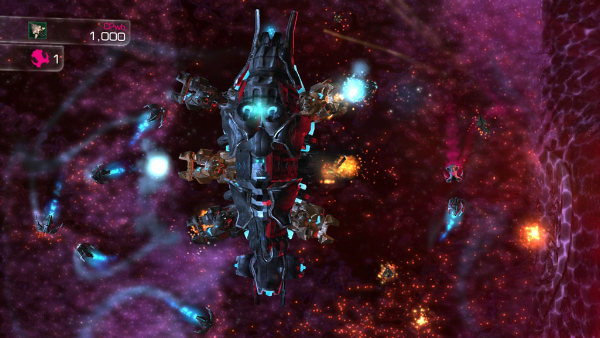
At the beginning of September, I had a chance to preview Ion Assault, a game that while at first blush appears to be completely derivative of other space shooters like Geometry Wars is actually quite unique, and contains a slower pace, and more strategy than other offerings in the genre.
Ion Assault is a level-based arcade shooter split into various single and multiplayer modes (including co-op). The career is divided into colorfully themed sectors (the first is pink/red, the second orange/yellow, and so on), with each sector then being further broken down into stages populated by an assortment of asteroids or other non-attacking entities and randomly appearing enemy spaceships.
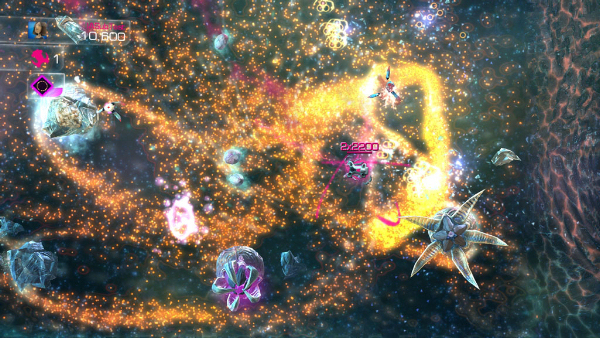
Instead of simply holding down on a single button to fire a constant stream of bullets at enemy ships, in Ion Assault you must first pull the environments’ freely floating ions into your ship (by holding down on the left trigger) to charge your weapon. By releasing the LT, your accumulation of ions is released in the form of a powerful beam of energy (your aiming reticule is represented on screen by a thin line extending from your ship).

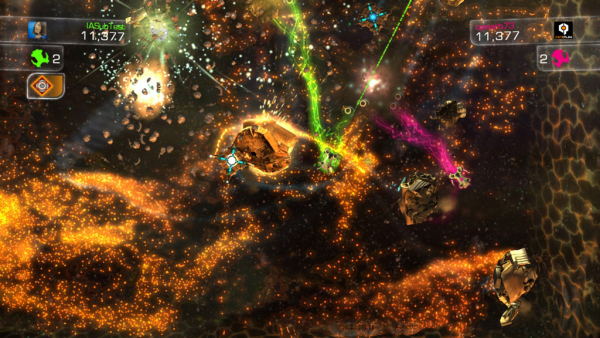
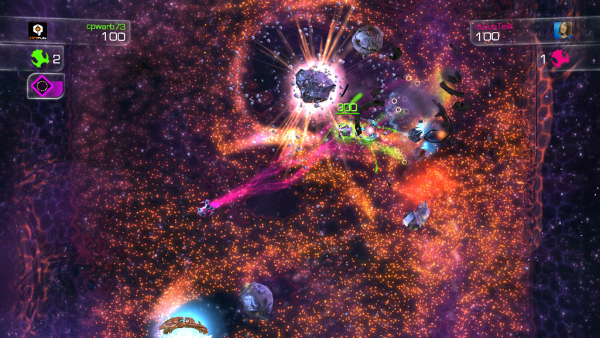

The longer you pull in ions, the more powerful your next attack will be, with the size of enemies and asteroids determining how many shots or how much force must be used to defeat them.
In terms of gameplay, the ion particle system is really what sets the game apart. The impressive in-game physics come into play instantly, as you watch particles float around the playing field, bouncing off of enemies and other obstacles, a la Newton’s three laws.
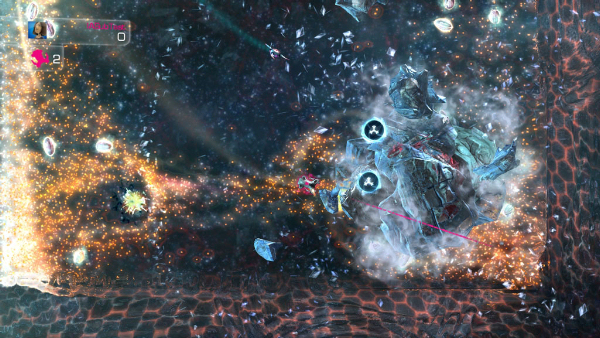
Once you become accustomed to the flow of particles around the environment, the system adds a great deal of strategy to the game, as you may find yourself in an area with too few particles to charge a damaging shot, or in a luckier situation of pinning an enemy into a corner, firing off a shot and then catching the particles as they bounce off of the wall, easily recouping your attack strength with little effort.
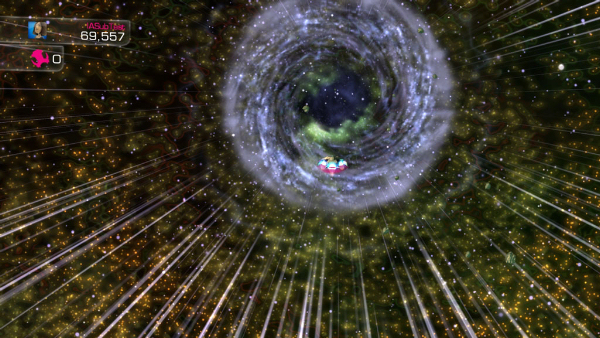
Asteroids and some enemy ships break into smaller pieces upon impact, which creates more work for your ship and more obstacles to avoid, as all on-screen objects must be eliminated before the warp gate appears, allowing you to travel to the next level.
It would be wrong of me to continue any further without bringing the game’s biggest negative to your attention, that being its difficulty. While Ion Assault is incredibly reminiscent of other, faster-paced space shooters, it is much more difficult than its peers when taking into account your ship’s slow movement (which is only exacerbated by the heightened speed of 99% of your enemies), and the sheer amount of objects on screen at once.
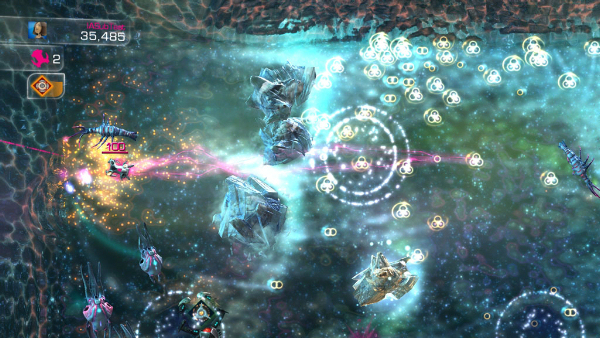
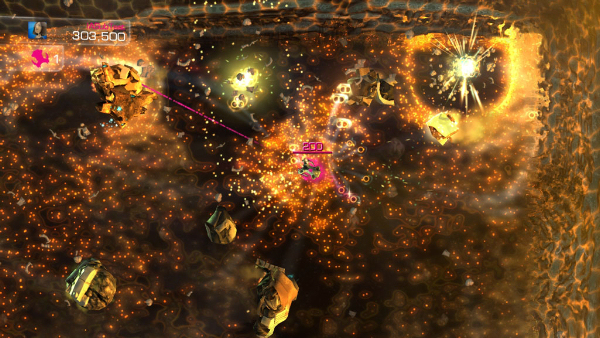
While at any one time, the majority of on-screen objects will be non-attacking remnants of asteroids or ships, your ship still takes damage when making contact with said pieces, making a quick escape from an oncoming barrage of drones incredibly difficult. That is, if you don’t get hit from a fast-moving drone in the front, you’ll wind up hitting a rock or even the environmental boundary, effectively committing involuntary suicide.
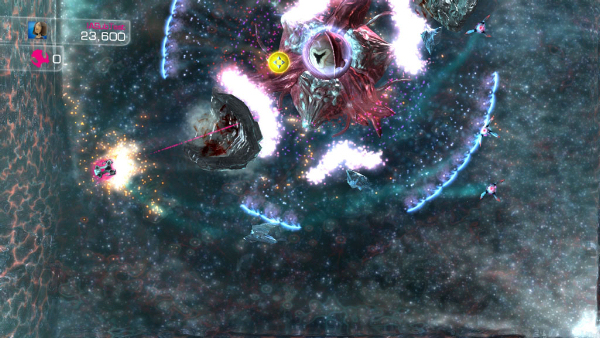
Likewise, the level of sensitivity your ship expresses to oncoming attacks seems a bit skewed. For instance, in one level, I found myself uncontrollably bouncing off of rocks like I was in a pinball machine, only to eventually bounce into a clear area, life intact, while in other levels (boss fights especially, with a boss being located at the end of each sector), a single enemy bullet that seemed to only graze my left flank caused me to explode into a cloud of space dust.
As for the game’s touted “dynamic level intensity” system, which supposedly creates a more challenging experience for those who destroy enemies quickly and with wild abandon, I have to say I never noticed a change. Even after purposefully changing my attack strategy to force multiple enemies to be destroyed in a quicker time frame (by using power-ups that are dropped by certain enemies), new ships appeared at the same pace as before, and with the same fervent desire to kill me.
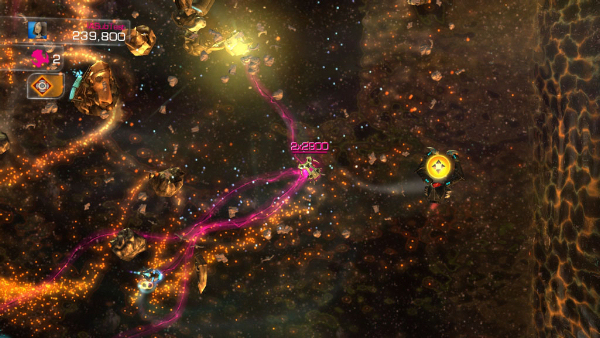
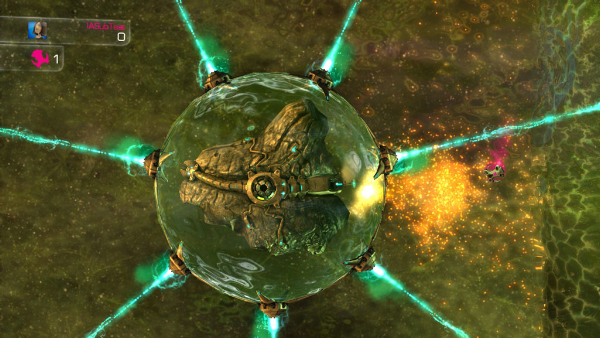
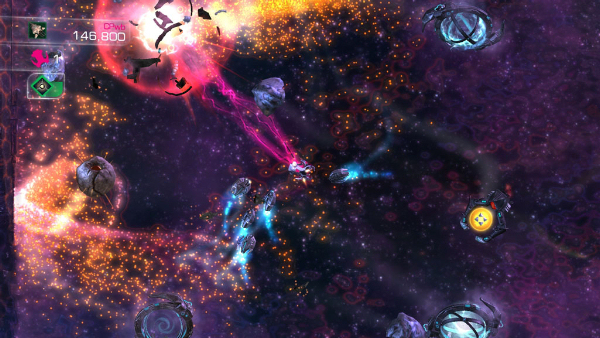
This undeniably puts the game’s accessibility into question, as while the controls are simple enough for anyone to pick up, the game is just far too difficult (and your ship far too slow) to not cause frustration in any age of gamer, but specifically younger children who already tend to lack patience.
However, for those that persevere, the game does become a bit easier with practice. Once you become accustomed to the speed of your ship, you can better guage how long you have to get out of the way of oncoming fire, or how long it will take an incoming threat to cross your path. That being said, it’s questionable that many gamers will give the title that much of a chance.
If Ion Assault excels at anything, it’s the graphics. With groups of particles, ships, and all inanimate objects moving independently across the screen at the same time, one would think that lag would be a given. However, the game handles all of the on-screen action with ease. Even when triggering massive explosions that send dozens of objects careening to the far corners of the screen, along with mass amounts of particle spray, the game displays everything with noteworthy detail.
The overall graphical design of Ion Assault is quite beautiful, with ions taking on a colorful cloud-like appearance when in dense groupings, and explosions creating a sort of fireworks effect on screen. Likewise, the sound department is incredibly well done. Combat is convincing, with all of the modernized sound effects you would expect from a space shooter being combined with an upbeat rock/techno soundtrack throughout. A female voice also plays at various instances, like when achieving a new high score, being rewarded with a new life, or to praise you for eliminating large groups of enemies with one shot.
For all that Ion Assault has going for it: the gorgeous graphics, the head-bobbing soundtrack, the impressive particle physics system… it still suffers from a difficulty level too intense for the casual consumer. Given that the game is such an acquired taste, even at ten bucks it’s only recommendable to diehard fans of the genre.
Special thanks to Brandon Price and Black, Inc. for providing a copy of this title.