
I have a tentative relationship to cute; like the color pink, a lot of feminists of the stompier variety (myself included) fear that edging too close to weapons-grade cute as can be found in greeting cards and certain kids’ programming can, in a cross-gendered sort of Samson and Delilah, strip us of our cred and ability to be taken seriously.
Still, I’m nowhere near the bottom of the statistical curve of women in terms of how often I’ll saw “awwww” when a co-worker brings a baby to work, when my cats do anthropomorphic things with their paws, when rats sleep in a big pile, or when a UH-60 dumps a bunch of cluster bombs on a cocaine field. I’ve even been the (very) occasional wearer of the cute label myself, usually when I get restless and bored and do things like bounce up and down in place or do random somersaults. We’ll put it this way: I have a working relationship to cute. I recognize that it’s a useful behavior, usually evolved to keep things alive long enough to not be squished by their parents in exasperation, and has its place in the grand panoply of crap that is the modern world, like iPods and organic toilet paper. I’ll respond appropriately when it comes my way, but I generally won’t go and buy it. For cute to work for me, it needs to have a touch of the pragmatic: a little hoppy pink bunny is cute. A little hoppy pink bunny that explodes into a ball of foot-long teeth and claws and can skeletonize a cow is adorable.
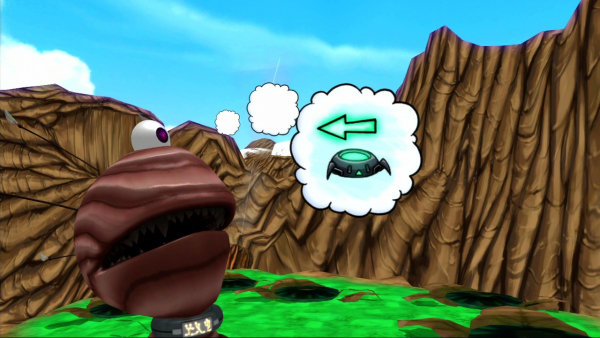
 Enter The Maw, by Twisted Pixel games. From the title screen and into the opening sequence, it looks like you’ve just downloaded the latest Pixar short- brightly coloured, vaguely cuddly aliens, silly-inscrutable sci-fi technology and scenery, and crisp, technically attractive animation and storyboarding that looks like an animation student’s doctoral thesis. Before your credit card has fully cooled from the 800 XBLA points you just burned off it, you know you’re in for something cute. Cute, funny, and intriguing.
The Maw details the fast friendship of Frank, a young bipedal aqua-skinned buggy thing, and Maw, an (initially) unassuming, small, homuncular blobby purple thing. Frank is captured by intergalactic bounty hunters, evidently to be part of some galactic zoo collection. Shortly he spies Maw, kept in a prominent, bell-jar container covered with warning labels, amongst a passel of other freaky critters. You know, like that old Star Trek episode. Except that instead of standing around delivering moralistic soliloquys to callous intergalactic billionaires, Frank and Maw escape their collector-ship in a crash landing and run around for a couple hours squishing and eating everything in sight.
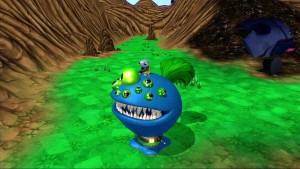 Gameplay is pretty straightforward: you control Frank, who in turn does his best to control Maw. In addition to running Frank around, you use a bracelet-mounted plasma leash to perform various tricks of physics: in addition to leashing Maw, it can be used to drag/move heavy objects, grab other critters on the landscape, and catch and hurl things around. The basic point of the game is to feed Maw everything you can- in fact, you can’t finish a level until you’ve grown him to a certain size. Over the course of the eight levels Maw will grow from a roughly knee-high little blob to a monstrosity of absurd proportions (and beyond).
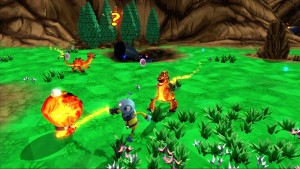
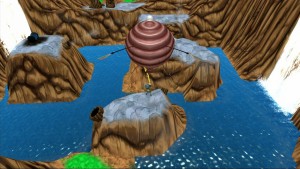
Aside from growing, though, Maw will also absorb (for the duration of the level) the adaptations of some of the special critters he eats; for example, scarfing a fiery salamander will enable him, in turn, to breathe flames. Another flying puff-ball thingie will turn Maw into a hot air balloon, another will ‘morph him into a charging rhinoceros beetle, and so on. As you might have guessed, each of these adaptations is crucial on a given level for overcoming various obstacles, obtaining full access to the landscape, and defeating certain hostile critters. Gameplay channels a bunch of “steal their powers” games over past decades; I found myself recalling the NES title A Boy and His Blob, for obvious reasons. The focus is clearly on getting Maw to go where you want, and eat who you want, made complicated by the use of Frank and his plasma leash as intermediaries.
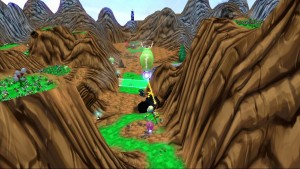
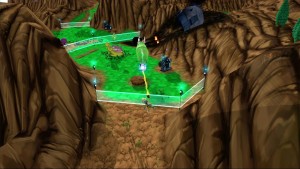
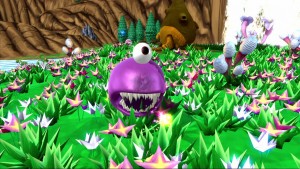 People who don’t care about technical details probably won’t feel as passionately about this as I do, but for a 148 MB game, The Maw is gorgeous. Environments are kept simple, usually with lots of open space or terrain that can be redundant without looking dull; as a result, by generally conserving resources by keeping the volume of stimulation simple, they can make the visual landscape look great. Frank, Maw, and the host of alien snacks and foes are animated with impressive complexity, and have a lot of character- everything has a handful of ‘idle’ animations that show off their goofy behaviors, and faces (or, to be alien-sensitive, face-equivalents) are delightfully expressive on the level of, as I said before, a well-designed Pixar character.
The music is fun, too. There’s a varied soundtrack inspired by the 1940s and 50s sci-fi kitch sound; expect lots of Thermen sounds and up-tempo beats reminiscent of Ed Wood B-movies. The soundtrack is composed by Winifred Phillips, of God of War fame, and there’s an originality and concise understanding of theme that shows she’s really hitting her stride. The music is also dynamic, shifting when Maw takes on new forms or at pivotal game moments.
 My criticisms of The Maw stem largely from its nature as a relatively small, XBLA download. There’s not much play; I got through it in two industrious evenings, and was able to do the “100% Eaten” and “all secrets” achievements in a subsequent hour, since you’re able to skip to any level you’ve already played through. After that, there isn’t much to do; once you’ve gotten through each level by appropriate use of Maw’s form-of-the-day, there aren’t really any surprises or clever secrets to find on a second play-through. Fortunately, three more levels are on their way, playable as “deleted scenes” and being placed chronologically in between existing levels.
Also, due to the wide-open nature of most of the levels- which is more often a strength than a weakness as it allows for a non-linear feel to play- there are times when you can take much, much longer on a level than you’re meant to simply by taking a different path than was ‘obvious’ and bonking your head in frustration at a seemingly impassable obstacle only to find that you missed the relevant morph-meal or switch waaaaay back at the beginning. There are also some very occasional layout flaws that mess with an otherwise impeccable and slick graphical presentation- I’ve spotted a handful of overlapping textures, image collisions, etc.
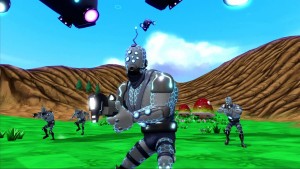 Lastly (and again, likely the natural consequence of the game’s brevity), there isn’t a whole lot of variety in the challenges offered to you. While each level does have a unique, attractive, and interesting feel, the problem solving isn’t very diverse. Maw only changes into about four or five different things, usually only one per level, and never more than two, so you’ll spend a LONG time looking at “floating gasbag Maw” and “fire breathing red-skinned Maw.” Each form only introduced one very specific problem-solving mechanic, which means after awhile, the obstacles get pretty predictable and feel repetitive.
THE FEMALE PERSPECTIVE:
I respect the right to self-determination of all sentient beings, so I won’t go ahead and assume the gender of crawly, skooshy red things or giant alien beetles based on crude Earth-based assumptions; heck, Frankie could be short for Frederica for all I know. Representation isn’t an issue here in the same sense that sea cucumbers don’t complain about not having any seats in Congress. Though I’ve heard rumours.
 More generally, The Maw offers broad appeal and clearly isn’t aimed at a hardcore, niche market; its cute stylings make it equally appealing for children or any lighthearted gamer. Ditto the gameplay itself, which is very forgiving- you simply cannot die or even be pronouncedly hurt in The Maw, and there are never any punitive consequences beyond taking longer to finish a level. What passes for violence is absolutely cartoon in its sensibilities; I’d happily hand the controller to a kid of any age without having to worry about explaining an hour later that no, the mutant raiders aren’t dead, sweetie, they’re just sleeping, and you can’t have a rocket launcher for your birthday. There’s nothing grim, disturbing, or patently adult being tackled in this game; it’s a good-natured flight of fancy.
SUMMING UP:
 As with most of my recent XBLA ventures, I find myself increasingly pondering what my standard these days is for the “Did I Get What I Paid For?” algorithm. When something falls within the $10 price range, your basis for comparison becomes increasingly more difficult- can I weigh the pleasure of an 800-point download against, say, a pack of cigarettes, or a single malt in a downtown bar, or your average fast food meal? Watch this space for an upcoming, needlessly lengthy editorial where I tackle this at greater length; in the meanwhile, I can say about The Maw what I can say about most XBLA titles that are obviously the result of more love and care than a repackaged retread of an 8- or 16-bit title chucked out for a few fast bucks in the slow season: it’s fun, it’s novel, and it’ll be an entertaining change of pace for a couple days.
Special thanks to Michael Wilford and Twisted Pixel for providing a copy of this title.