
Reviewed by Brandy Shaul
Since the “Edutainment” genre hit its stride with games like Brain Age and Big Brain Academy on the Nintendo DS, it seems that not a day goes by without a new mental-acuity-boosting title being released for public consumption. Walk into any respectable video game department and you’re likely to see all-around brain trainers, reflex testers, vocabulary builders, language coaches and more, all of which are so similar that they have become quite trite. Nevertheless, game companies continue to release such titles with reckless abandon, saturating the market in their never-ending quest for the all-mighty dollar.
After playing more than my fair share of titles such as these, I’ve become pretty familiar with the package basic activities that “test your brain” via rudimentary mathematical equations, simplified versions of “which item doesn’t belong” and a variety of other tasks that even a young child could master with ease.
After learning that EA had included a brain training title in their newest line of “For Dummies” games, I was immediately fearful that it would be just another in the line of clones that populate the industry. Even worse was the fear that, if the title was “for dummies”, wouldn’t that mean that it will be simplified even more? Luckily no. In fact, Brain Training for Dummies can be equated to that goth or rock chick that sits at the back of the class, is daring and does the unexpected, all the while earning the silent jealousy of her peers.
 As in EA’s two other Dummies titles, gameplay here starts with the How-To mode of tutorials for the series of activities available within the game, along with presenting some biological information about the human brain that helps skeptics understand why training your brain with said activities is such a valuable use of time (as this is one instance where “use it or lose it” actually applies).
The next mode, simply entitled “Practice”, lets you participate in any of the game’s 15 activities at your leisure. Unlike other games that challenge only one area of your brain at a time, such as your reflexes or reasoning skills, Brain Training for Dummies actually combines numerous skills (math, language, spatial reasoning, reflexes, logical reasoning and memory) into pairs, giving your brain twice the workout in the same amount of time.
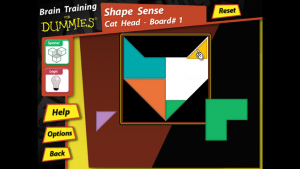
While there are some activities here which resemble other games, such as “Word Wend” which is practically identical to the board game Boggle, with the difference being that when creating words the letters do not have to touch, and “Shape Sense”, which gives you an outline for a shape and asks you to fill it in with smaller shapes, a la Shape Inlay, the majority of the other options are actually quite unique, and offer more challenge than I have found in other brain-trainers.
For instance, games like “Quick Compute” and “Speedy Spelling” task you with creating mathematical equations and words (respectfully) out of either number or letter tiles that fall from the top of the screen to the bottom. The challenge here comes in the fact that not any old equation or word will do, as you are forced to create either math problems with a certain number of digits, or words with a certain amount of letters. The games become even more challenging as the tiles start descending faster in each round.
 Likewise, the difficulty is high in games like “Lost Locations” and “Math Matrix” that focus on a grid with varying numbers of squares filled in. In Lost Locations, you are asked to memorize a shape made from said filled in squares. Once you memorize the shape, it is transformed, and you must identify what has changed about the shape.
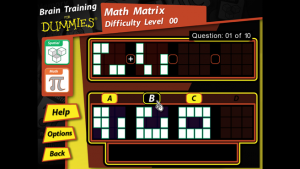
In Math Matrix, instead of transforming grids, you are instead left with multiple stationary patterns that take the place of digits in a mathematical equation, where you must either combine or remove the filled in squares from each to see what shape you are left with in the end. While both of these activities start out fairly tame, in higher levels you are allowed little time to give your final response, and the grids become more detailed (that is, more filled in squares per grid, or more steps to complete before you arrive upon your final answer).
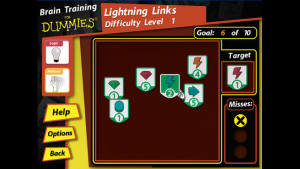
Other activities in the game come with varying levels of difficulty, such as the fairly simple “Lightning Links” that utilizes more falling tiles, each of which contains a colored shape and a number. You are given one beginning tile, let’s say a green arrow with the number four at the bottom, and must click on falling tiles that either have a shape of the same color, the same number at the bottom, or the same shape itself. With so many tiles falling down the screen, there really is no strategy other than to simply click on every number four in sight and then quickly switch to a new color and click on every tile of that color on the grid and so on.
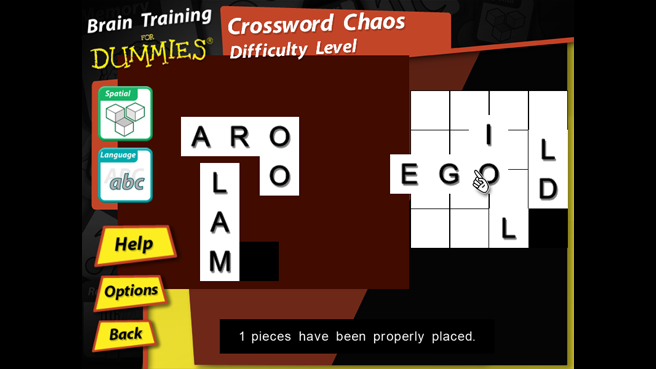
 Conversely, a game like “Crossword Chaos” offers a bit more in the way of challenge, by asking you to fill in a box with set shapes of letters, that when put together correctly will spell out words both horizontally and vertically, like in a standard crossword puzzle.
Other games ask you to memorize shapes, words, and numbers written on cards that are then flipped over (that is, you are then looking at a blank slate) while you are asked an assortment of questions like “Which is the smallest number”, “Which word contained more letters”, etc. and must click on the appropriate card.
After you have become familiar with each of the games, you can then move onto the final mode, Play, which tests you in skill areas of your choosing, but in activities chosen by the computer. While you can take a complete test including all 15 activities within the game, you can also take smaller tests that cycle you through either six or nine activities, or through just the activities relating to a certain skill that you may feel you need to improve. After taking these tests, your gameplay is measured, but instead of giving you an overall score, the game instead uses your information to adequately change the level of difficulty in each game so that you are always challenged while playing in that mode.
With an overall goal being to sharpen your mental abilities and reflexes, it is a very positive thing to note that the game’s technical aspects have been kept simple enough as to not become a distraction. The game’s pallet is the trademark “for Dummies” combination of black and yellow, along with quite a bit of brown, but few other colors in between. Additionally, each menu is intuitively designed, allowing you to change an activity’s difficulty, adjust the sound levels, and more on the fly.
Furthermore, the game’s sound effects are actually rather lacking, and consist mostly of the occasional ding or chime signifying a job well done, and soft background music that is quite reminiscent of scores found in various RPG’s that I’ve played over the years.
While Brain Training for Dummies may be the newest offering in an overfilled genre of games that seems to have left most people quite jaded (seriously, how many times can we answer 2+2= without becoming so?), it doesn’t politely take its place in line, but instead pushes ahead, and is leaps and bounds above most of its competition. For those who are new the brain training world (if anyone in that category actually exists anymore) or for those who want an option on something other than the Nintendo DS, Brain Training for Dummies offers enough originality to make it well worth the price of admission.
Special thanks to Katie Carrico and EA for providing a copy of this title.