
Reviewed by Rebecca Wigandt
I consider it no coincidence that Fallout 3 came out in the same consumer marketing season as the Guns N’ Roses album, “Chinese Democracy”. My generation has been in kind of a coma since the early 90’s; everything is still basically run by rich old white guys our grandparents’ age, and everything is generally marketed to people younger than us with half the attention span and twice the buying impulsivity. (See Tyler Durden’s “middle children of history” rant in Fight Club). One thing a lot of my generation does, for better or worse, is wait with varying degrees of patience for things to come around. This past year or so has seen a lot of our childhoods and adolescences repackaged and sold back to us in varying media, with varying price points and degrees of desecration.
Black Isle Studios hit us with Fallout: A Post-Nuclear Roleplaying Game in 1997 and Fallout 2 less than a year later, two isometric Baldur’s Gate-style turn-based RPGs that made anyone with a love for the genre swoon and call their mamas. For those of us that were really old school, it was a love letter to the 1984 Interplay classic, Wasteland (and the Fallout series has been widely considered the spiritual successor ever since). They introduced us to a parallel Earth that gradually diverged from our own from the 1940s onward and featured an American culture frozen in the World of Tomorrow, “duck and cover” zeitgeist of the 1950s. The global mindset of paranoia and competition eventually devolved into a nuclear holocaust between the United States and Communist China in 2077, and in the decades that followed, two surviving human populations began to resettle the broken world- the (un)lucky folks that survived the bombs and struggled to rebuild the world, and the citizens of hundreds of enormous, underground bomb-proof Vaults that the wealthy and fortunate entered to save their families from the ensuing holocaust. The Fallout series has, for the most part, centered around the lives and times of the descendants of those original Vault citizens who find themselves leaving the veritable time capsules of the old world to face the wasteland for one reason or another, typically uncovering a plot along the way that confronts humanity with some demon of our pre-war past.
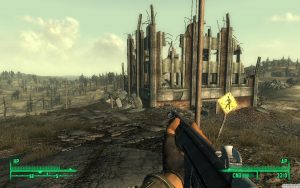 I find it almost impossible to evaluate Fallout 3 without comparing it to Bethesda’s 2006 game Elder Scrolls IV: Oblivion, which is fair, as it’s built on the same Gamebryo engine as Oblivion, and in the months (and years) leading to its release was often touted on message boards as “Oblivion with guns”. While I can confidently say that anyone familiar with Oblivion will jump quite comfortably into Fallout 3’s interface with both feet, the feel, atmosphere, and fundamental mechanics of the two games are really apples and oranges. Those of us who truly loved Fallout were waiting for this for a long time, and many (though admittedly not all) would have probably been satisfied with an updated issue of Black Isle’s isometric format.
What we got was beyond those expectations: a 3D world with all of the do-as-you-will sandbox playability that Black Isle was really pioneering with its earlier titles. Bethesda’s been no stranger to sandbox play either: the little-known 1990 DOS game Terminator dropped you into a sprawling 3D Los Angeles and left you to your own devices. While Fallout 3 has a structured “main plot”, it combines the best elements of freedom from both its precursor volumes and Bethesda’s Elder Scrolls design sensibilities.
This ‘always an alternative’ approach to game design leads me to another unique feature of Fallout 3. The VATS (Vault-Tec Assisted Targeting System) was introduced to integrate the mechanic of targeting specific body parts, aiming for weaknesses, etc., which was a basic aspect of the old turn-based combat system of previous volumes. As the design journals have said, integrating a turn-based system into a real-time game is quite a challenge, and the compromise Bethesda arrived at was brilliant. You can use VATS or not, as you choose. No, really. You can completely ignore it and conduct all your shotgun diplomacy in real-time, trusting your hand-eye coordination to aim your shots. Or, you can use VATS exclusively to outline your debate strategy- simply press V once a ‘discussion’ ensues, and spend a pool of (attribute-derived) Action Points, just like in the old isometric chapters, to plot out your PC’s attacks to multiple opponents or body locations. Even if you don’t prefer a turn-based system, all the time, VATS is still tremendous fun, as it drops you into a cinematic camera mode while your plotted actions are carried out, letting you see your character (and hapless opponents) in all sorts of great dramatic angles that you wouldn’t be able to get in the heat of real-time battle.
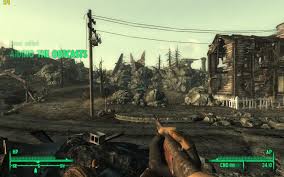 In previous volumes, your trusty Vault-issued Pip Boy was mainly used as an in-game mechanic to show your ‘quest log,’ game time, etc. In Fallout 3, almost the entirety of the game interface is integrated into your Pip Boy- and it ends up feeling a lot less contrived, overall, than it sounds. The bulky, “Space Age” wristwatch device is also plainly visible on third-person views of yourself and all your fellow Vault Dwellers, reminding you of just how many game mechanics have an in-character context (if you look carefully, you’ll even see Pip Boys occasionally displaying the actual body and limb health of their wearer, just as it is portrayed in your on-screen menus).
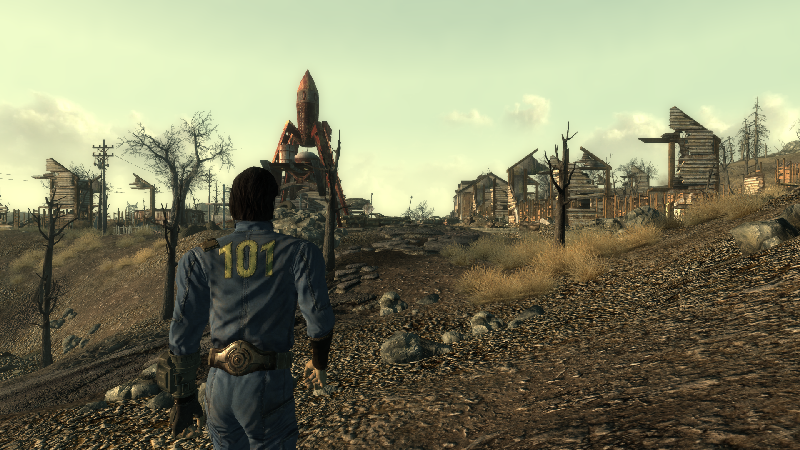
The initial story hook places you in Vault 101, located somewhere outside Washington DC, and into one of the most cleverly embedded character creation systems I’ve seen. Taking a cue from the in media res style of Oblivion’s character generation, Fallout starts you off literally at the moment of your birth and plays through several episodes of your childhood at various ages, during which time you’ll establish your appearance (using the very detailed Gamebryo face builder), stats (the seven-attribute system, now officially termed S.P.E.C.I.A.L., remains unchanged from previous volumes), skills (starting ‘tag’ skills now only determine which get a healthy starting bonus rather than railroading your future skill growth), and even some of the foundations of your relationships to the other Vault citizens. Players who care about an immersive roleplaying experience will enjoy the chance to define their PC in a wholly ‘in character’ way, establishing along the way their relationship to their father, their problem-solving style, and so on.
As the game progresses you’ll also be able to purchase a ‘Perk’ at each experience level- some simply bonus boosts to skills or stats, but many are unique advantages that serve to have an explicit in-game effect (for example, opening unique interaction choices with children, robots, the opposite sex), in many cases unlocking an otherwise unknown problem-solving ability. As compared to previous volumes, many Perks in Fallout 3 hearken to the interaction system of Activision’s 2004 Vampire the Masquerade: Bloodlines, where players are made aware of how very specific character attributes are interacting with the game world. This is a real evolution of Perks for the Fallout system- they allow you to personalize even further your character’s distinctive strengths.
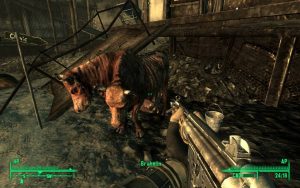 As you can probably guess, you don’t stay in Vault 101 forever, or even particularly long- your father mysteriously escapes the never-opened Vault, and circumstances compel you to follow his cue, dumping you more or less on your own in what has been named the Capitol Wasteland- a generally faithful (albeit with some healthy artistic license) post-apocalyptic layout of D.C., as well as an expansive wilderness in all directions. In true Fallout tradition, you’re on your own at this point- go anywhere, do anything, follow your bliss. You can get straight on dad’s trail while it’s still warm, or wander off and scavenge the ruins of the Nuka-Cola bottling plant, or work a stint as a slaver (the post-war version of Human Resources) in charming Paradise Falls.
I gave Fallout 3 a rigorous workout to really evaluate this playability: alternating between “good girl” and “bad girl” characters, I experimented with avoiding the main plot at all costs, killing plot-central NPCs, using and abusing followers (old-schoolers rejoice, a descendant of Dogmeat is back) vs. going at it alone, and otherwise trying to “break” the conventions of the game to see if it would forcibly restrict me or just vomit in helpless despair like so many of my past competitors whose bones now adorn my ebon throne.
The results of my stress-testing were mixed, which lead me to some of my few real complaints about Fallout 3. Anyone who was a fan of Oblivion (and here the comparison is really meaningful) had to acknowledge that, despite the awe-inspiring beauty of it, it was more full of bugs than a Bowery flophouse mattress- it crashed when you exited the game, it crashed if you approached certain terrain at a funny angle, it crashed if you cast a fireball on Tuesday. The Oblivion community set to work on an unofficial patch to address close to 2,000 known bugs. While my gut sense thus far is that Fallout 3 is more stable, I’ve had more than my share of frustrating, almost random crashes and lockups, sometimes losing a good 30 minutes’ progress, that happen in the same sort of unstable ways as Oblivion did. While Fallout’s default auto-save settings are fantastic (every time you enter a new area), long jaunts outside towns and buildings can leave you vulnerable to a maddening crash. Manually save often when you’re wandering the wasteland (a good rule to live by in general). Followers function so erratically they almost seem to be afterthoughts (although remember what a disaster they could be in Fallout 1 until the AI was vastly improved in the sequel) – they routinely lose you when following in twisty terrain and are often completely unable to accompany you through complex paths like jumping onto higher levels or crawling under obstacles.
 The good news is that the game world itself is very robust. You can behave in just about any way you like (right down to murdering your childhood friend and killing the NPC designed to help you find your missing father) and the game will not only allow it but adapt. Quest objectives will change mid-stream to accommodate you if you take an ‘unconventional’ path to resolving something. I can’t count the number of times I found myself saying “Oh, no, I’ve skipped this/worked around that/accidentally pissed off that guy, and now I’ll never be able to advance X quest”, only to find a completely different sequence of events that keeps everything consistent and moving forward. There are often at least three decidedly different ways to accomplish a task, which allows for a huge variety of character concepts. You can make a hard-core computer nerd, a tacit gun-bunny, or a foul-mouthed knife-wielding sadist and still have a way to accomplish just about every mission or job (and there are at least 60 of them) in a manner well-suited to your PC. This sort of robustness is one of Fallout 3’s most noteworthy and impressive qualities, but there are two other important elements of it that I feel are worth trumpeting about.
Firstly, while there’s plenty of violence (passing well into the realm of ultraviolence), it is not only possible but plausible to solve the vast majority of specific problems in Fallout 3 non-violently. Almost every quest or job that could end in a climactic firefight with a given adversary can also end peacefully with some very careful and clever dialogue choices and information-gathering, and given how sophisticated the stealth system is, it’s even possible to entirely avoid the random violence of wandering the wastes. Some situations, though, really highlight the absolutely beautiful, engaging work the writers have done; activating a robo-butler to read Sara Teasdale’s “There Will Come Soft Rains” as a bedtime poem to a bunkbed of skeletal children is absolutely heartrending, and is one of many examples that reminds you that no matter how well-intentioned (or not) you choose to make your character, this is a harsh, unforgiving game world, alternating between the Darwinian angst and cruelty of the ‘present’ day and the somber, funereal remnants of the pre-war world.
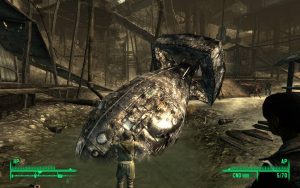 The second is a detail of game design that’s always been a critical consideration for me: the consistency and depth of the portrayal of female characters. Fallout 3 meets my standards in this regard- the enormous wealth of voice acting (featuring such notable talents as Liam Neeson and Malcolm McDowell, yum) has alternative scripts for player character’s of either gender, with many dialogue options taking these details into account to real effect. Female NPCs are cast in great variety of ethnic diversity, appearance, sexual orientation, and social position- the post-holocaust world, it seems, is pretty equal opportunity. Females are portrayed in roles admirably heroic, thoroughly despicable, and everything in between. While there’s a lot less coarse and explicit sexuality than in the “Mom’s not looking” days of Fallout 2, there’s plenty going on to remind you that however grim and amoral the game world may be, women are citizens of the Fallout world with all the same human potential as their male counterparts.
Fallout 3 has a lot to offer. The game is hugely immersive and inherently replayable due to the sheer variety of decisions and amount of real estate to explore. The world is gorgeous, atmospheric, and feels utterly real. The main plot is compelling and worth following closely, and plenty of details faithfully tie in and expand on the Fallout timeline with lots of inside references to delight old-school fans. The decision to offer a blend of real-time and turn-based combat styles will appeal to players of all stripes, and there’s plenty of “crunchy” though seamlessly integrated stat-based mechanics to delight the hard RPG fans if they want to pay attention.
On the downside, the game is still somewhat buggy and prone to unpredictable crashes (though patches have begun rolling out). Follower NPCs can be frustratingly difficult to keep alive and in line. Paper dolling is more limited than was really necessary (clothing/armor consists of one whole-body ‘outfit’ and a piece of headgear) leading to a little blandness in diversity of appearance. System requirements (numbers to follow) can be pretty unforgiving: unless you have a system capable of running Fallout 3 at full-tilt display options or very close to it, the attractiveness of the textures and objects declines sharply with each reduction in quality. At the highest quality, the PC graphics blow the other offered platforms (Xbox 360, PS3) out of the water, without question. If you don’t have enough horses under the hood, though, you’re probably better off playing this on console (though the console ports are slightly buggier, particularly PS3).
Those of us that mourned the passing of Black Isle Studios have waited a long time, in decidedly nervous anticipation, for what would emerge from the Vault when the Fallout torch was passed. Now that our dark dream of the future has been given new life, it’s safe to say that warts and all, it was worth the wait.