
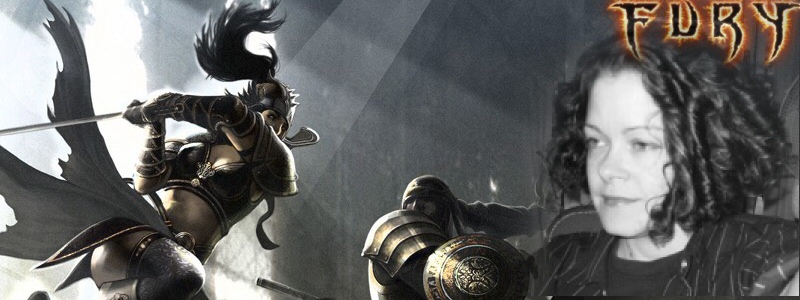
That day during E3 when I had the chance to play Fury, I didn’t know who the nice girl behind me was, teaching me the basics, answering all my questions and telling me all I wanted to know. After I left, I realized I never got her name and had no idea who she was or what exactly her job was regarding the upcoming MMO.
Well, a month later, I finally had the chance to get to know Connie Hewitt, one of the team members at Auran, lead QA of Fury and an amazing woman. This interview will introduce her, her life and her work to you as well.
Didi: Could you give us a little bit of a background about your life before videogames?
Connie: Video games entered my life when I was very young – I only had about 6 years “before” video games. However, my life outside of video games has included not quite completing a university degree to become an English teacher, working in a photography studio, delivering all kinds of goods while driving all kinds of vehicles, entirely too much food preparation/hospitality, processing consumer questionnaires for various market research firms and working on the casino floor of the Bellagio.
Didi: When did you have your first contact with games? Do you remember the first game you ever played?
 Connie: I have the ultimate classic story – the first video game I ever played was Pong, when I was 6 years old. It was a tabletop arcade console at the Hotel Sofitel in Brussels , Belgium . My family lived there for about 2 months while trying to find housing and I remember being very bored. A lot. I was 6, my brother was 3 and there was just not much for a couple of young kids to do there – we only had the toys and books we had brought in our suitcase, we had to be quiet all the time in the room and it was too cold to play outside very often. We had to eat in the hotel restaurants every day, so we had a crash course in formal dining and Keeping Quiet While Adults Are Talking.
(I’ll say right now my mother deserves sainthood just for keeping her sanity during this time.) There were a few standout memories of this time – our miniature metallic Christmas tree we put up on the vanity in the room, learning to play Uno, the indoor swimming pool my mother occasionally allowed us to visit and – the Video Game. It was situated in a cozy spot next to the fireplace in the lobby and my brother and I would sit at it and pretend to play as often as possible. (Very VERY occasionally my father would give us coins to actually play, but it was literally throwing money away because of course we weren’t any good at it.) It had knobs to turn to move the paddle back and forth, a spotless glass top and sat in the formal sitting area like an alien spaceship. It was fantastic.
Didi: I’ve heard that you’ve had an interesting life that even included truck driving. What encouraged you to work in the gaming industry, and what steps did you take to get to where you are now?
Connie: My brother took his preschool Pong experience to heart – he started programming in BASIC when he was 8, on my family’s first home computer – a TI 99/4A. I wasn’t very interested in it back then, I’m afraid. I helped program and debug a few little games but the most exciting thing I figured out how to do on my own was make the monitor flash different colors. Many years later, he became a database programmer and designer and eventually started working for Westwood Studios in Las Vegas . I had played EverQuest for several years and many kinds of console games, but frankly never thought about what was really required to MAKE a video game. I moved out there to make a fresh start to my life and suddenly I was surrounded by the living breathing people who make video games. And live video games. And breathe video games. It was great! I started dating an artist/designer that I met through my brother, which exposed me to even more interesting people with fascinating ideas about gaming. I informally applied to be a CSR for “Earth & Beyond, but was turned down. Shortly afterwards, EA closed Westwood Studios. About a year later, Joseph and I got married and moved to Australia so he could become part of Auran’s exciting MMO project, now called Fury. I did some other work in Australia, but Joseph and I hanging out with the other developers from Auran meant I was always surrounded with talk about The Game. I found I really wanted to be a part of that world. When they had an opening come up for a Games Tester (QA), I immediately applied. I haven’t looked back since.
Didi: Tell us a bit about you current project.
Connie: It is set in a semi-apocalyptic world, where reality is unhinging and all remaining universes, or Realms, are fighting for their very existence. The seals and wards keeping the Fade at bay require the application of magical Essence. It is bound into the fabric of ancient battlefields and ruins and unleashed when fresh combat is held there. You play as one of the Chosen , a hero that has been Reborn countless times and called forth again by the protectors of the realm. Ancient memories of gladiator bouts, fierce magical duels and battles both won and lost will keep resurfacing as you engage the Chosen from other Realms in these tiny pockets of reality. These awakened memories allow you to expand your repertoire and increase your power for your next round of combat!
Fury is an amalgam of acronyms: an MMO that is part FPS, part RPG and all PvP. In gameplay, Fury is completely unique, which makes it a bit hard to describe. If you like any form of *competitive* player versus player gaming, you will like this game. People who like to lurk in the bushes with their top level character to jump out and gank newbies trying to complete quests need not apply. There are no quests and no non-consensual PvP. We have something for everyone else: the people who like solo play, small group strategic play, fierce Clan competitions and above all, the people who think that an evenly matched tooth-and-nail fight is the best fun they can have in a virtual world.
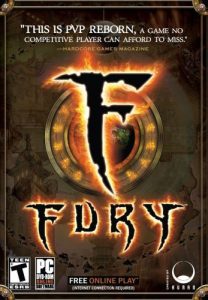 Every bit of progression through the game is a result of Player Vs. Player combat. There are no classes – you can unlock every single tier of over 400 different Abilities and choose from the billions of combinations this affords you to make your own unique Incarnations. Combat is EXTREMELY fast paced. Most new players go through a button mashing phase as if somehow you bang the keys hard enough you will win through sheer force of will. The first time you actually see an opponent do X and immediately do Y to counteract them is a huge turning point. I love seeing people hit that point – their smile and the obvious thrill is very contagious. I think the most telling thing is that even though my QA team plays the game for 8-12 hours per day, when we get our full team playtests together everyone still yells and cheers and has a fantastic time. I’ve personally been solely on this project for almost 2 years and still look forward to playing.
Didi: As a QA, what are the responsibilities of your job?
Connie: QA isn’t something you do for the money or just so you can have a job… you have to really want to get into the games industry and be willing to go all out once you are there, especially if you have your sights set on a taking on a different role eventually. (Testing is a great way for artists and programmers to get their foot in the door.) The basics of QA are easy to understand – make sure the game has no errors or bugs. To accomplish this, we work hand in hand with the artists, designers and programmers to highlight areas that need work or bugs that show up in-game. Once they’ve applied a change or fix, we then retest it to see if the fix worked, and make sure it didn’t introduce any new errors. Additionally, the designers write specifications that say how each system is supposed to work. We compare these in game and ensure their vision is being carried out – make sure the building matches the plans. We even make suggestions along the way to improve gameplay and the elusive “fun factor”.
Didi: What’s your favorite thing about working with your team?
Connie: I have a great bunch of guys on my team. They work hard, they play hard and we can all have a laugh together. They are very individualistic, but share a common love of games and a strong desire to see Fury hit the top of the charts. We sometimes have to work some really long hours and it’s just really good we get along so well.
Didi: Which characteristics do you look for in a game, both when playing and when working?
Connie: Gameplay-wise I tend to be a goal achiever. Give me lots of little puzzles to work out or levels to complete and I will always want “just one more”. I also thoroughly enjoy the social aspects of getting together with like-minded players. The allure of MMOs for me is the combination of gameplay mini-goals I can complete, the persistence of my character and this social fabric to hold it all together. I played EverQuest for five years and have played World of Warcraft since early beta. MMOs that I tried but didn’t play for long are those where I didn’t make friends and contacts I didn’t want to keep, or where my friends moved on as well.
Work wise, I am just thrilled I am working on a game I can also enjoy. I suppose if I had no choice but to QA for some kind of sports game I’d do the best I could, but I wouldn’t be having nearly as much fun as I am now.
Didi: Is it still diffcult for a woman to find a game-related job?
Connie: I’m not sure I can answer that one very well. I do not personally know any women besides myself who have attempted to get a game-related job and failed to do so… and I got in on my second try. I know several women in the industry who hold important positions and they certainly didn’t stab anyone or sleep with anyone to get there. I suspect the problem is that relatively few women are trying to get in. I am the only woman on a team of over 60 men, and in several waves of hiring QA personnel that have generated over 100 resumes I’ve only had TWO women apply: a foreigner trying to get an Australian visa and a woman who was still at university so couldn’t make our work schedule.
Didi: Do you think that certain marketing campaigns may discourage women from playing games or even trying to work in the industry? What ideas do you think could be implemented to get more girls interested in either playing or working with games?
Connie: This is another hard one to answer. My background in market research has made me a bit cynical about all marketing, and the marketing targeting men aged 15-30 tends to glorify risk-taking and some of the worst behavior of which men are capable. That’s not likely to change… it’s very effective in parting young men from their disposable incomes! So you end up with an advertisement that appeals to the lowest common denominator of your biggest target market, which is frankly the smartest thing you can do with your advertising dollar. Unfortunately, those same kinds of ads are the kind put off your average 15-30 year old woman.
This has resulted in a repeating cycle. Women don’t play games, so new games are designed by men, for men, marketed to men and sold to men, so women don’t play the new games. Teenaged boys buy the games and dream of one day making video games – so they read all the magazines, surf the web, apply for all the beta tests and play every game they can get their hands on until they can work their way into the industry. Very few teenaged girls follow suit. It’s not nearly as socially acceptable, especially since the games are very clearly pitched towards men. So the majority of new game developers are still mostly men and we go around again for another few years.
The single thing women can do to stop this wheel from turning is become a viable market. Games like World of Warcraft have really made some big companies sit up and take notice – a far larger percentage of the player base is women than in any other MMO. The average player age in WoW is also higher than in previous games so the idea that only young men fork out subscription fees is being challenged. (I’m 35 myself, and my mother plays WoW, has a level 70 and another character past 60.) Give it a couple of years for the teenaged girls currently having a blast playing WoW and City of Heroes to hit the industry work force – then we’ll start seeing more games designed with women gamers in mind and marketed to women.
Didi: So far, what would you say was the highlight of your career?
Connie: Being promoted to the Lead for Fury. It’s a great game and a great team to be part of.
Didi: What are your plans for after Fury?
Connie: Well, Fury being an online game means we don’t get to just stick in a box and be done with it – there will be patches and free new content downloads that will require QA before being updated for players. We have also already started outlining our first expansion, so I see Fury being part of my life for quite some time to come. If you mean plans for after the Fury release… I’m hoping to reduce the 12 hour days and maybe even take a short vacation with my husband away from anything that looks like a computer.