

Written by Rebecca Wigandt
Over one billion people have turned to videogame expert Scott Steinberg – author, entrepreneur, radio/TV host and creator of game industry documentary series Players Only – for insight into all things high-tech. An internationally-acclaimed gadget expert and videogame authority, he frequently appears as a technology analyst on ABC, CBS, FOX, NBC and CNN, and has contributed to 400+ outlets from The New York Times to Playboy and Rolling Stone. We actually managed to get the author of Get Rich Playing Games away from his busy schedule to answer some of our questions.
Rebecca: So, why are we interested in your perspective? What is it about your body of work that is of interest to the layman/consumer level reader?
Scott : Hmm, good question – perhaps you’re secretly closet masochists?
But realistically, I’ve experienced every side of the video game business from software development and publishing to marketing, media, finance and distribution. And, of course, have self-published games, books, magazines, video shows and more, which tends to give one unique insight into the entrepreneurial part of the equation.
The bonus being that I’ve also been an avid player since 1982, and covered the topic for 400+ outlets from ABC, CBS and CNN to The New York Times and Rolling Stone. It’s provided the kind of crash course in inner industry workings and the magic of the medium that you can’t get simply sitting in front of a TV/monitor, or behind the controller. So take my perspective for what it’s worth. Having started out an anonymous fansite owner who advanced to sign hit titles before he’d turned 21, only to become an oddly prolific evangelist for the medium and advisor to some of the most noted companies in the business shortly thereafter, well… Maybe there’s a story or two there worth telling, maybe not. Either way, I’d like to think I do my best to give a little something back to the industry that changed my life, and pay it the respect it deserves.
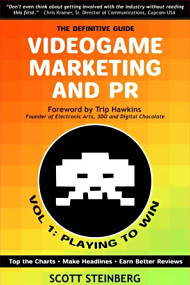 As for my body of work, well – take it from it what you will. But I’ve always advocated the need to dream big; walk without fear; put knowledge and education first; and – most importantly – be true to yourself, and able to stand on your own two feet. Which is a fancy way of saying we preach the DIY gospel. Everyone talks a good game about wanting to break into the business, start their own studio, change the gaming world, etc. I do what I can to provide the kind of real-world roadmap needed to do so, which you won’t get in school or at your day job.
The experts’ dirty secret? All they often have that others don’t is knowledge and experience, and just like any other entrepreneur, many still have to make it up as they go. No one ever gave guys like Electronic Arts and Digital Chocolate founder Trip Hawkins, Ultima creator Richard “Lord British” Garriott or Interplay/InXile’s Brian Fargo a how-to manual and said “here, go make history”. If you want to call your own shots, sometimes you have to throw the rules out the window, and write your own playbook as you go. I’d like to think I’ve helped provide a few people with the means and incentive to do so. As all of the amazingly talented editors, artists, videographers, programmers and producers I’ve worked with (who deserve far more credit for these projects’ success than yours truly) can attest, we don’t do this to win the admiration or respect of millions. We do it for the one of every 10,000 who can read between the lines, and is willing to listen.
Rebecca: Do you see any realistic place in the industry for up-and-comers? There’s a growing and healthy (by all accounts) community of “indie” game studios and producers, but is this a flash in the pan or the sign of a sustained trend? Is the industry in five years going to look more like Stardock or EA?
Scott: Both, actually, as alluded to above. We’ll see gaming giants like Activision, UbiSoft and Electronic Arts continue to gobble up smaller developers, just as the larger movie studios began to exert more dominance as the film industry matured. However, I also expect that we’ll see the greatest innovation, and most clever business models, come from smaller start-ups, including a few guys or gals here and there operating out of their own garage. Necessity is the mother of invention, or so I hear, and with barriers to entry lower than ever, let’s just say as follows. I suspect we’ll begin to see greater and greater things from indies as growth in broadband penetration, more cost-affordable technology, a rise in ways to connect and communicate directly with buyers, and an increasing surge in audience numbers give those with their back against the proverbial wall a fighting chance to rise and shine.
Rebecca: What excites you the most about emerging trends in development and gaming technology? Engage in a little gratuitious futurist prediction for a moment- what cool stuff do you see just over the horizon? Also, why don’t I have a jetpack yet?
Scott : The most exciting trends to me are titles for the iPhone and social networks, as they’re simpler to produce for indies (allowing for more risk and innovation), meant to be played in short spurts, affordable to more people and – through their social nature – are helping to draw in new types of players and bring folks together. Also very cool: The explosion in ways to digitally distribute titles, which – in many ways – are helping us return to the garage days of old, and enabling smaller, quirkier teams and titles to flourish. Likewise, I love seeing the rise in quality and volume of free-to-play Flash titles that run in people’s Web browsers, helping bring millions of new fans to the table.
But realistically, I suspect that motion-sensing interfaces (e.g. Sony’s wand, Microsoft’s Project Natal) that minimize or eliminate the controller entirely and cloud computing are the two major technical innovations coming down the pike that hardcore gamers will find most promising. The former has tremendous potential to change the field in that it enables completely new ways to play and gaming experiences. (Even developers are struggling to grasp just what possibilities and new game types the control method opens.) And the latter means that very soon, thanks to scalable servers that do all the hardcore number-crunching remotely, you may not have to spend thousands on a pricey desktop rig or console to enjoy the most advanced games money can buy, and still enjoy them on your HDTV or desktop.
As for why you don’t have a jetpack? It’s less a function of scientific innovation than practicality. People drive poorly enough as is – imagine them trying to successfully navigate at 150MPH with a rocket strapped to their back.
 Rebecca: Is gaming, as it currently exists, good for our culture? Is it good for us as people?
Scott: Absolutely, undoubtedly, without question. Could things be better, from the way we tackle complex topics to the degree of respect and dignity with we treat today’s player? Certainly. But consider this: As infants, every one of our routines consisted of “eat, play, sleep” – the key word there being “play,” to which we can all relate. Which means that games not only have the power to teach, inform and broaden horizons in general, as proven by countless serious games and educational ventures: They also have the power to touch every human being on this planet. Call me crazy, but I think there’s magic in that.
Rebecca: What are you playing these days? What do you wish you had time to play? What absolutely sucks?
Scott: What I’m playing: Grand Theft Auto: Chinatown Wars, Batman: Arkham Asylum, Heroes Over the Pacific, The Secret of Monkey Island: Special Edition, and a lot of peek-a-boo and pattycake with an infant in the house. What do I wish I had time to play? More turn-based strategy games like Military Madness: Nectaris and role-playing titles like Dragon Age: Origins and Mass Effect– also BioShock 2, given that I’m a sucker for storytelling, atmosphere and characterization.
What absolutely sucks? The fact that like many hardcore gamers who also serve as parents and working professionals, I seldom get the time to sit down and really spend as much time as I’d want with deserving epics. Instead, I have to turn to titles such asShadow Complex and various iPhone games (e.g. The Oregon Trail) or downloadable outings including Plants vs. Zombies and the new Zuma that better fit into my schedule.
Still, no complaining – I often fire up DOSBox and the titles I grew up with such as SSI’s Pool of Radiance or Interplay’s The Bard’s Tale and wonder how the hell I had so much free time and patience to suffer through such slow-moving, complex outings back then. Ah, the glory days…
Rebecca: When the bombs fall and the grid gets wiped out, how do you intend to amuse yourself? How would you earn your water ration if you weren’t an industry consultant?
Scott: Regarding the former: Lots of scavenging, hoarding, and fighting mutant ants and ghouls – endless hours of Fallout 3 have left me well-prepared, I confess. As for the latter, perhaps stand-up comedian or politician: the mouth never stops, and well seldom runs dry of bad jokes. (Although once in a while, something meaningful might come out, or so rumor has it.) Then again, my wife might say by playing male nanny or maidservant to rowdy pets: Maybe it’s that we connect on an intellectual level, but there’s apparently something about me that infants and dogs can’t resist…