
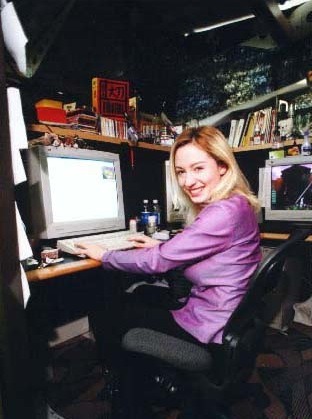
Written by Rebecca Wigandt
I had the great opportunity to interview Stevana “Stevie” Case on a few issues, including the future of gaming economics, the state of gaming culture, and her latest professional outing as a VP of Austria-based virtual transaction managment developer fatfoogoo, where she oversees development of the company’s North American market.
If you’re a young woman with any sort of interest in the gaming world, 32-year old Case is pretty much an ironclad role model for just about any level of the business you’d care to aspire to. If I were the jealous type, I’d look at the list of accomplishments of a woman my own age and seethe with envy. Since I’m not the jealous type, I look at Ms. Case’s list of accomplishments, tell someone in the house to hold my calls until about Sunday, and lie on the floor of my shower with a bottle of something really classy and forgiving, like Clan MacGregor.
Long before you ever heard of her, and back when I was smoking cigarettes under the bleachers with the other Goths, Stevana sued her high school district following the banning of “Annie On My Mind” from the public library (Federal Court in Stevana Case, et. al., vs. Unified School District no. 233, et. al.). The effort won Case the J. Phillip Immroth Intellectual Freedom Award. By 1997 Case was playing a little game called Quake, later whipping then-generalissimo of id Software John Romero in deathmatch play. As is so often the case in life, firearm-related violence led to romance, and Case moved to Dallas with Romero, working at his next venture, Ion Storm, in playtesting and level design.
By 2003, Case was VP of her last joint venture with Romero, the short-lived Monkeystone Games, but something happened in those in-between years that seemed to define Case’s online presence even more: a photo shoot for Playboy in 2000, an opportunity which arose from Case’s already entrenched “hot gamer chick” image established by numerous prior interviews and portrayals. Make no mistake, Case has no (expressed) regrets about the photo op (which, by the way, made extensive unauthorized rounds online but was never actually published in the iconic mag), but it was a turning point in her career’s public face. Case has made countless emphatic statements of her pride as a whole woman, sexuality included, and makes no apologies- for better or worse.
One of the annoying things about the Internet is that, like your unpleasant childhood, even though it moves ridiculously fast, nothing ever really goes away. Do a search for ‘Stevie Case’ these days, and while the datelines may be a good 5-7 years back, you’ll find a legion of ‘homage’ treatments that speak of a gaming persona that seemed to take on a life of its own- as one of the first “professional gamers” in the Cyberathlete Professional League, being a young and attractive female is going to… well, like I said, see what the searches still think Stevana Case is.
Whatever other strengths she may have, one thing Ms. Case has always excelled at (probably from her teenage days of zealous interest in political science) is positioning herself, convincingly and effectively. Look at an old web appearance, and you’ll see her name as Stevie “Killcreek” Case, a reference to her well-known gamer tag. Look at a bio these days, though, and you’ll see Stevana “Stevie” Case. Case knows who she is these days- an international businesswoman, a mom, and a gaming trendspotter, and even though she may not headline it anymore, she can still kick your butt.
 It’s hard to reinvent yourself, but Case is like a personification of the excited curiosity that comes over you the first time you eat at a kaiten-zushi bar, where the sushi rotates past you in an endless traffic jam of whatever the chefs toss out: ‘oooh, I’ll have some of this, and some of this, and this is awesome, and oh my freaking god I want more of this.’ Case had decided it was time for her career to mature, and when she left Monkeystone, she found her way to the development team for Warner Bros. Online’s mobile projects, working on the casual and bite-sized games Monkeystone had first tackled and joining some of the earliest asserting forces of mobile gaming as a serious (and profitable) platform. Tira Wireless enticed her along the way, as well as the Spleak Media Network, creators of the now-defunct Spleak bots that allowed users to publish and rate material publicly- design concepts that, it’s worth mentioning, are the kind of concept now taken for granted in the architecture of things like FaceBook.
You can probably see the pattern here: Case is becoming increasingly interested in emerging trends, and increasingly excited about the top-down business of getting people excited about emergent technology. She’s been a gaming icon, a subculture idol, a creative force, and a mover and shaker.
Not bad for a girl who got her start playing Lode Runner on her IIe. (For the record, Ms. Case, for me it was Oregon Trail on the Vic-20.)
GI: The first big question is: exactly what is fatfoogoo, and what are you doing with it?
SC: fatfoogoo is a European company that I’m working for, and I’m vice president of business development and sales for North America… we’re a technology company, and we’ve developed a platform that supports virtual economies for big MMOs, virtual worlds… virtually any online community. If you want to sell virtual items to your players or users, we have the technology to make that happen. So my job is to take that technology, and introduce big publishers or developers out there who might be making the world or making the MMOs to our technology, and convince them to license it and use it as part of their games or projects.
GI: And this is where your interest in microtransactions comes in?
SC: Exactly… we support a few different business models: …the collection of subscriptions… what’s called the primary markets, the sale of virtual items directly from the creators of a game to the user, or a secondary market, where users would sell items to each other. Within that, we can support transactions completely in virtual currency or we can support microtransactions which are all the rage and the hot topic at the moment… all those micropayments and sales in real money, that is one piece of what we do.
GI: Okay, now, paying real money for virtual ‘property’… is a little bit of a controversial issue; obviously there’s been a lot of concerns about fraud, about exploitation, certainly there’s been kind of been an unregulated market… for MMO currency and things like that. What do you feel are the ethical obligations of exploring this kind of market?
SC: …the issues you raise are part of why we’re in existence today. There’s clearly a demand from gamers to be able to sell items, and buy items, and trade currency; gamers want to do this. So, I think that not only is there an ethical obligation, but there’s a desire on the part of these publishers and developers to have some more control over it, because when you have any kind of negative interaction around your game or around virtual items associated with your game, that’s just a negative for all involved including the people who made the game, even if that transaction took place… outside of your service, on Ebay, wherever it may happen, ultimately that comes back to bite the creators of the game. So, we really facilitate a much more organized and official exchange of currency and items, and that allows developers and publishers to have a lot more control… players to do what they want… and facilitates these transactions in a much safer way. So we help prevent fraud, and we’ve got a whole suite of technology built around mitigating fraud and finding users who are trying to take part in these malicious behaviors and excluding them from the process, and protecting users who really just want to enjoy the game and take part in the marketplace.
GI: So how does fatfoogoo actually facilitate these transactions, and ethically speaking, what standards or structures are in place, or are hopefully going to be in place… I have to confess, the idea of a market for such an intangible product can raise a lot of questions… how do we establish fair value and things like that?
SC: …so our technology plugs directly into a game or a virtual world… we’re a ‘white label’ solution, which means that the end user, the gamer, they never see fatfoogoo, our technology is on the back end, and what it does is enable the publisher to have control that’s directly tied to the game. So say that you’re a user and you want to create an auction for an item you own and you’d like to sell it, well, auctioning of course allows the other users who are interested in buying to set what is believed to be- at least by the community- a fair price, and then when the transaction takes place, because the technology is directly linked into the game, we can control the delivery of the payment and confirm that before they deliver the item. So before going to Ebay and… having to rely on these verbal commitments, and you don’t have a firm way to control it, within the game this way we can confirm that the transaction has happened and if there is any kind of issue we have a formal dispute management process, we have a ticketing system… it’s all tied into the game, so it’s just much more tightly controlled. But, you know, I think you touch on some larger issues as far as ‘how do you determine fair market value for items like this, and how do you control user behavior?’ and that’s a much tougher question, I think that we’re still really at the infancy of this market, this whole idea of virtual item sales.
GI: Let me ask you this then… aside from speaking as a businesswoman, speaking as a gamer, on that level, what do you make of this kind of market? I mean, aren’t there questions of what sort of thing this does to the balance of the game? What do you make of people… bringing real-life resources to bear in terms of advancing in a subscription game where there is at least an intention towards balance and fairness of play? …it seems like it would create almost a classist system where someone can buy their way ahead.
SC: …I think the point you make really highlights one of the key issues that I think is going to be a big topic over the next few years, and that’s that when you have these kind of microtransactions, these sorts of complex markets, design is key. I mean, design is everything… so you cannot… unleash a game without fully thinking through your virtual economy, because you’re going to have all the behavior that you can see, you’re going to have fraud, you’re going to have people doing things you don’t expect, you’re going to have people gaming the system, and you don’t want, in most cases, users to just be able to buy their way in. So… we’re seeing people start to mitigate that in design with some pretty basic stuff, like having a bought currency and an earned currency and you manage them individually, and you put limits on each, and how you can get them, so there’s some basic things you can do there… as a gamer, the thing I like about microtransactions is that they’re very democratic. You see very quickly through microtransactions if your users are actually enjoying your game, because if they’re not into it and they’re not investing the time, you’re not going to make money. It’s not like packaged goods where you’re going to get your money up front and then if your game sucks it’s just, ‘too bad, you’re out of luck’… you have to keep your gamers happy or they’re not going to keep paying.
GI: Well, investing time certainly, but what we’re talking about here is introducing a real investment of money that wouldn’t have been present previously… certainly as a barometer of a game’s success I agree that these sorts of transactions are an excellent one, in that if people are willing to kind of pay a premium on this content it means you’re doing something right, but on the other hand, not everybody is necessarily going to be able to afford to interact on that kind of premium level. Isn’t this the sort of thing that might discourage people who say, you know, are certainly willing to invest the time and enthusiasm but for whom the subscription is pretty much the limit of their monetary investment.
SC: …I think it all comes down to the individual game. What we’re seeing a lot more of now is free to play games, where all of the money is coming in not through subscription but through virtual item sales. So you can come in and play for free; take a game like [Three Rings Design’s] Puzzle Pirates, which I think is a fantastic example where it’s done a great job of balancing… you can… certainly buy lots of things, but there’s not such a power in buying that it negates the experience of just going in and earning. And I think that’s where design comes into play, it’s just going to be a matter of the skill in balancing things so it isn’t… people can just come in and buy what they need and all of a sudden they’re at the top of the ladder.
GI: …you’ve been speaking of this mostly in terms of its position as a virtual economy, but we are of course also talking about the investment of real capital, and certainly for, you know a sufficiently entrepreneurial person there’s the potential to turn a real, real-life profit. Things like [Linden Labs’] Second Life spring to mind.
SC: (laughs)
GI: And I guess I find myself wondering, in the midst of our current economic situation, when we think that a lot of the problems that got us here were things like derivatives and these kind of abstracted levels of transactions, do you foresee that this is the sort of thing that someone going beyond the level of an individual selling gear per se, that there’s the potential to really sort of franchise this and possibly run into trouble?
SC: I think there’s the potential there, I think that in general most designers, most developers are heading in a direction of virtual currency that cannot be cashed out, you know, I think that cash-out and real money trading are hot topics, there are a lot of reasons not to do them and the ones you cited are among the biggest… the others would be [that] as a designer and a developer, do you really want people taking money out of your game? It raises lots of legal issues, lots of complexities, and you know, it also doesn’t keep them hooked in. So I think there’s certainly the potential there, but I think most designers will stay away from this, from the types of designs that would encourage that… Second Life is interesting, it’s a very open market in that way, but I don’t think we’ll see too much of it, at least not in the short term.
GI: Okay. If I may say, this sort of interfacing between virtual and real economics is rather far afield from what brought you into gaming in general. How did you get here?
SC: (chuckling) Well, it’s been an interesting path, you know? I started out as a pro gamer, and evolved into a level designer, and then kind of turned into a more of a producer type role, and eventually I ended up in LA, I was at Warner Bros. and I was managing their product development for mobile, so I was helping develop mobile games, and get those outsourced, and while I was there, I was contacted by some guys at a company called Tira Wireless and had the opportunity to go and do some sales and business development for a couple of years, so I kind detoured through mobile, and then I detoured from mobile over to business development and sales, and ultimately it was connections made there that led me to fatfoogoo. So it is pretty different but at the same time it feels like it’s all built on my past experience and brought it all together… in this one place.
GI: This sort of level that you’ve reached in the industry does kind of take your eyes directly away from the games. So how do you feel about it? You’ve moved very much more into the abstracts of the game industry; do you miss the hands-on?
SC: I would say I miss it sometimes, it brings its own unique challenges, and I’m sure that at some point in the future I’ll want to be a little more hands on with games again, but I think for now that what we’re doing is really cool, it’s kind of a cutting-edge thing, and in many ways the future of gaming, it’s certainly a forward-looking business model, and I really like that, I like seeing where it’s gonna go. But I’m always open to trying different things, so I don’t doubt that I’ll be doing something completely different down the line.
GI: Well, trying new things has definitely been sort of the course of your career. I guess what I’m wondering, when I look over your resume, have you ever had the urge to strike out on your own?
SC: For sure! Yeah, I think that if there’s anything I’ve discovered about myself, it’s that I love the entrepreneurial feel. I love small companies, I love working with a small group, there’s so much passion and so much drive. Right now, this is a great opportunity with fatfoogoo because it is a small team, it’s a great challenge because the team is primarily based in Europe, so I get a chance to grow the US business, and in a lot of ways it’s really the best of both worlds. So certainly at some point, I’ll run off and do my own thing, but it would be foolish to pass up working with such a great team and having so many of the benefits of entrepreneurship but without the drawbacks.
GI: Absolutely. All right, well, back to speaking of you as a gamer. What are you playing these days?
SC: You know, it’s funny! I’ve followed a very traditional progression of gamer, I started off with the hard core… got into all sorts of stuff, when I was working in mobile I was really fascinated with casual games, and these days, I’m super busy and I have a 5-year old daughter now, and so what I find myself playing is like Guitar Hero, Rock Band, my daughter can actually play games now, we play Mario Party together, you know, it’s really the more casual stuff that you can sit down and play for short spans that I’m getting into these days.
GI: Dealing with a 5-year old, short spans are a good thing to keep in mind.
SC: (laughs) Yes.
GI: So, let’s talk about that for a second. You know, your daughter is already gaming, and certainly she’s probably going to continue as she goes along, given the influence she’s going to have at home.
SC: Sure.
GI: Now, as a teen, you had a fairly noteworthy crusade in terms of censorship, and I imagine that’s an issue that’s still fairly dear to your heart.
SC: Mm-hmm.
GI: But now as a parent, game content is certainly a concern. So could you perhaps speak to that for a minute, what do you feel is, I guess the age-old question of video games, what sort of influence do you see games having on your daughter as she gets older, as she’s exposed to other concepts?
SC: Yeah. That’s a great question, I mean, you’re right, I’ve always been a champion of open market, I don’t believe in any way that games should be censored, to be honest, I’m not thrilled with the idea of a rating system, I think it ends up simplifying some of the concerns that people have and kind of dumbing things down. As a parent, I hope and I’m already starting to see that games will have a really positive impact for my daughter, but I mean to be honest, (laughs) I am really much more conservative in what I expose her to, you know, I think as a parent, you’ve got the responsibility to figure out what’s good for your child, what’s appropriate for your child, so I’m super pro-gaming for her, but I’m definitely pretty heavy-handed on controlling what she plays and when and what the right timeline is for introduction of stuff. So I’m sure she’ll say when she’s older that I’m a pretty overprotective parent, but I think I’m just thoughtful about what I let her see at what age.
GI: So how old is she going to have to be to play GTA?
SC: That’s a good question! (laughs) You know, that’s a good one. She would have to be quite old, to be honest, I certainly don’t see myself as a parent who would let a 12 or 13-year old play a game like GTA, I mean, for me, you really have to kind of build up your kid’s framework for making appropriate judgments and knowing right and wrong before they’re introduced to that kind of game. Not that I would ever, you know, it’s tough, I would never fault a game for putting bad ideas in my kid’s head, I just think that you’ve gotta build a positive framework before you expose your child to stuff they might not otherwise see that might influence them in that way. So I don’t know, I mean I certainly would say late teens. I’m pretty conservative on that (laughs).
GI: …going back to my question, the rating system would agree with you on that [age standard], but you have said and understandably so, that you’re not a fan of a standardized rating system in games. So how would you do it?
SC: Well, you know, I don’t know that I have a better alternative. I think that ratings in concept are great, the way it’s being done now I think is really simplistic and ends up working to stifle creativity and really kind of putting too tight a control on what designers can do with their games, because [it creates] very limited kinds of brackets, and you’ve got certain retailers that won’t carry Mature games, and just, it really ends up in a kind of controlled situation, when there are such nuances in games, and such room for interpretations. So… I guess it’s the best we’ve got going now, but ultimately, I think it all comes down to… relying on parent responsibility, you’ve got to know what your kid is consuming, you can’t just rely on some basic rating system to tell you if it’s appropriate or not.
GI: …in terms of the presence of women in gaming, this is something that is a critical issue to me when I interview developers and producers and programmers, and I get a variety of responses in terms of how they, particularly men, view the current situation. I’ve even been told on occasion that ‘you know, the days of female exclusion, of bias, are kind of gone..’
SC: (laughing out loud)
GI: ‘…and it’s paranoid to think of in these days, and what are you talking about, it is democratic, girls are buying more video games than ever,’ but I have to tell you, I don’t always see the money there. So, what do you think of the current state of the culture? Is feminism an outdated concern?
SC: Absolutely not! I think that to be honest it’s still a little shocking how homogeneous the industry is. We have made progress, I run into more women now than I ever have, and that’s awesome, but you know, I’m in there, working in these roles, working in companies that are 95, 96% male, and the sexism is still there, a lot of it is still this very well-intentioned but uninformed attitude that, you know, girls just aren’t into certain things, and there aren’t more girls making games because girls just don’t like this stuff. And I just don’t buy it. I don’t buy it for a second. The industry is set up in a way that makes it very challenging for a diverse set of people to get involved, it’s not conducive to lifestyles outside (laughs), you know, single person working 18 hours a day and not really having too much of a life outside of that, there are lots of exceptions now, there are places you can go and work and still have a life, but there’s still that core that is traditional gaming. So I don’t think that the days of feminist concerns are anywhere near over, I think we’ve got a long way to go on that still.
GI: I’ll leave my boots on, then.
SC: (laughs)
GI: Speaking on that, speaking of sort of what the normative culture is as you’ve described it, and very eloquently by the way, how the normative culture produces its product will inevitably raise the issue of how women are depicted. Now, there was a small amount of controversy a number of years ago when you posed for a Playboy cover.
SC: Yep.
GI: And there were a lot of very pointed questions about that, and one of the things that I noticed in terms of you defending your decision to do that is a kind of, if I may use the term, a kind of sex-positive sort of outlook.
SC: Yep.
GI: And I guess I’d like to see, how does that philosophy, which I certainly agree is a very healthy one, how does that philosophy interface with the problems that exist in, well, I’m sure I don’t need to draw a map for you, the sexualization of women in games, the portrayal of female roles in games. What’s going on there? And what’s with the culture lag?
SC: Well, you’re right, I consider myself a hard-core feminist, I am not afraid in any way of that word, and my attitude has always been that the problem is not that we have sexy video game characters or that in some games women are sexualized, the problem is that there is not a diversity of representation. You know, we have games, and it’s not as bad as it used to be, there are more of the different types, more of a variety, but for the longest time, it was 98 percent of video game characters, if they were women it was this… very sexualized-looking woman, this very kind of one-dimensional character, and that’s really the wrong . I don’t have a problem with that character, I have a problem with the lack of other characters. And we’re getting there, we’re getting there, I think it takes time, I think that because I am not so resistant to that character that’s probably helped me get to where I am today; I think that guys creating those characters certainly aren’t super-friendly to women who come in and are adamant about ‘you cannot sexualize women, and that’s a bad way to model what we want our young girls to be,’ and I get that, I get that perspective and I respect that, but I think it’s just got to be more about diversity than limiting how we should represent characters. We’ve got to leave room for creativity as well.
GI: So you feel that the most positive approach is going to be to favor more of a middle road where the encouragement is variety rather than a sort of discouragement of a particular message?
SC: Exactly. I think there’s room for everything out there. There’s room for these very sexualized characters, both male and female.
GI: So there’s a place for DOA [Extreme Beach] Volleyball? Really?
SC: (laughs) Yeah. I think… where’s the fun if we can’t create extreme characters and extreme storylines? I mean that’s what this (gaming) is all about; it’s about escape. So I certainly don’t object to that. There’s a lot of appeal in different types of characters, and I’m hopeful that more of those games with different types of characters in more variety will get funded, will get made, and will get made by a more diverse set of developers so we can have a broader range that’s going to appeal to more of a mass market.
GI: Okay. So let’s say, speaking both as a businesswoman and a gamer. You’ve got the the team of your choosing and an unlimited budget. What kind of game would you make?
SC: Oh my gosh, that’s such a tough question. (laughs) I think that, you know, to be honest, I would love to tell you I have a fantastic and brilliant idea for the perfect game, but as a savvy businesswoman I would rather go out and hire a brilliant designer, so I would go out and hire me a Cliffy B. (Epic Games’ Clifford Bleszinski), or somebody like that, and have them tell me what they’d like to make, so that’s their bag, and as you get older, you realize your strengths, and my strengths are in building teams and building relationships, and I think that’s what I’d focus on.
GI: You live in California. You mean to tell me that you don’t have a script in your back pocket?
SC: (laughs) No, unfortunately I’m not one of those.
GI: All right. Well, one encapsulating question if I could. If your career were to end tomorrow, what would you most want to be remembered for in terms of your impact on the industry?
SC: I would say, I’d love to be remembered for my ability to build relationships, to bridge different aspects of the industry and sort of bring together these bigger picture ideas, to push things forward, and to make connections that allow people to really push the envelope. I think that’s what I value, and that’s what I’d like to be remembered for.