
Written by Didi Cardoso and Carrol Dufault
Carrol and Didi: Welcome James, and thanks for taking the time to talk to us. So tell us, what brought you to this field?
James Semple: Hi and thanks for having me. I’ve really been a huge fan of film music since I was a young boy. From the first time I saw Star Wars to be honest. I’ve always liked the big orchestral soundtracks, and over the last 15 years I noticed how they were becoming increasingly popular in videogames, and videogames themselves are often particularly focused on their soundtrack to add atmosphere. What I feel is that videogames are a younger and more interesting market at the moment, so it’s an area for innovation and experimentation.
Didi: When did music hit you as a career option? Was it always a dream of yours or something that happened all of a sudden?
James: I loved film music as a child. I was a young boy through John Williams’ really amazing patch (Star Wars, Superman, Raiders, E.T.). As I became a teenager, I got into playing rock guitar and played in bands through my twenties. Eventually, I built my own studio and since then, I’ve realized that I’m capable of writing film music. For the last few years, my focus has been working on orchestration, arrangement and production.
Carrol: Is there a particular game genre that has attracted your attention over others?
James:: That’s a good question. I guess RPGs are my favorite for the most part, so I’m not particularly drawn to Wii games or racing games using rock or dance tracks. For me, the games with the interesting scores are the Star Wars games (unsurprisingly) plus medieval style games, although there have been some really impressive entries in the horror category. Bioshock was particularly atmospheric.
Carrol: Have you played any of the music based mini-games that occasionally crop up in RPGs, like Neverwinter Nights 2 for example? And if so, what did you think of those?
James: Well I never got a chance to do that in NWN2 but I did try out the lute in Lord of the Rings Online. It was pretty funny because the main Shire theme from the films is pretty much just up and down the major scale so everywhere you went you could hear tortured renditions of this melody.
In terms of music games, I notice that nearly all of them are based around rhythm and timing so I tend to be pretty good at them. I do worry that playing some of these games might put people off learning real instruments because real instruments don’t have that instant gratification like computer games. In fact some instruments really seem like they don’t want to be learned at the start, like guitar, which was my first instrument.
Still, I hope that these mini games do at least make people aware of the music in the game. So that’s always a good thing because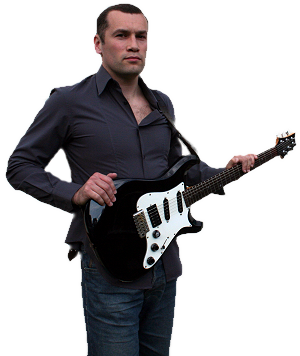 usually a ton of work has gone into making that music.
Carrol: Yes. About that ton of work, how do you feel about writing music to other people’s timetables?
James: Good actually. For whatever reason I feel it gets me feeling creative and makes me work. If I have a piece I’m playing around with and no deadline, then I’ll tinker with it for weeks. But given a deadline I work a lot faster. I think it stops me second guessing myself and makes me focus.
Carrol: It sounds like you have the right temperament for your chosen career. I know that you have previously worked in film. Do you plan to continue working in both areas (film and games), or to specialize?
James:: Now more than ever there seems to be some fairly high profile cross overs between the two genres (Danny Elfman, Michael Giacchino and Harry Gregson-Williams for instance). So I think working across both areas is fine by me.
Didi: Where do you usually draw your inspiration from?
James: Lots and lots of places, no doubt. I listen to huge amounts of music regularly and I’m constantly trying to expand my knowledge. I have a lot of favourite film and game composers but I also find inspiration in rock, pop, jazz and folk music. I recently heard a track from a fisherman’s choir (of all things) and it sounded absolutely epic. It would really be perfect for game music and I thought I really have to get that arrangement!
Carrol: Games certainly are getting more and more cinematic. For game music, do you find that the people you work with are different from the film crowd?
James: Well given where I’m working at the moment I tend to meet a lot of people who are taking on multiple jobs. So for the films, the director might also do the editing in the game world this tends to mean that a lot of the people are “techy” by their nature. What’s perhaps more difficult about games is that you often need a lot of film skills as well as these tech skills. Particularly in terms of direction and cinematography, but overall I find the people quite similar to be honest. They always think they don’t know what they want musically.
Carrol: I imagine that often game developers do not necessarily have much cinematography experience. Does that make for more difficult scores?
James: It can do. The easiest way to score a scene is to play across it, almost like a music video, but I really hate doing that. I like the music to respond to the drama and the action.
One thing I’ve found in both game (cutscenes) and films is that often someone will want an establishing melody but will not have considered that when they edited the scene, so there is no room to add it in. Although with modern editing approaches you often need to write motifs that are very brief so that you can work around this.
Didi: Did you have access to the script before you began composing for the The Witcher mod “Births and Virgins” by the Medusa Collective? How do you go about creating the right music for the mood?
James: Yes, the team were very forthcoming. Before I really saw much of the project, we spent time selecting a suitable “palette” (i.e. the main instruments that would create our soundtrack). After that, I learned the main story and created a main theme in isolation. Then we discussed the kind of feelings that each scene was aiming for, where the pivotal moments were, etc. Very much like scoring a movie. In the case of ambient and fight music, again we discussed which instruments I might use and what kind of feelings we needed the music to evoke. Having created my themes I was able to re-use them and adapt them to the various pieces of music.
Carrol: Would you say that the game pieces tend to be shorter overall?
James: Yes. Certainly as far as cutscenes go. Games are an interactive medium and as such cutscenes can’t be too long, otherwise they get skipped. So cutscene music is short. On the other hand, games usually require a lot of ambient music. I mean, something like World of Warcraft must have hours of this kind of music.
Carrol: So we’ve covered the time constraints to some extent. What do you feel most people overlook when they first consider adding original music to their games?
 James: Well one thing that surprises me is that often game devs are quite structured in every aspect of the game, but have no consideration for structure of the music. I don’t mean structure of the individual pieces of the music, but how the music is structured throughout the game.
To give an example in film, in ET the main theme is subtly hinted at throughout the first half of the film a few notes here, a chord change there. By the time the flying bikes appear, the music seems incredibly familiar and almost inevitable. It’s as if we thought of it ourselves, because John Williams has been subtly guiding us towards this moment.
Now with games we have less control than a director in a film, but we can lay out these little seeds in the music suggesting motives and linking various concepts together. So if we have already met a bad guy and heard a theme for him, then when we approach his lair, the theme might be embedded in the ambient music. Perhaps in a slightly disguised form but it will sound “right” for whatever reason. Although game devs are no different from directors in this regard.
In fact, that’s one of the first processes I usually need to go through on a project: winning the trust of the other people. Once they get a sense that I can write music true to their vision then they tend to relax and give me more free reign, but the first few cues are always a little prickly. Establishing a common language and terms of reference can be a good idea, although thankfully one thing I’ve not had from videogames are temp tracks!
Carrol: Sounds like you need to know a lot more than music! By the way, what are temp tracks?
James: Yes, I definitely have had to study how music works with visual media. A temp track is used by editors to help them cut and edit their footage. Most scenes have a natural pace and music helps an editor to follow that pace.
The temp music might also suggest a certain kind of mood which suits the scene. They are great as frames of reference, but can become a burden as the director and editor become used to watching the scene with that music and so anything different starts to jar with them. In fact, a game I play with other composers is to watch a film and try and guess what the temp track was.
Carrol: Seems like these tracks can trap them in a paradigm at times.
James:: Yes, in fact composers being forced to “write it more like the temp track” have resulted in some pretty nasty court cases in Hollywood and it obviously doesn’t really stir your imagination as a composer being told to copy the temp.
Didi: What are your thoughts regarding live music as opposed to computer-generated?
James: I am pleased to see that a lot of larger budget games use live musicians, which is great. In fact, 24: The Game uses a live orchestra whereas the TV series used computers and samples. For me, I’m always trying to get as much live stuff in as possible. Obviously I often work where we don’t quite have the budget to hire an 80 piece orchestra, so I use a lot of samples. But particularly with solo instruments I try to get a live player. They really add so much to the tracks and let’s hope it stays that way!
Carrol: Are live musicians difficult to find?
James: Well they can be, but I’ve started to build up a small (but evergrowing) team of musicians whom I trust and who produce consistently good results. Most of them I’ve only spoken to over the web, and so we have “remote sessions” where they send their final takes to me. But it works really well.
Carrol: That sounds very interesting and definitely something that would not have been possible a decade or so ago.
James: Well I think the basic cost of setting up a home studio was just so much higher ten years ago. And the samples weren’t really anywhere near the quality of the stuff released in the last few years, and the computers just didn’t have the power. Nowadays I can produce all of this on a single machine.
Carrol: Do you have your own home studio?
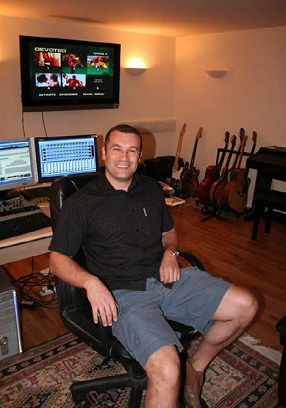
James: Yeah, a custom built place at the bottom of my garden, sort of like my own “kennel”. I have just two computers there, and only one of them is working on the music stuff, but I have a few monitors and a plasma screen. Between them, they kick out enough heat. I try to minimize what I’m running.
Carrol: And, I can only assume, an awesome sound system?
James: Well most of the sound is coming from near field monitors. When I’m sitting in an optimal position the idea is that they form an equilateral triangle with my head; around 1.2m on each side. It’s amazing how much work goes into setting these places up.
Carrol: Does that make it useful for surround sound?
 James: I still mix down in stereo at the moment. For film, little more than stereo is usually needed because the music track tends to come out of the front speakers as a normal stereo spread. However for games, there is more of a reason to work in surround, usually because the music guy can get asked to provide other sounds.
But you have to be a little careful because the game audio engine may have its own surround mixer incorporated. So you don’t want to mess that up. At the moment I work with two good quality monitor speakers and no sub.
Didi: What kind of wisdom would you like to pass on to others wanting to follow a composing career in the field of their choice?
James: Your question is great and quite tough… I guess I would recommend upcoming composers to find their niche and really excel in that area. It will stand out if it’s an area you particularly enjoy! Try to hone your craft and make sure you get out there and get heard!
Didi : Thank you very much for your time James, and we look forward to seeing your name in the credits of future games and movies.
James: Thank you Carrol and Didi!
To learn more about James: and his work or to listen to some samples of his fantastic music, visit http://jamessemple.com/.