
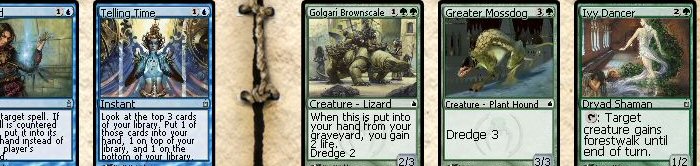
Magic: The Gathering is a trading card game produced by Wizards of the Coast that has been around for almost 10 years and in several different editions. If you are a newcomer to Magic, it may seem intimidating at first with all the different sets and expansions. This set of articles is meant to de-mystify this fun yet complicated game.
Magic is a game that can be played in a wide range of settings, from casual to professional (there are people who pay Magic tournaments for a living, and make enough money to sustain themselves). I wouldn’t suggest starting out on the Pro Tour right away, of course. The best way to learn how to play Magic is to find a friend that knows how to play, has some cards and decks built already, so you can get the gist of it. However, if you don’t have friends who play Magic, I would still suggest playing with at least one other person, because Magic is at least two-player game.
If you happen to own a computer still running Windows 95 or 98, and you can find an old copy of Magic: The Gathering – Duels of the Planeswalkers on CD-ROM, this would be a good way to get acquainted with the game. However, Wizards of the Coast doesn’t support or produce this game anymore, so it may be difficult to find. It also doesn’t seem to run on newer systems. There’s also additional elements to this game that doesn’t have anything to do with how Magic is played (like running around being chased by creatures… and in dungeons and such). If you happen to find this game, you can play it solely on Duel Mode, where you can play with pre-built decks, or build your own. All of these cards are from a much older edition of cards (Revised, I think), which they don’t sell anymore. But at least it will give you a starter as to the general game play.
If you don’t have any of the above and you are starting from scratch, I would suggest buying one of the starter packs. Get the Seventh Edition Starter, which is their newest and up-to-date starter pack. This will include two full decks, one booster pack (15 additional cards), and some other stuff. One thing to keep in mind that since this is a trading card game, many cards are designated as “uncommon” or “rare”, and some have shiny foil bordering or more exclusive art. Some people collect the cards just for the art (which is quite detailed in most cases)! But if you are only concerned about game play, then you should pay attention to the uncommon or rare cards. Nowadays, Wizards makes it easy to distinguish uncommon and rare cards with the symbol on the right side of the middle of the card. Black is common, silver is uncommon, and gold is rare. Generally uncommon and rare cards are “better” cards in game play, but only if you know how to use them well! (NOTE: Sometimes rare cards can be really bad cards even though they seem to be good; these are often called “skill-testers” – more on this in an upcoming article.)
There are five major color categories which represent different elemental themes. Here’s a basic chart of the colors and what they generally represent:
White: Life/Order. Generally involves healing or prevention of damage but sometimes have some rather cataclysmic spells (such as “Wrath of God” which gets rid of all creatures in the game). Black and Red are the opposing colors, so many spells and creatures are particularly effective against black and red spells and creatures.
Black: Death/Decay. Generally involves spells that deplete health and the undead. White and Green are the opposing colors, so many spells and creatures are particularly effective against white and green spells and creatures.
Blue: Water. Generally involves “control” spells, meaning spells that do certain things to manipulate the game play but not necessarily causing damage. Red and green are opposing colors, so many spells and creatures are particularly effective against red and green spells and creatures.
Red: Fire/Chaos. Generally involves direct damage and “fast” spells. White and blue are opposing colors, so many spells and creatures are particularly effective against white and blue spells and creatures.
Green: Nature/Growth. Generally involves living things, and manipulation of environment. Black and blue are opposing colors, so many spells and creatures are particularly effective against black and blue spells and creatures.
In general, there is a delicate balance in each color so that game play is not stronger for any one color. However, this really depends on your style of game play. Some of the Magic expansion sets also seem to favor one particular color, also. (More on expansion sets in a future article). Most people will make a deck with a combination of two or three different colors, which adds a bit of variety.
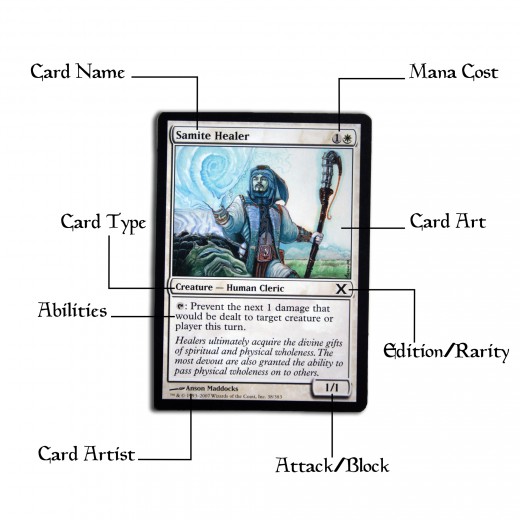
You should also think of your creatures as creature spells, rather than just creatures. In older editions of Magic, these were “summoning spells” to summon a particular type of creature. Newer cards refer to them as creature spells, and the card tells you what type of creature it is in the middle of the card just below the card art. All cards, creatures and whatnot, have some kind of casting cost associated with it. This is where your Land cards come in. Since there are five colors in the game, there are five different basic Lands: Plains (white), swamps (black), islands (blue), mountains (red) and forests (green). There are other types of Land but this will be covered in a future article. Land is used to get mana, which are used to cast spells. The casting cost is in the upper right corner of the card, and you may see a number and/or some symbols. The symbols represent the color needed to cast the spell, and there may be more than one. The number represents spell points that can be drawn from any Land. For example, if you see a “2” and two sun symbols, that means that it takes 2 mana of any color (or “colorless mana”), and two white mana to cast that spell. This is definitely a good thing especially if you are playing a multi-colored deck. If you are playing a green and white deck, you could use forests for the two non-color-specific mana so you can save your plains for the two white mana required. Once you use a Land for mana, you “tap” it (turn it sideways). There is a little circular arrow symbol (though not on lands anymore) on any card that requires to be tapped for whatever it specifies. Then in the main text box of the card there may be some additional information about that card, and sometimes an amusing made-up quote. Creature cards have an additional bit in the bottom right hand corner. What looks like a fraction is actually the numbers that determine attack/defense power. So a creature that has a 3/4 designation attacks for 3 points and can block 4 points of damage. See the diagram below to get an idea of what to look for on any card.
There are some general rules of thumb to follow when creating a playable deck. One thing to remember is that you want a good supply of Land cards, but not too many. This element is what really throws a bit of randomness into the game. Sometimes you may have enough Land cards to play the spells you want; sometimes you don’t and get “mana screwed.” Your deck also shouldn’t be too huge. In general, decks are around 60 cards large, with about 24 land cards. You can experiment with different numbers to see what you like best.
Gameplay Basics
Let’s get to the game play now. In general you play against one opponent. You start with 20 points of life, and the point is to kill the other player. You play Land cards to get spell points, and you cast your creature and other spell cards which are used for your attack against your opponent, and defense for yourself. Basically you have several ways of depleting your opponent’s life points. If you want to get really snazzy you can get a 20-sided die to keep track of your life points (though, pen and paper works for me). Each player takes turns, and each turn is broken up into different phases (which I will explain later). You can attack with creature cards, which have strength and toughness ratings on the bottom right corner of the card (strength is the first number, and toughness is the second). You can also attack with different spells, some which you can play on your turn only, and some which you can play at any phase. For defense, you have your creature cards to defend other creatures, and there are also cards that can prevent damage or heal you or your creatures. You can think of your creatures as being kind of a buffer for damage meant for you by other creatures or spells, but it’s not entirely this black and white.
To start the game, each player shuffles his/her own deck and draws seven cards. Depending on who you are playing, you may be able to take a “mulligan” (put your hand back into your deck, shuffle your deck and re-draw your hand) if your hand doesn’t has no Land, all Lands, or if you simply don’t like what you’ve drawn. Let’s say you have a hand with only one Land. This isn’t usually a good one to keep, because who knows when you’ll get another one. However, if you take a mulligan here, you would only be able to draw six new cards; and so on and so on if you take more mulligans, at least this is one version of the mulligan rule.
There is a general layout for your playing field, here is an example:
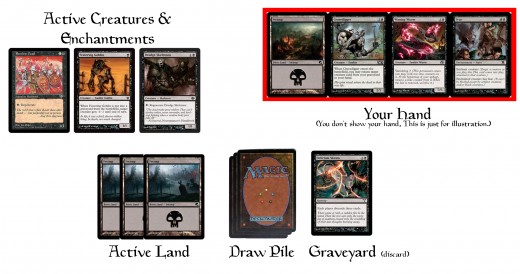
This picture will make more sense as you read about how the game is played, and this is only one example. The most important thing is that it is clear where your cards are, and whether they are tapped or not.
So now might be a good time to explain the different phases of a turn. Here they are:
- Untap/Upkeep/Draw
- 1st Main Phase: Play land, play spells
- Combat
- Enter Combat
- Declare attackers
- Declare blockers
- Resolve combat damage
- 2nd Main Phase: Play land, play spells
- End of Turn / Cleanup
For those that have played Magic before but not in a long time, you may notice that these phases have changed. Seehttp://www.wizards.com/default.asp?x=mtgcom/daily/bb48 for more information on the changes to game play. This is also a good article for beginners to read to clarify game play.
1. Untap / Upkeep / Draw
In the very first round, “untapping” doesn’t really apply since there aren’t any cards on the board. In future rounds, this is when you untap your tapped cards (turn them back to right-side up).
In the very first round, upkeep also doesn’t really mean much. However, once you get to the second round, this is the first phase where things happen before you play a Land card. The only spells you can cast here are instants. Basically this phase is reserved for cards that have an effect on your turn, such as creature, land or enchantment abilities, but not casting the creatures, land, or enchantments themselves. Your opponent can also play instant spells or activate creature/land/enchantment abilities during this phase too.
Then you will draw a card from your face-down deck of cards to put in your hand. In the very first round, the player that goes first does not draw a card on this very first turn, so will still have seven cards. The player that goes second however does draw a card, so will most likely have eight cards after this phase.
2. 1st Main Phase: Play land, play spells
This is when your turn really begins. You can play a Land card if you have one in your hand, and I would recommend doing so at this early stage of your turn. Generally the more Land you have the better spells you can cast. Of course you need to watch out if there are any spells in effect that hurt you because of Lands, or if your opponent might have a card that will destroy your Lands.
Once you play a Land card, you should probably cast some kind of spell. Here’s where things get tricky. A good thing to remember is that if you have no creatures out, you can play a creature before casting any other spells. On the other hand, if you already have creatures out, do not bother casting a creature spell before the combat phase, because a creature cannot attack the turn that it has been cast (unless otherwise specified or under a spell effect that allows it to attack right away, but these are rare).
Another thing to note is that there are several types of non-creature non-Land spells.
These are: Enchantment (also Enchant Creature), Artifact, Instant, and Sorcery.
Enchantment and Enchant Creature spells are in effect permanently until removed somehow by spells or whatever is specified on the card for removal.
Think of Artifacts being just that – items that you cast into the game and have a certain effect or will do something if you pay a particular cost. There are also spells that effect Artifacts, especially Disenchant, which not only removes Enchantments and Enchant Creature spells, but will also remove Artifacts. Sometimes you will also find Artifact Creatures, which you would place in among your other creatures so they are involved in combat, and will be affected by spells that affect creatures as well as Artifacts. Generally Artifacts do not have a color designation, and will not need specific colored mana to cast.
Instant spells are spells that do something immediately, but only once (unless otherwise specified, of course) and then it gets discarded.
Sorcery spells are similar to Instant spells, except that you can only cast them during your turn, and NOT in response to any spell (this will make more sense below). It also gets discarded once you play it.
In older editions of MTG, there was an additional type called an Interrupt spell, which in theory was a “faster” spell than an Instant. An example is Counterspell, which, obviously, counters a spell being cast. The idea was that the Counterspell was faster, so it blocks the other spell, which gets discarded. Now Interrupts don’t exist, and all the cards that were Interrupts are now designated as Instants, but they generally have the same effect as before. There really is only one type of card that would fit an “Interrupt” designation, and those are generally spells that do some kind of spell countering. This became redundant because of the notion of the spell “stack,” which determines the order of spells being cast. Think of it as “last one in, first one out.” If you mentally picture an actual stack of spells as they are cast, this will become clearer. The last spell to be cast is the first one to have any effect. So let’s say you cast a creature spell, and your opponent casts a Counterspell to try to prevent this from happening. Well, you have an Instant spell that makes your opponent pay 2 more mana to cast a spell, and you cast that after he casts his Counterspell. So then your opponent says “uh oh” and realizes he doesn’t have the 2 mana, so his Counterspell is essentially countered as well. Now your creature spell has been waiting in the wings for all this to resolve, so now that you have managed to thwart his Counterspell, your creature spell gets happily cast. Be aware that you can only use Instant spells to respond to other Instant spells – at least this is the general rule. You may have cards that have their own instant effects also. For example, you have a card that when you pay 1 mana will hit a creature or player for 1 point. Well, you can think of those as Instants also, which you can play at any time, but that also goes on the spell stack in the same manner.
3. Combat
Keep in mind that if you don’t have any creatures, then you don’t have a combat phase. Even if you have creatures, you can also choose not to attack unless otherwise specified (some creatures require to attack every round, or they die, or something silly like that). Here is how combat basically works, and this is REALLY basic. There will be another article on more detailed combat situations coming soon. Keep in mind that the “stack” as described above comes into play in combat as well, which will also be explained more in the future article, but this should get you started. And while this is VERY basic yet looking complicated, in actual game play goes much faster than it seems.
Enter combat – You must explicitly inform your opponent that you are entering combat, so that your opponent can decide to do something about it. It’s possible that your opponent may have spells that will prevent your creatures from attacking. Remember, you don’t have to attack at all, too.
Declare attackers – you choose the creatures that you want to attack your opponent. You signify this by visibly designating the creatures as attackers, which is accomplished by tapping the creature cards. Remember, tapping a card means to turn it sideways. It’s important to know that by tapping a creature to attack, you prevent that creature from being able to defend on the opponent’s turn. Some creatures do not require a tap, which is nice because then you can attack and be able to defend with them on your opponent’s turn. Normally though, you do not untap the creatures until your next turn.
Anyway, when your creature attacks, it is coming at your opponent with the attack power listed on the bottom-right corner of the card, and the top number is the attack power. Let’s go back to the creature with a 3/4 designation. So this creature is attacking for 3 points of health from your opponent.
At this point, you and/or your opponent can choose to cast Instant spells, whether it affects the creatures attacking or the players directly. For example, your opponent may cast a spell that somehow removes your attacking creature from the game, or does something that makes your attack not as effective, etc. etc. There’s a ton of things that can happen here. You might want to consider not doing anything to boost your attack power until your opponent declares blockers so you can see if you need to do anything. It’s always good to save spells that you may need later.
Declare blockers – So your opponent has let you declare attackers. This is actually important to make sure that your opponent is okay with those attackers attacking. Your opponent may now assign creatures to block the attack, or just take the damage points. Only creatures that are untapped can block. Even if your opponent has creatures, he can choose not to block with them. Blocking creatures do not tap.
This part of combat may be also used to prevent blockers from being able to block, or do something to the blockers so that their blocking is ineffective, etc. etc. Or you can do something to your attacking creatures to enhance their attack. Either way, please note that at this point damage has NOT been dealt yet. In MTG terms, damage has not “gone on the stack.” So while you are pumping up your creatures to have more attack power, their attack hasn’t actually gone through yet. I know this is probably confusing, but that’s why we’ll be writing more articles. 😉
Resolve combat damage – Both players at this point must agree that they’re not going to cast any more spells before damage gets resolved. Once you let damage resolve, you cannot change the amount of damage being dealt by attacking or blocking creatures. So at this point it is easy to resolve, it’s all just simple math.
If that was really confusing, here is an example of a combat phase. Let’s say you want to attack with a creature that is 3/4. That means the attack power is 3. You have a Giant Growth card in your hand which boosts a creature +3/+3, but I would keep it in your hand for now while your opponent declares blockers. Your opponent has a 4/5 creature in play, and chooses to block your 3/4 creature. This means that your opponent’s creature can block for as many as 5 points of damage, so it will obviously block your creature. At this point you need to look at your creature’s defense vs. your opponent’s creature’s attack power. Your creature’s defense is 4, but your opponent’s creature’s attack is also 4, which means that your creature will die from the attack unless you do something. Well now would be a good time to pull out that Giant Growth and boost your creature to 6/7. So unless your opponent can do something to boost his creature, his creature will die from blocking your creature because it does not have enough attack power to kill your creature, and it does not have enough defense power to survive 6 points of damage. The other point of damage unaccounted for doesn’t carry over to anything, unless your creature has a special ability called “Trample,” which means that the extra damage DOES carry over.
So what happens if you and your opponent have more than one creature each? It gets a little more complicated here.
When you assign attackers, you do not specifically assign a creature to attack a particular target, unless there are special abilities of that creature (for example, a creature that can tap to cause direct damage to a player). After attackers are declared, the player defending can choose to have one or more creatures defend any particular creature, or allow any creature to attack the player directly, unless otherwise specified by special abilities (some creatures specify that if they attack, they must be blocked by at least one creature).
There will be another article about combat coming soon, to get into the nitty gritty of combat strategy.
4. 2nd Main Phase: Play land, play spells
After combat is all over, you can choose to cast some more spells. Now would be a good time to cast a new creature since very likely some of your creatures have died in your attack. You always want to cast a creature during this phase of your turn, and not before combat, because a creature cannot attack on the turn it is cast (unless it has the Haste ability, which does allow it to attack on the turn it is cast, but those creatures are few and far between).
5. End of Turn / Cleanup
You may only hold seven cards in your hand at the end of your turn. If for some reason you happen to have more than seven cards in your hand right now, you will have to discard cards until you have seven in your hand, and the discarded cards go into your “graveyard” (essentially a pile of face-up cards next to your stack of cards). Now in recent expansion sets of MTG, there are many spells and creatures that benefit from discarding cards or having cards in your graveyard. So, this has become a key phase in game play as of late.
Your opponent may choose to play a spell before his/her turn (hence the “End of Turn” step). This is useful for the opponent’s using leftover untapped lands from the opponent’s last turn for mana before the first new turn phase, which is where everything gets untapped again.
In general….
If this all seems really confusing, it may make more sense to play it out. It would also make sense to try to play with someone who has played before, to help you learn the ropes. It’s not too difficult to learn how to play the game itself, but learning the strategies may take some practice and time. Another good thing to have is a friend who actually has pre-built decks. Some cards work well with others, and during game play you will see why. For example, you might have a card that requires you to discard cards in order to play a spell. Then, if you have a card that uses discarded cards in order to play other spells, or enhance that spell or a creature, this becomes pretty useful.
This is just the very basics of MTG, and we hope this helps pique some interest in playing the game.