
I’m big into Greek mythology, so I was pleased to find out about Age of Mythology, a new incarnation based on the original Age of Empires game. I really hadn’t played Age of Empires II: Age of Kings (the last incarnation) for at least a year, maybe two. This game was well worth the wait, and while it took me some time to get back into the micromanagement mode, I still had a great time playing this game and I don’t think I have stopped since I received it.
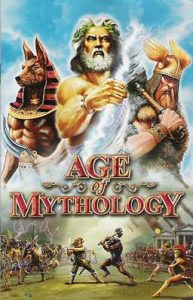
When I looked at the box cover, I wondered what would be different. For starters, the opening cinematic is quite impressive. I swear they modeled the main character here after Ben Affleck. So as you watch the movie, Ben Affleck finds himself in some ruins, where he touches a seemingly dormant statue and then finds himself in a huge battle against forces he’s probably never seen in his life. The suddenly he’s back in his real life, and Ben Affleck walks around some more and touches more statues and is transported again onto the battlefield, etc. etc. It’s actually quite entertaining as long as you imagine Ben Affleck in chariot costume.
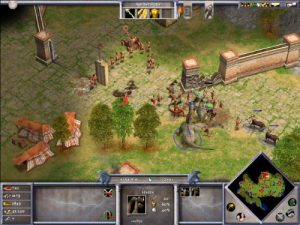 Anyway, as I played this game more and more, I came to realize while the game engine and basic play is pretty much the same as before, the concepts of advancement are hugely different, plus there are many added elements that we’ve not seen before. Right off the bat, a major difference is that are only three civilizations to choose from: Greek, Egyptian, and Norse, most likely because most of us are at least somewhat familiar with those mythologies, with Greek of course being the most commonly known, and also the primary civilization in the game. But, the game box says nine civilizations to choose from? That is because each of the three civilizations can start with a particular alignment to a God. So, for example, you can be Greek, but you have to choose between Zeus, Hades, or Poseidon to be your main God. Each God tweaks your civilization in a different way, by giving you different advancements and myth units, which are special units that are particular to your God. As you advance through the ages (four in all, like previous games), you will choose minor Gods as well, which will add different advancements and myth units. What is nice about this is that you can really customize your game to your style of game play. There are Gods that support economic growth and town defenses, and then there are Gods that support combat and more aggressive battle tactics.
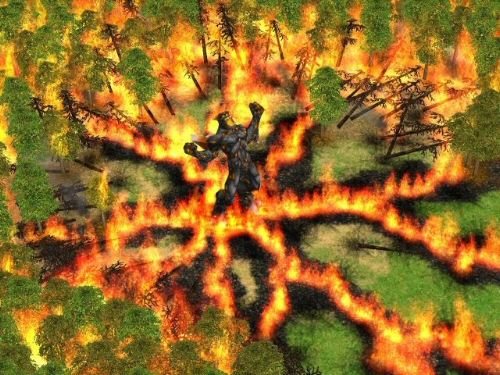
With these Gods come God powers, which is a completely new concept to this game. Remember a game called Majesty? It’s similar, except you can only use a particular God power once in a game, which makes it that much more crucial. In Greek mythology, Zeus is known as the “king” of the Gods, and most people know that he wields a lightning bolt. So, it makes sense that the God power granted by him is the Lightning Bolt strike, which will strike any unit down with a big lightning bolt from the sky. But since you can only use this once, you must use it wisely. When you advance to the next age, you will have the choice between two minor Gods. If you’re unfamiliar with mythology, there are nice explanations of who these Gods are, and what they support, and in fact specifically what advancements, units, and God power they’ll give you in the game. Since there are four ages, you will obtain a total of four God powers, which you can use at any time. Not all God powers are offensive spells – some will support your economic growth for a short period of time. Plus they aren’t so powerful that they would obliterate an opponent completely.
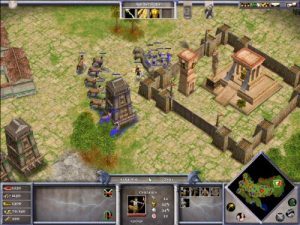 Another major difference in this game is that each civilization is unique from the other in game play. So, it’s not like in previous Age of Empires where the only differences were the advancements and some special units. In each civilization, every single unit is totally different from another civilization, with perhaps the exception of a villager, but even that is different especially for the Norse. They’re even dressed differently! The Greeks are probably the most familiar civilization to those who have played Age of Empires. There’s a Military Academy for infantry, Archery Range for archers, Stables for cavalry, and the Fortress (which is similar to the huge building that shoots arrows and used to provide a unique unit for the civilization) for additional special units. However, to illustrate a difference, the Egyptians have Barracks, which provide infantry AND archers, the Midgol Stronghold which is similar to the Fortress, but provides more units, and also a Siege Works building. Greeks do have siege units but they come from the Fortress. Each civilization has a temple, which provides the myth units based on which Gods you choose to follow.
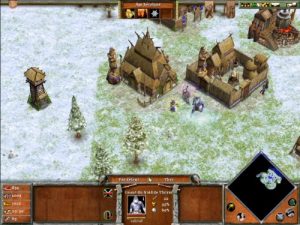
There are also very special units for each civilization, and I’m not just talking about the myth units. The Greeks have Heroes, one per age, which are your strongest units (and you can only have one of each) that can effectively fight those tough myth units. When they die, you can re-buy them at your town center or Fortress. The Egyptians have the Pharaoh, historically it is the king, and in the game it’s an especially strong unit that also has the ability to enhance pretty much everything from speeding up the construction of a building, to speeding up resource gathering, or even converting wild animals to do your bidding if you follow Set. The Norse don’t exactly have special units to this caliber, but they do have dwarves, which are like villagers who can gather gold more effectively, and the Ulfsark which is like an all-purpose infantry unit which build structures as well as fight in combat. Norse villagers can also be converted to Ulfsark units for a small cost.
As far as economic and technology growth goes, you will notice that units, advancements, and buildings may not cost the same between civilizations. The Egyptians rely heavily on gold production, because more of their advancements cost gold rather than food or wood. Also, an interesting thing is that the Greeks have a building called the Storehouse, which is a building that will store both wood and gold, which can be nice if there is a forest right next to a gold mine. The Norse do not have any kind of storage building for resources. They use an Ox Cart, which is like a mobile storage building, which can be used to store any type of resource.
 There is one more type of resource that is new in this game, and that is Favor. Each civilization gains Favor from their Gods in different ways. The Greeks gain Favor by having villagers pray at the temple. The Egyptians build monument structures which generate Favor. The Norse engage in battle to gain Favor. Favor as a resource is used for recruiting myth units and for researching many advancements.
Farms and fishing have been made to have infinite food production, so once you build a farm, it doesn’t go away unless you manually delete it. However, it’s a slower process to gain food from farms and fish than to hunt animals. Again there are farm animals that you can gain control over, vs. wild animals like deer. The animals are also specific to terrain, so don’t be surprised to find lions in the desert. Speaking of lions and such, there are more animals that will attack you if attacked, and also those that will just attack your villagers if they get too close. All animals, regardless, will give you food. Your farm pigs and cows will fatten over time, so it’s good to bring them back close to your town center and leave them there until they stop growing so you can get the maximum amount of food from them.
Graphically, this game is much improved. Each civilization’s buildings look completely different from the others. If you have enough memory and graphic card performance capability, you can also change the camera rotation angle, so you can spin the whole screen around with your mouse wheel (that thing in the middle that you generally use for scrolling), kind of like the movie The Matrix. You can also rotate buildings around if you are going for a particular look. Houses look kind of fun when they are all facing different directions. The units are nicely designed with a great level of detail to be distinguishable between civilizations. Trees will actually fall over when you start chopping them. There are different types of terrain that fit each civilization, but it’s more for appearance than anything else. The play interface is generally the same as before, except the menu for villagers has been simplified – no more having to click on a button to build, repair, etc. etc. all you have to do is click on a villager and the full menu of things they can build or do will pop up. If you want to gather resources you just right click on the resource for that villager to gather. If you want to build a building, you just click on the villager and then click on whatever building you want to build. You can also custom-assign your hot-keys if you are big into using the keyboard (which many power-players are, because it’s much faster than using a mouse). There are some cute chat messages that come from the computer players also, which clue you in as to what they are doing, and where they are at in their advancement.
The scenarios are nice because you start out with some tutorials. For those who have played Age of Empires, they may be pretty easy, but I think they are important so that you get used to the new game. It’s also really cool to see the cinematic for each scenario, which look like mini-movies in letterbox format, and also like you are zoomed in to the ground level so you see everyone’s faces. There are also voiceovers, which are a little cheesy, but kind of neat to have. You can also create your own scenarios, and apparently you can also add your own cinematic, but I haven’t quite figured out how to do that yet.
 Don’t forget that in the main menu when you click on “Learn to Play” you can find cinematics on how to play the Egyptians and the Norse, since they are not included in the main tutorial scenarios (which are based on the Greeks).
The only con to this game so far is that there is a huge difference between the “Easy” and the “Moderate” level of play. I feel that the “Easy” level is great for learning, but once you get used to the game, it becomes entirely too easy and you can build up your town through all the ages without really ever seeing an opponent. However, on the “Moderate” setting, I get my ass kicked all over the place. This would be a great game for multiplayer, because it probably will be easier to survive with more allies.
One of our friends says it’s the best game he’s ever played, and he’s big into strategy games. I think this is clearly a remarkable accomplishment to create a fresh new look and game play to a game that has been around for a while.