
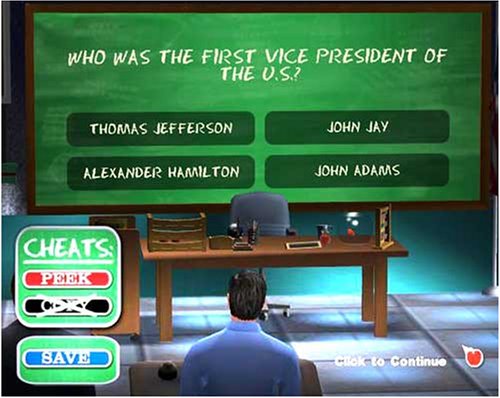
I don’t really follow the game show on TV, but I’ve watched it a couple of times, enough to know how it all works. Are You Smarter Than a 5th Grader for PC recreates the game show environment where you try to achieve the million dollar mark in a single player mode, but adds a few twists to the gameplay with some multiplayer modes.
You begin by creating your avatar and customizing a few simple options: gender, skin color, hair style and color, top, bottom, accessories. Nothing too fancy, really, just something to give you a virtual representation of yourself – or not, since the options are quite limited.
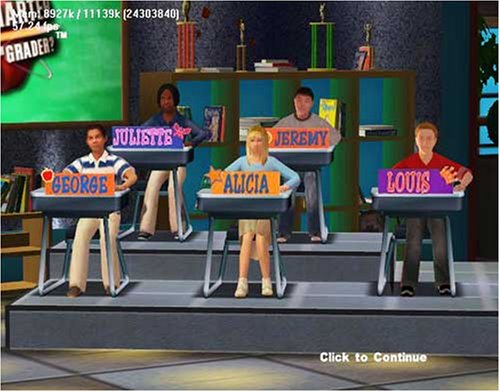
There are a few different modes in Make The Grade: Homeroom, Flashcards, Spelling Bee and Academic. Homeroom Mode is what you know from the game show. You join host Jeff Foxworthy on the set, are introduced to the five children who will be your opponents, and play your way to the million dollar question by picking the subject and answering the respective question. You have three cheat opportunities: peek, copy and save. Peek lets you look at the 5th grader’s answer and change yours if you want. Copy takes what they answered and makes it your answer as well. Save is used for when you answer wrong and they have the correct answer.
Flashcards Mode is for one or two players, placing you against up to three AI-controlled opponents through 10 rounds, to see who can answer the questions faster and accumulate the most money. The longer you take to answer, the less the question is worth.
Academic Academy Mode gives you the same questions for up to four players to answer, which means the family can play together. If you play against AI opponents, then don’t pick all three, or you’ll be waiting for all of them to make their decisions before you get your next turn, and at the end have to watch all of their choices. It becomes a pretty slow and tedious process of watching little cutscenes, so this is best played with only one AI-controlled 5th grader or one real opponent. The same cheats as the single-player mode apply, but here the subjects are picked at random.
Spelling Bee Mode is a game to identify mispelled words, where can you go up against an AI-controlled opponent or a friend for 10 rounds. The value of the questions increase as you progress.
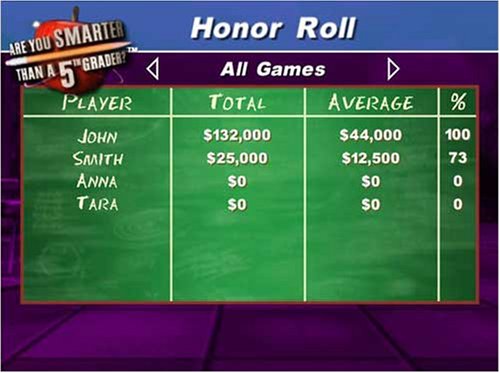
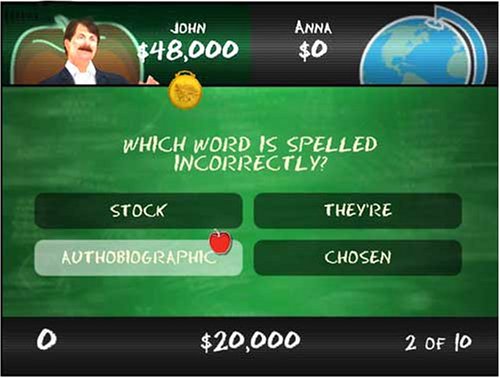
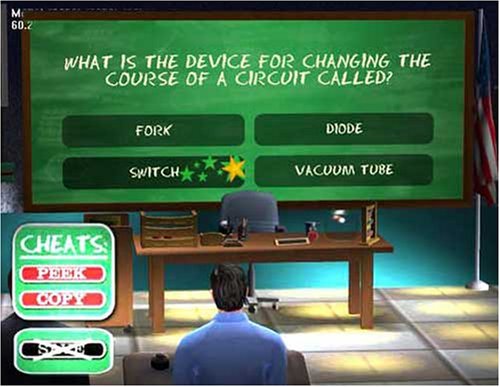
The game features over 6,000 questions belonging to 23 subjects, which include Animal Science, Earth Science, Grammar, Music, Art, Reading, Social Studies, Chemistry, US Geography, World Geography, History, English, Math and Health. Now this would be all fine and dandy, if I had actually gone to school in the US. As it turns out, my education was extremely different. Not only my 1st to 5th grade education happened 25 years ago, but also in another continent, with very different subjects. Needless to say, it didn’t make the game very fun for me when it came to Chemistry (which we only started in 8th grade), History (we mostly concentrated on Portuguese and European history and I’ve always sucked at it) and Geography (starting on 7th grade, with a huge focus on weather maps and forecasts for some reason). Not to mention all my measurements were in Celsius and metric system, so I have no idea what temperatures are in Farenheit nor distances in yards.
And maybe it’s just me, but I’ll admit it… most of the subjects in school I’d study for on purpose just for the tests, then forget all about it when it was over.
As for the presentation, typical game show atmosphere, the theme song from the TV show, and the actual voice of the host. The overall look isn’t too bad, though I prefer playing it on windowed mode, since full screen seems to lose definition.
Although the game itself was tougher than I expected and definitely made me feel very dumb (for the reasons listed above) it was an educational experience. Are You Smarter than a 5th Grader?: Make the Grade is something I would recommend for parents to play with their children, if they are in this age group. No one said learning can’t be entertaining, and turning school subjects into a game show seems to be a good way for kids to revise what they’ve learned.
Special thanks to Kristina Kirk and THQ for providing a copy of this title.