
It’s been a while since I took on a city building challenge of any kind. I think my last experience was with Immortal Cities: Children of the Nile, and I thoroughly enjoyed it.
As well as Egyptian, I am very fond of all things Roman. These two ancient civilizations have always been fascinating to learn about. I have fond memories of Caesar II, since I love city builders and had the chance to enjoy one of ancient cultures I like the most, so Glory of the Roman Empire came as a very pleasant surprise.
The gameplay in Glory of the Roman Empire is divided into three modes.
In Campaign Mode, you are given a series of missions in different cities. Usually, the missions relate to increasing population or city stature, so they’re not extremely hard. You begin by fulfilling the needs of one settlement, and soon your popularity as governor rises and your services will be required elsewhere. Besides, the first few campaign stages actually make for a great tutorial to get acquainted with the interface and the requirements of city building.
Challenge Mode puts you through a series of four random missions, each with different goals. These missions will have certain obstacles that will make your progress more difficult, but you are also given three bonuses from which you pick only one to help you out. Challenge Mode awards you a score according to your progress (monuments built, people’s happiness, number of slaves, plus the total score from challenge conditions, minus the score from the bonus you have chosen). This mode also provides some competitiveness by letting you upload your final challenge score onto an online leader board.
Last but not least, and just like in any city-building game, there is a sandbox option aptly named Free Build. You choose from a range of landscapes and build your city from scratch with no missions to worry about.
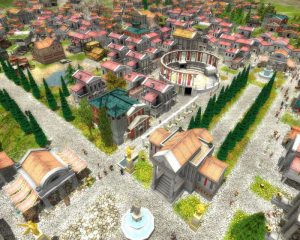
What you need to know about GotRE is that you don’t place buildings and they don’t cost money. Like in Children of the Nile, you only place the foundations on the ground, and then sit back and watch your slaves carry the materials to the site and build it. Buildings vary from residences to support structures (warehouses, wells, herbalist), resouce gathering (mines, clay pits, farms), entertainment (theatre, coliseum) and more (temples, fountains, statues, gardens, baths). The only things you need to build and maintain something are the respective resources (timber, stone, marble, clay). Without resources, your city won’t prosper, and this is where strategy comes into play.
Your citizens will need their houses in range of goods and services. At first, they need food, clothes and water, so the first steps are to make sure there is wheat, meat, flax and water wells. At a certain point, people will want to worship their gods, so you will have to place altars. Altars increase prestige in the vicinity, so any houses in range of an altar will evolve. As you build other facilities and decorations (for example, temples, baths, monuments, a theatre), the buildings affected by them will become more luxurious.
 As you grow and prosper, it will be more difficult to keep everyone happy. Your slaves will eventually have a heavier schedule, and the only way to get more slaves is to obtain gold. Gold isn’t a currency in the game, it’s a trading good, so you either have to mine it or get it from establishing trade routes with other cities.
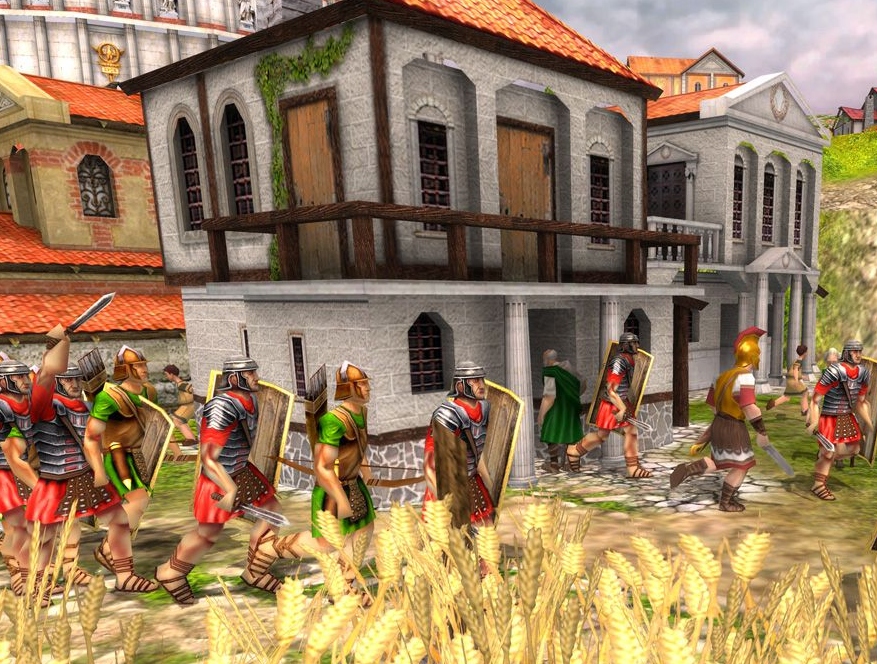
Of course, the Roman Empire wasn’t build in a day, and certainly not without conquest. GotRE also includes a military component so you can create your own army and produce your own weapons. There are barbarian camps in many of the scenarios, so you can set out to invade and conquer before they attack you.
Glory of the Roman Empire is a light take on city building, with no relation to actual Roman historic personalities or events. The scenarios can get pretty wacky at times, with citizens being hit by lightning every other minute, fires breaking out everywhere or barbarian invasions when you least expect it. But they are exactly that, challenging, yet fun.
The Roman fanfare type of music sets the mood without becoming overpowering. The sound effects are minimal and they are mostly used to reflect certain events such as riots, fires or celebrations. You can set the voice to all latin, which is a cool feature and totally worth activating.
Graphically, it may not strike you as stunning, but you can see a good deal of detail in your surroundings, and it’s especially interesting to see the different instances of buildings as they evolve. The characters seem a little blocky and lack definition, but you can observe them go about their daily routines. You can truly immerse yourself in the game by just watching slaves building and transporting materials, bakers baking, prefects carrying water buckets from the wells to put out fires, children playing in the gardens, actors performing in the theatre or a fight in the coliseum.
I did have a small problem with one of the challenges offered. My first mission was to gather 100 gold, but the given scenario offered no gold mines and no trade routes that I could obtain it from. Now that’s a puzzler! How am I to reach a goal when I can’t gather the resources in any way?
My major quirk comes from the requirements. Although the game states that it will run in Win 98, 2000, ME and XP, I had problems with it. I still have Win ME on my computer (yes, I know, I need to upgrade) and Glory of the Roman Empire insisted on running only in 800×600 resolution. Any attempt made to change the game’s options (any options, not just graphical) would boot me straight to the desktop.
I played it with the default settings for a while until I couldn’t take the somewhat grainy look, then migrated to my husband’s XP-equipped computer, where the game actually detected the graphic settings right away. No problems there, aside from observing a few graphical glitches in mountainous areas.
I am pleased with what I’ve seen of Glory of the Roman Empire and I have been playing it quite a lot. I find that it actually makes for a good casual game, since it’s easy to pick up and play, there are no complex management menu screens, and you can play it for a short while and still feel like you have accomplished something. Not many games do that, and especially not the ones that usually give me a fix for my “god complex”.
Special thanks to Ted Brockwood and CDV for providing a copy of this title.