
I can’t remember when was the last time I played a good RPG on my PC, so it seemed fitting to look for one at this point, if only just for a change in the puzzle and simulation/tycoon spree that I’ve been having.
A little while back, I came across a press release for Gods: Lands of Infinity and I was instantly captivated by the storyline and the screenshots. I just had to play it.
Gods: LoI comes to us as the first project from an indie developer all the way in Slovakia. Now don’t get discouraged by the word “indie”, I can assure you the game doesn’t fall into the “short plot and cheap graphics” category.
The story begins with a fairly long intro, beautifully narrated by a woman’s voice. It tells the tale of a war between the gods of Bellarion, and how the God of Darkness discovers a powerful weapon capable of destroying everything. In a last desperate measure, the God of Fire creates a divine avatar and sends it to seek out a counter-weapon in another world. Unfortunately, while traveling to Antasion, the avatar’s powers are absorbed by its existing deities. And so you begin the game as Vivien, a seemingly human girl. Her quest is to retrieve her lost godly powers as well as the weapon that can save the gods and realm of Bellarion.


Vivien starts out as a mix of warrior and mage: she is skilled with a blade but also wields a little magic. Through game progression, you can change Vivien’s attributes to suit your fighting style of choice.
Leveling up is what we know from any other RPG: kill things, get experience, gain a level, get skill points, distribute them among your stats. It’s totally up to you if you want a character to be a strong swordsman, skilled archer or a frail yet powerful wizard.
However, class advancement doesn’t rely on regular leveling. As you will notice by inspecting equipment and weapons, some will require a certain class to be at a certain skill level (Neophyte, Apprentice, Journeyman and so on). This special kind of advancement is done through trainers scattered all over the world, and it costs money.
Vivien won’t be alone in her journey. At certain key points in the story, party members will join her, so the party system is pretty dynamic. You will meet a series of useful characters that will help you in your journey, all unique both in appearance and fighting style.


The combat system offers traditional turn-based mechanics with a strategy element and it’s really easy to get into. Before you set out adventuring or after gaining a new member, you should set your party’s formation, since this is a very important strategy element for combat. You don’t want your casters and healers in the front row taking damage, so arrange them in the back and bring your fighters forward.
Each party member begins a fight by having a certain amount of AP (Action Points). Every action costs AP, be it a change in formation, using a potion (only on self, not on other characters), picking a melee attack or casting a spell. Characters can recover 3 AP (up to a maximum of 10) by picking “Defend” for one turn.
The magic system is interesting. You don’t really learn spells as you level, you find or purchase crystals which you attach to your equipment. Some crystals can only go on armor, others on weapons, and many only on spellbooks. Spells range from summoning creatures to fight at your side, to support and defense or attack. You can drain life from enemies, conjure a giant spider, create a magical barrier around someone, heal, do damage, providing you have the right crystals. Obviously, the most powerful spells and books with the most slots are pretty expensive.
 In fact, character development doesn’t come cheap. Aside from equipment, spells and paying to advance certain classes, you also need to carry a supply of food and water. You can camp anywhere to either wait a few hours until it’s daytime again (because you can barely see a thing at night) or to heal fully. In any case, your characters will become hungry and thirsty as time goes by, so you need to have supplies handy.
Making money in the game becomes a complex process of buying and selling at the right places, since selling what you have looted from things you kill isn’t enough. You will play travelling tradesman a lot, buying in one town to sell in another far away. Have you ever played Tradewinds? It’s the same process: pay attention to who is buying what and at what price, and you can easily amass a small fortune. Your best bets are to buy honey in Petrovce and sell it on the Border or past it, or buy alcohol to sell in the Elven city.
At least, you don’t spend time traveling on the map. Going from point A to point B is a simple point and click process on the world map, provided that spot is on the map already. Accepting new quests will often unlock a new area for you to visit.
In every zone there is a signpost, which is your way in and out of it. To go somewhere else, you click the signpost and are taken to the map. Click the spot on the map that you want to go and you will travel to it. There are also maps for each individual area that will show NPC locations after you have found them, as well as stating what each merchant is buying or selling. Getting lost is pretty much impossible.
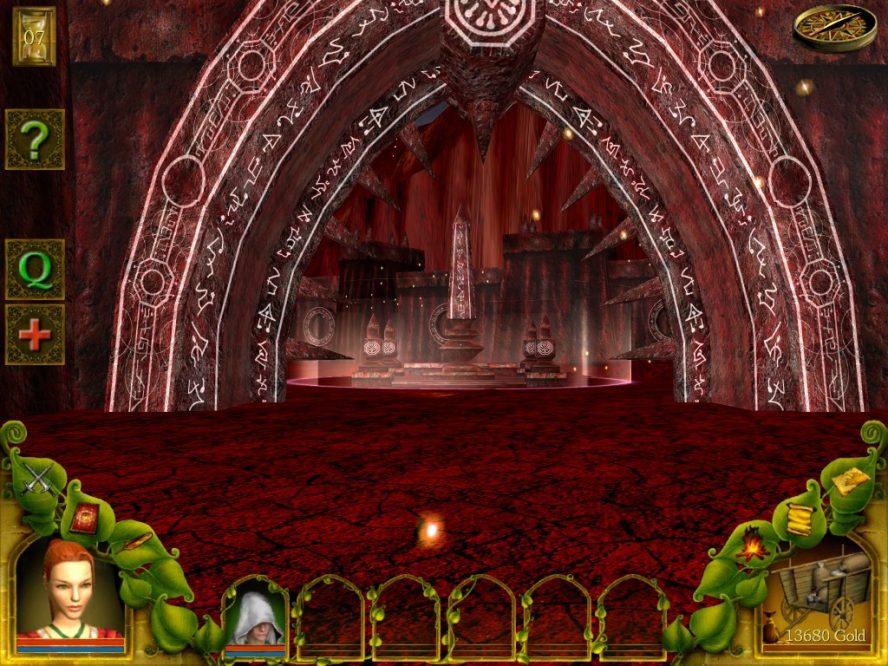
It was in my travels that I became even more enthralled by this game. The graphics are just gorgeous, and everything is so crisp and bright. The world is vast and varied, with environments ranging from busy towns to snowy plains, enchanted moonlit forests and dark musky swamps. The textures are very detailed, and I constantly stopped to admire windows, walls, NPC clothing and even monsters that attacked me. Some of the faces on people were extremely photo-realistic while others had a cartoony look, but you will eventually find them to be repetitive. More original and varied are the textures for weapons and armor, they make each of your party members have their own unique looks.
I was especially fond of the water effects, the reflections of trees and buildings on the gently rippling surface of lakes and rivers were just so realistic. The game also incorporates a day and night cycle (beautiful skies, I must add) as well as weather effects.
Gods also excels in the sound department. The voice acting is very well done, and although not present for every piece of available dialog, it comes across as very professional in key scenes. The sound effects are no less impressive, and they all come down to attention to detail: birds chirping, a weaponsmith’s banging, wolves howling, the “twang” of a bow launching an arrow. The soundtrack is absolutely breathtaking, from the heavenly voices on the menu screen to the orchestrated battle theme or the peaceful melody you hear while walking through elven lands.
All the praise is not to say that the game is flawless.
The first thing I noticed was the need of an English language revision in the dialogs, items and other little things. You will notice “Do you want to enter to Border?” when traveling on the map and the “ingrediences” in your alchemy book “recepies”.
The other is Alchemy itself. There are many ingredients you can find and lots of things that you can extract mana from, but the game never gives you a clear tutorial on how Alchemy works. You can even combine magic crystals if you find out how to. So far I have only found one Alchemy merchant, and he doesn’t sell everything you will probably need. You can pick several herbs and mushrooms all over the world, but I haven’t figured out what to do with them. Plus, you get stuck trying to finish the level 5 Alchemy quest, since you can get to the end of the game without having a clue about where to find those 20 herbs.
And I’m not sure if it’s because I’m running Win ME, because this doesn’t happen on Win XP, but every single time I exit the game, my computer crashes. There are also some graphical glitches in the snowy lands that look like vortexes are escaping from the 3D surroundings, causing lines to appear across the screen when looking in a certain angle. A few random lockups, crashes and being stuck in invisible walls or in fights that never load, make me thing the English version is in need of a patch.
Other than that, Gods comes across as a great first-person RPG that will keep you entertained for a good number of hours (about 20-30). You will meet other great adventurers on your journey, as well as a parade of fantastic creatures including gorons, giant spiders (it wouldn’t be an RPG without them), trolls, bandits and even unicorns.
Gods: Lands of Infinity surprises you with unexpected plot twists until you see the end of Vivien’s adventure. It does a great job of keeping you on your toes with unexpected situations and different party members coming and going. Although it needs a few edges polished, this is a game I would strongly recommend to any RPG enthusiast.
Special thanks to Stefan Pavelka and Cypron Studios for providing the full version of this title.