
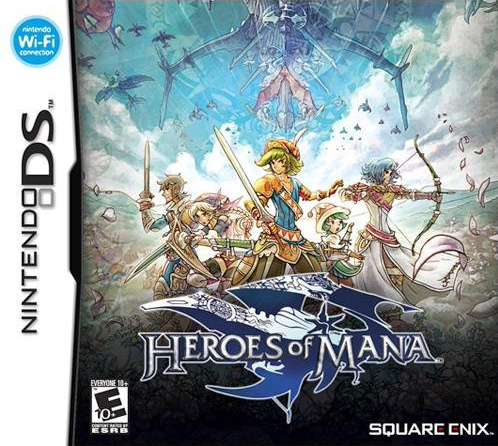
Square Enix has been taking the Mana series into different directions, evolving from a type of gameplay into another. This time around, it takes a turn into the RTS universe.
The story in Heroes of Mana places a group of heroes in the middle of a series of conflicts with Peddan soldiers. The action begins early, with an unexpected turn of events. From there on, Roget and friends stay together to figure out what is behind these events and bring justice to the world.
After the complexity of Ys Strategy, I couldn’t possibly imagine how another RTS would work on the Nintendo DS, but Heroes of Mana is pretty straightforward. The interface is simple enough for RTS beginners, while anyone already familiar with Warcraft and the like will be impatient enough to just skip over the entire tutorial chatter.
Before any stage, you select a number of characters from those you have available in your army. Each character has certain bonuses that affect units within a certain range, such as higher attack power or range. You being with your party members, a few resources and an airship. Like in every other RTS, you must gather resources before you start building and producing units. There are only two types of resources, Treant Berries (to produce units) and Gaia Stones (to build), and none of them lasts for too long, so you must manage what you have available.
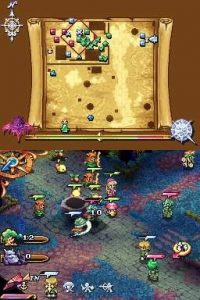 After creating a couple of Rabites (your gatherers) and harvesting some resources, you can start building. But unlike other RTS games, your buildings aren’t placed in the map. Instead, you build them inside your airship.
There are specific buildings for each type of unit, and each type of unit has its strengths and weaknesses. For example, ground units are stronger against missile units (archers), but take twice the damage from heavy units. The relationships of power between the units are explained to you early on and it’s where the strategy resides.
Your party members can also fight alongside with the other units, but keep an eye on their health, since certain stages require certain characters to live. You can also build special facilities such as a healing building which will heal over time any units in range of your airship.
At first I couldn’t see why the heck I should even need an airship, but the concept grew on me after a while. The airship must be anchored in certain spots on the map, and usually there is more than just one hook so you can move around. While moving, the airship can take damage from enemy units though, but mobility becomes handy especially when resources and enemies are far away, or when you want to group up to heal.
Everything is done by simple touches of the stylus. Tapping the airship takes you to the build/production area. Tapping any building inside shows a menu with the units available for production.
Tapping any of the icons at the bottom of the screen selects that particular unit. Using the “group” function allows you to draw a circle to select several units at the same time.
Moving them to a different location is as easy as touching the spot on the map you want them to go. Unfortunately, getting there is sometimes a problem.
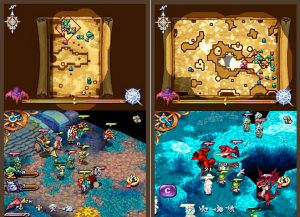 Your troops will take the longest way to the place you have sent them to and eventually you lose track of them. They will get to an enemy and stand around instead of attacking, because they can’t all reach their opponent at once. Or they will be standing there being beaten on, but won’t fight back until you remind them. The pathing is just horrible, and it’s especially frustrating in areas with platforms, hills, stairs and narrow passages, where your troops will end up scattered all over the map. And even in the fastest setting, the units still move slowly, which makes the battles somewhat tedious.
Opposite the poor AI, there is the great story and beautiful artwork. The character art is fantastic, and so are the little cutscenes here and there. The dialogs are really good, but sometimes it feels like there is just way too much text for small scenes.
The game is presented in chapters, and at the end of each you get to save your game and see a summary of the events, so if you want to skip the dialogs, you can catch up on the story like this. Finishing a chapter will also show a stats screen, telling you how well you did and giving you a final grade. It also tells you what items you have found, so you can equip your party before you start the next battle. There is also an added feature lets you swap the top and bottom screens, which makes reading the chapter’s summary, equipping a character or scrolling through the map easier.
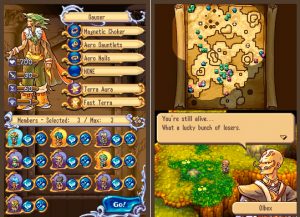 There are many reasons for me to enjoy this game: the characters having active and passive bonus abilities, moving the airship around, the presentation and the music, the great story, the simple and easily accessible interface. What really brings it down is the unit AI on the battlefield.
But when all is said and done, Heroes of Mana is a pretty good RTS. And even if that many not be what fans of the franchise were expecting, it fits well into the many tales of Mana.
Special thanks to Charlie Sinhaseni and Square Enix for providing a copy of this game.