
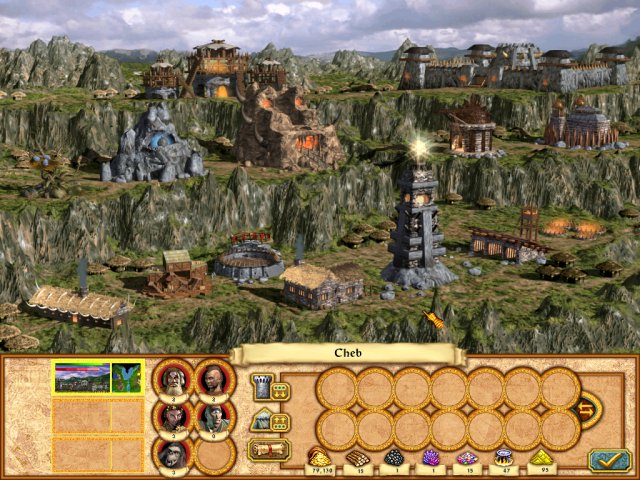
Heroes of Might and Magic IV is a turn-based adventure RPG which captures the essence of the Might and Magic characters and monsters and wraps them in an electronic board game. I had the pleasure of playing and reviewing Heroes II and III, so I was definitely looking forward to Heroes IV. After a few setbacks, the game finally came out, but it was buggy and the multi-player capability was just not there yet. That was a bit disappointing, to say the least – not to mention I was having a hard time playing the game on my computer because it apparently was not fast enough or memory sufficient, even though it did meet the minimum recommended requirements.
A long time later, I discovered that Heroes IV released an expansion, called The Gathering Storm. I read the cover of the game (don’t you love the new compact boxes?) where 3DO finally included the Multiplayer Update. I also assumed that some of the bugs had been ironed out. Plus there was new stuff, which I’ll get into later. So after many months of Heroes IV collecting dust, I bought the expansion.
Heroes IV may surprise you, if you are a longtime fan of the Heroes series. One enormous change is that it just doesn’t look like Heroes. Heroes II and III were very similar graphically, with III being more detailed of course. Heroes IV is definitely more detailed and intricate graphically.
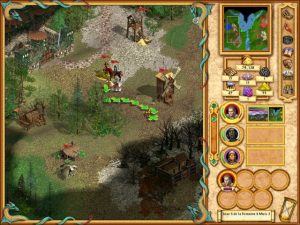 I had a difficult time getting used to combat, and the game play in general. The game concept is similar to the other editions but there are quite a few changes to the way the game is played. In previous versions, the gameplay was fairly straightforward. You have a kingdom, or more than one if you conquer other towns or castles.. You build structures in it that create creatures, generate resources, and support the town and castle structure. You hire a hero to run around the map with the creatures you create from your kingdom, killing creatures and opponents that block your way. You are aligned in a particular race or faction, so your hero and your creatures from your castle are aligned with this race or faction. You pick up artifacts, gold, resources on the map, or you find mines that produce resources automatically. Sometimes you find creature lairs that give you prizes like gold and artifacts. Your heroes gain levels while doing this, and learn skills. In the new version this is pretty much the same. Yet the way this happens is much more complex. Here are a few of the major differences:
Kingdom buildings:
Old – Each type of kingdom has its own buildings.
New – Same as above, except that for creature buildings, (except the first level) you have to choose between two buildings. For example, the “Life” aligned 4th level creature is either an Archangel or a Dragon Golem, you can’t have both generated in one town. Once you choose to build one, the other will be grayed out.
Notes: Marketplaces and Blacksmiths are permanent fixtures and you don’t have to actually build them. To find them, click on the scroll at the bottom of the interface. Also, remember when you built your town up to a castle, you would have turrets that shoot any opponent attacking you? This isn’t the case anymore. Read more below in “Combat.”
Heroes:
Old – Hire a hero from your tavern in the town, which would give you two choices of hero to choose. Usually the first choice is of your race. Of course once you hire that hero of your race, very often the replacement hero isn’t of your race and you have to wait until the new week for a hero of the right race. Your hero brought your troops around the map. They didn’t do much except cast spells during combat. Once a hero dies, you are able to re-hire him.
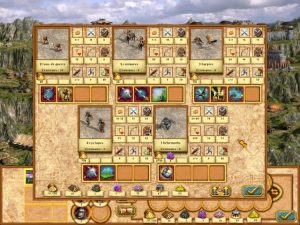 New – You actually have a choice as to what hero you hire, down to the gender and their bio (which is not crucial to the game). You also have the choice to hire heroes from other alignments that happen to have an alliance with you. They are also not required in a party to walk around the map, though it’s more helpful. Groups of creatures can go around the map just fine if they want to. Heroes also take a more active role in combat, as I’ll talk about below. You can also have more than one hero in a party (or no heroes at all). When a hero dies, a number of things may happen. If the rest of your party survives the battle and can get back to your castle or a sanctuary, your hero will magically be revived. However, if the whole party dies, and you lost to an opponent’s army, your heroes become prisoners in the opponent’s castle and you must conquer the castle to get those heroes back (every town/castle has a prison). If your party dies from a random neutral creature army, then a marker on the map appears where the hero died and another one of your parties needs to go back and get that hero.
Alignment/Race:
Old – There were 6 races based on kingdom type (Castle, Fortress, Inferno, etc).
New – there are 6 types of alignments, centered around the type of magic: Life, Order, Death, Chaos, Nature, and non-magic (Barbarians… go figure). Creatures from previous Heroes games have been shuffled around a bit, so they may not be where you think they will end up exactly.
Regular Combat:
There are many differences here, and I may miss some, but a chart should help:
| Old | New |
| Hero can cast spells once a turn (as long as he/she has a spellbook). | Heroes do have spellcasting ability still, but are much more involved in combat. |
| Creatures (both yours and your opponents) take turns, depending on their speed. | This is the same, but now your heroes also get their own turns. |
| High morale may allow a creature stack to repeat its turn in the round. Low morale will cause a creature stack to miss its turn in the round. | High morale allows a creature stack to go first, but if more than one stack has high morale, it’s in order of their speed again. Low morale has the opposite effect, pushing the stack to the back of the turn order, but they do not gain or lose a turn completely. Every stack gets a turn in a round. Morale also affects attack power. Morale is determined at the beginning of the round, which may be difficult to keep track of the good morale and bad morale signals popping up at the same time over different creature stacks. |
| Good luck may increase a creature stack’s attack power. Bad luck may decrease a creature stack’s attack power (though it never used to indicate this during battle). | Good luck lessens the damage a creature stack takes from combat. I don’t know if bad luck actually increases the amount of damage – I am under the impression that there isn’t “negative” luck, but I’m not sure. |
| Some creature stacks have spellcasting abilities, but usually it’s only one spell, or a random spell from the possible spells it can cast. | The creatures that have spellcasting abilities can choose what spell they want to cast. |
| Terrain has no effect on line of sight, but distance has effect on ranged attack which can be halved if too far away (unless there is an artifact or spell effect removing this restriction). | Terrain is much more of a factor in combat. The line of sight affects ranged attacks, which may either make the attacks 1/2, 1/4, or even 1/8 effective. Sometimes the stack or hero may not be able to do a ranged attack OR cast a spell if it can’t see the enemy stack it’s targeting. |
| Two combat formations: tight and loose. | Three combat formations: tight, loose, and square (which is odd, I don’t really recommend it). |
Siege Combat (castle battle):
| Old | New |
| If your Fort is upgraded to Citadel, you have one turret that attacks the opponent with a ranged attack. If it is upgraded to Castle, you have three turrets. | If your Fort is upgraded to Citadel, you have a gate and a moat. If it is upgraded to Castle, you have three turrets that you can use for your ranged creatures to attack the ground opponents. Creature stacks can move on and off of the turrets, too. |
| You have a catapult that attempts to break down the castle walls, or attack the turrets so you can get through to the castle. | No more catapult, you have to beat down the gate itself with your creature stacks. |
| You cannot attack through walls unless with a ranged attacker. | Somehow, you can attack through the wall, but only if each creature stack is standing adjacent to the wall. |
Experience/Leveling:
Old – At level up, the hero gains a point or two on primary skill (attack, defense, spell power, and spell points), and a secondary skill, and can learn a total of eight skills, all of which have basic, advanced, or expert levels. You have a choice from two secondary skills offered at level up. There are 28 secondary skills in all.
New – This is almost the same, except the secondary skills above are more like primary skills, and while each skill does have levels (five in all: basic, advanced, expert, master, grandmaster), it’s not so easy getting there. So there are nine primary skills, each of which has three secondary skills that you must learn to get to the next level for that primary skill. For example, Tactics is a primary skill, but to get to Advanced Tactics you must learn Basic Offense, Basic Defense, and Basic Leadership. Then you may be able to learn Advanced Tactics, if it gives you the choice at level up, and you get three choices.
 The other important new aspect of leveling is that each hero starts out as a particular class type, depending on their alignment. As you level, you choose different primary skills. Depending on these skills, your hero may level to an advanced class, which is a more specialized class. It doesn’t really mean anything additional than what is already happening in the game, though.
Etc.
A totally new aspect is the caravan, which is a kingdom structure. If you’ve played Heroes before, you should be familiar with the fact that you can claim creature dens on the map as your own, where you can recruit that creature type directly from the den on the map. Caravans take it a step further – you can recruit creatures from creature dens and have them travel back to your castle. The distance from the castle will determine how many days it takes for the caravan to deliver your creatures. You are also able to transport creatures and/or heroes between towns, which is similar to the Castle Gate in the old Inferno towns, but it is not instantaneous and generally takes the amount of time it would take for you to travel on foot. However, if hostile armies are blocking the way between the destination and arrival points, you won’t be able to create the caravan at all.
For those seeking the “grail” artifact, in the old game you searched for monoliths that gave you pieces of the world until it reveals the “x marks the spot.” In the new game, these are now called Oracles, and will actually not reveal the map until you find all of the Oracles. There may also be different-colored Oracles in one game that point to different ultimate artifacts, one which may be the grail, others which may be an ultra cool artifact.
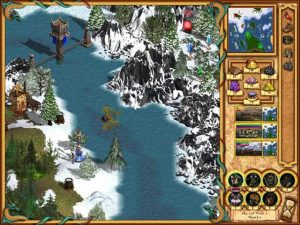
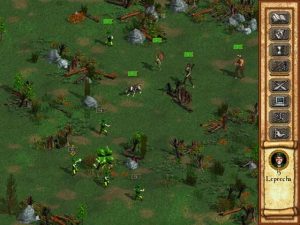 As you can see, there are many new changes and enhancements to the game. The world map has much better graphics than the old game, but I recommend turning the map animations off because it takes up a LOT of memory. The music is beautiful, but if your computer is too slow you might want to turn that off too. You’ll also notice it looks kind of like you’re seeing the world more in 3-D, so there is a bit of perspective in your view, which makes it look a little more slanted. Movement is pretty much the same, except that you can choose to make the creature armies on the map stationary or wandering, which can throw you for a loop when you aren’t quite ready to take on hundreds of fire elementals. There are many more structures on the map than you may be familiar with, but what’s nice is that you can right-click on anything and the structure will tell you what it does, or how it will benefit your party. I just right-click everywhere, even on the terrain it will tell you the movement cost.
I really didn’t like this game when I first played it. I suppose that teaches me a lesson about buying the game right on the debut date! If you haven’t picked up Heroes IV, go ahead and give it a try, but I suggest getting the expansion also just to make sure you’ve got all the updates, plus there are a few extra creature types, more scenario and campaign maps, more music (if you are listening to it), more artifacts, and of course the multi-player update. I would recommend a pretty fast system to really enjoy the game. It’s no fun when your screen gets choppy or things start freezing up on you. I have a 900MHz P4 and it still chops up every now and then, and that’s without map animations. Just remember, it’s definitely still a game that will waste your time away like tomorrow was already yesterday.