
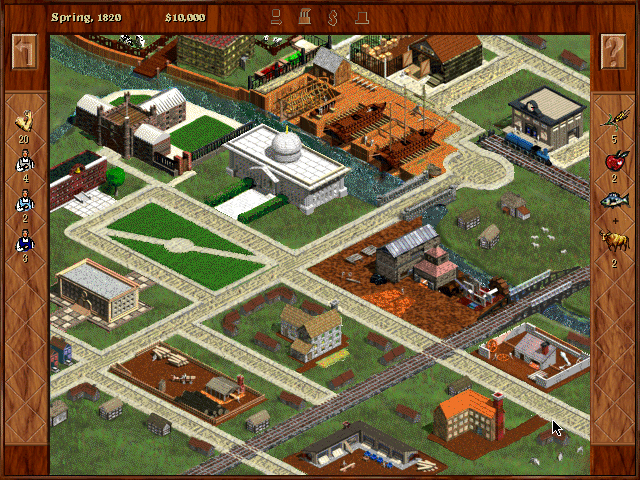
I’ve played this game a bunch of times, and haven’t quite managed to understand all the nuances of the game. It’s fairly complex, and not for a beginning gamer. There are so many little details that don’t make sense if you just dive into the game. You REALLY need to read the manual, or have someone teach it to you.
Imperialism is very similar to the Civilization games, in that it’s not quite real time. I have to say that there is a LOT that I have not yet stumbled upon in this game. It is VERY slow going, not terribly exciting in the first half-hour of play (I’m not kidding with that time frame, either). You can play single player or multi-player, but I have found some problems with multiplayer in that it frequently crashes my machine.
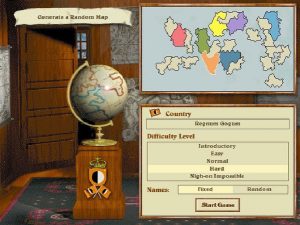 You can choose scenarios of play, which are based on actual historical events, or you can choose to play on a random map. You play as one of the Great Powers, or major countries, among other major countries and smaller minor countries. Winning this game is not based on conquering the whole world. This is imperialism, after all. About every ten years in the game (maybe every hour of play) something called the Council of Governors meets, and votes to support one of the Great Powers. If your country has more than 2/3 majority of support, you win the game that way. It’s not quite that easy to win, obviously. You have to prove yourself economically and diplomatically strong. Not to mention having a strong military, which is also important in this game.
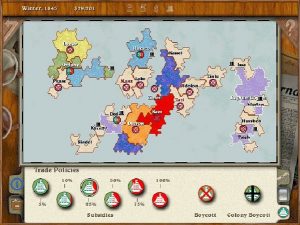 The most important components of this game are: industry, trade, and diplomacy. In order to become more powerful, these all have to be very strong. Military can be strong as well, but doesn’t seem to be as important unless you want to play a conquest kind of game. For each turn of the game, you have five different screens you may view: your terrain map screen, your transport screen, your industry screen, your bid and offers screen, and your diplomacy screen.
There are many different resources in the game which you need to gather to make goods to sell to the minor countries, and you can see them in the Terrain Map. Not only that, you have to upkeep your own country as well. Plots rich in resources are developed by your farmers, engineers, miners, or ranchers, and transport is generally done by rail or freight. Managing your resources can get tricky unless you REALLY know what is going on (which you won’t when you first start playing the game).
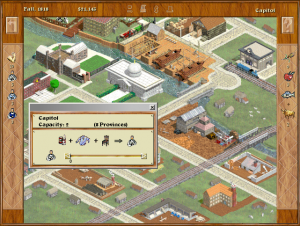 To manage your resources you need a capital city, which in the easier levels is already made for you. Smaller towns are not useful at the beginning of the game, until much later when they start producing some raw materials like steel or lumber. Eventually you will have enough diplomatic power that you will be able to prospect lands in other minor countries, who will then allow you to purchase land to develop for them. This increases good relations between countries. Sometimes you will be notified that a new invention has been made, like the cotton gin for example. These inventions and advancements in technology will allow you to better gather resources, but can be costly.
You can control the amount of resources you are pulling in in the Transport screen. This depends on how much of a rail network you have laid out, and also the amount of resources your trade boats can carry. This is useful if you are running low on a particular resource – you just slide the bars until you are “in the green”. This becomes more crucial as the game goes on and you need more resources.
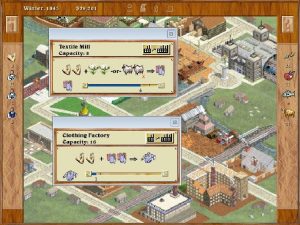 Industry
In the Industry screen you can see what is going on in your town. You have different buildings (with interesting sound effects) that produce from the raw materials you transport in. You have a certain amount of manpower, which you can buy more of during your turn. There seems to be a good balance between what you are using and what you are producing. You need to keep an eye on these things to make sure you have enough raw materials coming in to satisfy the demand. It is very difficult to really understand this balance until you have played the game many many times.
Finally, you can control the amount of items you trade, and you can see the prices they sell for in Bid and Offers.
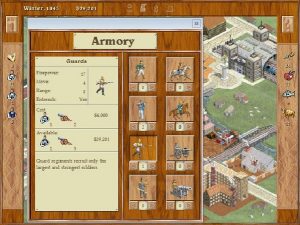
Battle is another story. Like I said earlier, military doesn’t seem to be as important an aspect in this game. However, since war exists in the world, you will need a strong military. There are two different methods of combat in the game: Strategic Resolution, and Tactical Battle. These can be set in the game preferences. The first method basically just computes how the battle should turn out based on numbers. The second has two ways of fighting – you can control all the battles yourself, or you can allow your defense minister (the computer) to fight the battle for you. Wars don’t seem to break out very soon in the game, so you have some time to build up a decent army for later on if you are threatened.
 Diplomacy is a huge key to the game. Diplomacy affects everything you do, especially trade. Basically you want to make all the countries like you. Mostly the minor countries, that is. And when they like you, they’ll buy your products. You can do many things to influence diplomacy, like making embassies, giving trade subsidies (discounts), or even bribing them.
Overall, Imperialism is really quite difficult to understand if you are playing it for the first time. I often found myself just clicking things to see what happens without really knowing what is going on. And the game is very slow, so if you are playing with more than one person, watch the hours go by and the day go away with this game. And you will feel like you haven’t really accomplished anything. It’s almost too complicated to be a really fun game to play.