
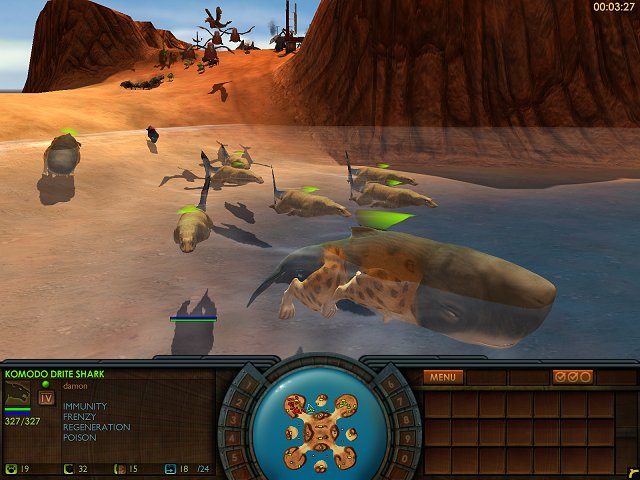
Impossible Creatures is a game whose box makes you do a double-take when you see it – a large snarling tiger head with a scorpion’s body (looking more like it has lobster claws, but maybe that’s just the poor choice of coloring). Below it, in smaller detail, you see a bunch of weird looking creatures that look like combinations of different animals fighting each other. That being said, I’ve pretty much described about 75% of what this game is about.
The story (should you be interested in the campaigns) is the main character, Rex Chance, receives a letter from his long-lost scientist father who wants to talk to him on some remote islands where he has been working on something called Sigma Technology. Rex arrives, only to find Upton Julius, who is your typical bad guy general type, who won’t tell Rex what happened to his father (who has disappeared). Rex finds these strange creatures running about, that appear to be combinations of two different animals. When Julius tries to kill Rex with these animals, a woman named Lucy Willing rescues Rex and explains that she is a friend of his father’s and then tells him the whole story about Sigma Technology. Lucy feels that the technology can be used for good, not for the evil intentions that Julius has in mind (generally to form his own creature armies and destroy those who stand in his way). I haven’t gotten far enough in the campaigns to know much more than that, and to be honest it’s not all that interesting of a story, and there aren’t any detailed cinematics to gawk at. Actually the storyboard style resembles Age of Mythology’s letter-box format, camera pans and fade-outs, which isn’t surprising since this is a Microsoft game.
 I prefer to play a multi-player skirmish game where the objective is simple: destroy your enemies. The tutorial is useful in that it gives you step-by-step instructions on how to build your camp with the appropriate buildings, collect resources, and build creatures for your army.
There are two types of resources: coal and electricity. You collect coal from coal piles which are clearly marked on the mini-map as yellow blobs. Your lab creates henchmen that will collect coal for you. Electricity is collected by building lightning rods at first, then if you find a geyser on the map (looks like a hole in the ground blowing steam), you can build an electrical generator which will collect electricity more rapidly. In the early game, coal is more important – later on, electricity becomes more of a factor in supply and demand.
Your lab also upgrades in Research Level, which affects the structures you can build, and also the creatures you can create (more on that later). Other places where you can do technology upgrades are the Research Clinic (Research Level II) and the Genetic Amplifier (Research Level III). The Research clinic helps with henchmen upgrades and defensive structure upgrades (includes land towers, anti-air towers, bramble fences), and helping your electricity collection be more effective. The Genetic Amplifier is used to upgrade your army’s creatures (the ones in play only) by upgrading stats.
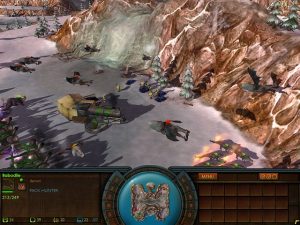 In the campaigns you use Rex to shoot darts at wandering natural animals on the map to collect their genetic data, which you can then use to create creatures in your creature lab. Otherwise, if you want to create your own army, you have to go to the army editing screen and create your own creatures. There are some preset armies available, which I recommend using at first to at least familiarize yourself with the game rather than spend hours trying to create your own army from scratch.
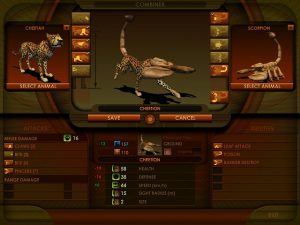
Combining animals to create these genetic monstrosities is the guts of this game. Not only do you have to pick the two animals you want to combine, but you also have to choose which body parts will be from which animal in the end product. Each body part from each animal has certain stats and/or abilities. They also contribute to the cost of the creature and the Research Level your lab has to be at in order to make the creature). Attack abilities tend to come from the head, forequarters, or tail parts. Sometimes special attacks come from other parts of the body as well; you just have to play with it a bit. The only confusing thing about the creature generation interface is the way it compares stats when you are flipping between different body parts, animals, etc. You’ll see green and red numbers, representing pluses and minuses to your choices. For example, if you are trying to decide whether to use a cheetah’s or a scorpion’s head, look at the numbers when you click on the head button on either side of the animal (if you click on the same head button twice, it will flip back and forth between animal heads). A cheetah head brings the coal cost down a bit, and its scouting radius is higher, but the melee damage is lower and health and defense are slightly lower as well. You have to balance these tradeoffs in order to create the perfect creature. Sometimes it is difficult to see where the difference lies – if this is the case, make sure you look at the attacks and abilities (on the left and right sides of the screen), which will light up when chosen, and dim out when not. When you are trying to select animals to combine, take note of each one’s special abilities. Of course, the more abilities, the more expensive the resulting creature will be.
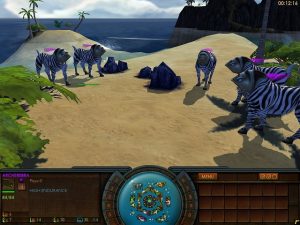 To prevent you from creating all insanely powerful creatures, there is the Research Level designation on each creature you create. It’s a good idea to get a good balance of creatures from each level, so that in the early game you are not stuck with nothing to create before you can upgrade your lab to the next Research Level. This really depends on the game play level – if you are on the easier levels, the computer AI enemy takes longer to attack, so you have some more time to upgrade and get to recruit the higher-level creatures.
The graphics are not terribly complex or groundbreaking. Building graphics are not as detailed as Age of Mythology. It reminds me a little bit of the Warcraft/Starcraft games. There are some cute animations of the structures while being built, but it’s nothing amazing. The camera angle control is also interesting but not a huge bonus as I tend to prefer overhead views, though I’m sure if you pan the angle right you can see the enemy coming from further away from one direction. The general background music is kind of fun swing dance music reminiscent of the decade in which the story takes place.
That’s about it. The real crux of this game is in the army building and creature combining. I’m sure if I play it more, I will appreciate the balancing act of creating ones army, but mostly I am just interested in having fun bashing my enemies with my zebra-legged mountain lions and shark-finned skunk heads.