
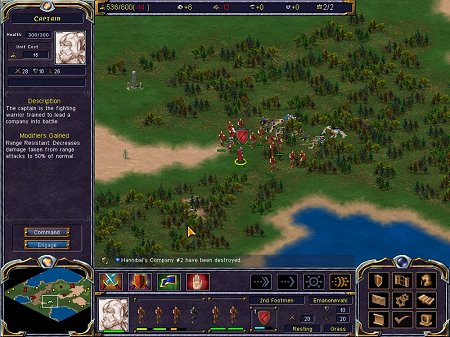
In keeping with the new trend of non-micromanagement strategy games, I found Kohan: Immortal Sovereigns when I was looking through the game aisles and thought the screen shots looked interesting enough to try. I was pleasantly surprised to find a game that was easy enough to learn, yet complicated enough to keep my attention and interest.
Kohan: Immortal Sovereigns has a storyline that you can either be interested in or ignore altogether, but the general premise is that the land of Khaldun was run by a race of immortals, called the Kohan, but their kingdom and culture were all but destroyed by the Cataclysms, a series of disastrous events. Since they are immortal, they don’t truly die, but exist as amulets that can be awakened by you, the player. Okay, it’s a corny story, and not all that crucial to understand while playing the game. You can treat the Kohan as heroes, because in a sense that is what they are in game play. And the Kohan are not entirely all-powerful either: while they do not permanently die, they lose all their experience points if they die and go back to amulet form. Also, it’s possible that they can be stolen by an enemy if your town is conquered. I am not entirely sure if that happens if your Kohan was discovered by a company that was commissioned from a particular town and that town surrenders to the enemy, or if it is because your starting town surrenders. This all makes your Kohan seem more vulnerable, so it is in your best interest to make sure they stay alive as long as possible.
There are four different factions of the Kohan, all with subtle but important differences: Council, Nationalist, Royalist, and Ceyah. The Ceyah is probably the most different from all the races because its focus is on evil (or “shadow”) and the undead. Differences between the factions range from different costs for upgrading cities, slightly different specialty units, and of course, different Kohan. However, during game play you may discover Kohan amulets that are not affiliated with your faction. Also, each of the non-shadow factions has special elite units that are in theory the strongest unit of that faction. It should be obvious that the Ceyah are probably the more difficult faction in game play, but most shadow units have strengths against non-shadow units. Not too many of the non-shadow units have strengths against shadow units.
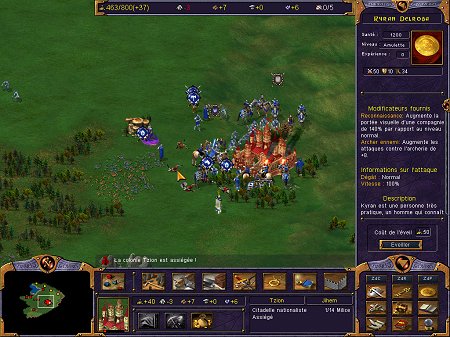
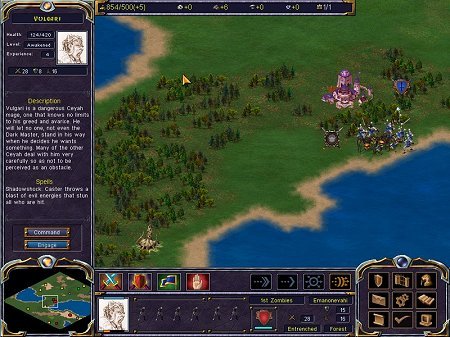
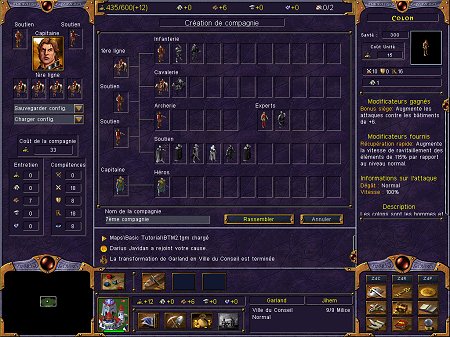
The campaign scenarios are based on the story of the Kohan, which begins after a great big war called “The Cataclysms” that apparently destroyed everything (but not quite). The tutorial scenarios are also very helpful if you have never played a game like this before, and even for those who have, it is still helpful to learn the different aspects of the game. You do not control individual units, but you do have some control in the form of companies. Companies are made up of at most 6 units plus a captain, with 4 units being the front line and 2 units supporting. Only certain types of units can be in the front line, so generally your special magic-using units are in the support line. A Kohan can be placed in the captain’s slot if you have one available.
An interesting thing to note about the map: when you begin your game with your first town, your mini-map is centered to your town, and not to where you are on the map itself, so it leaves you to discover where you are in relation to the edge of the map. There is a way to cheat and figure it out: try scrolling your mini-map screen until it seems to stop at a point. Then scroll it a different way, until you can outline the corners of the map. The map is displayed as a diamond, not a square, so the points are up, down, left and right. The mini-map also does not display the whole map inside of it, which makes it a bit more challenging to get your bearings.
Each town has four levels: village, town, city, and citadel. (I am using the word “town” in general here, even though one of the levels is called “town.” I can’t think of another word to use, so I hope it’s not too confusing.) There are slots to build upgrades to your town, most of which allow you to build certain units. The game uses resources in a similar manner as other strategy games. You are able to build resources in your town, but also you may find mines of resources on the map.
To make things more complicated, there is the concept of “zones” which are very important to game play. There is the “supply zone” which defines an area around your town which grows when you upgrade, but is also an area where your companies can regenerate. A company is not dead until the last unit is destroyed, which is nice because you retain experience even if you have to flee. As long as you can flee back into your supply zone without getting killed, your company will stay alive. A similar effect happens when you actually commission companies: you do not get your whole company at once, you have to wait for them to “come into existence” if you will, so generally I don’t move my companies until they are completely formed. A “guard zone” more immediately around your town is an area which is guarded by town militia who attack any enemy that walks too close to your town. Lastly, the “population zone” defines a large area whose purpose is mainly to define where cities can exist at all. You have settler units that can build new towns, but they need to be outside of the adjacent town’s population zone. These are nice for when you are searching for towns to conquer. Outposts are buildings that contain militia that have the supply and guard zones but not population zones, so searching by zones isn’t entirely foolproof.
Your town itself generates gold for income, so you can build those nice upgrades and also pay to commission new companies. However, your resources directly affect your income if the demand for resources surpasses the supply of resources coming in. Most individual units cost some resources, so you need to be strategic in how you commission your companies. Some of the upgrades in your town also cost resources, although some also generate resources and gold. The more towns you have, the more opportunities you have to obtain income, or spend it!
Once you have figured all the town capabilities, and you have commissioned a company that is complete, you can start exploring the map a bit. You might find mines for additional resources, which need to be in your supply zone of course, so generally you commission a company of engineers to build outposts and mines. There are also random temple ruins or monster lairs which sometimes give you gold, or new technologies. These technologies are those that you cannot obtain normally through building upgrades. Some include entirely new units that you may recruit from your towns if you have the prerequisites. Sometimes you may find Kohan amulets in these temples or lairs. With lairs you usually have to fight creatures guarding the lair, and actually destroy the lair to obtain the reward. Usually, with temples you do not have to fight anything, but just explore them, though sometimes there may be creatures guarding the temple if it is a good reward. Finally, you may see an independent town that has a bluish-grey color to signify its independence from any other player in the game. They will not attack you outright if you are in their guard zone, but if you click on the town and choose to attack it, they will then come out in force. After you have hit a town enough times and done enough damage, it will surrender to you and become one of your towns. You can use your engineers to repair the damages, since if you leave it alone it becomes more susceptible to surrender to other enemies.
Some independent towns are of races that are not from the original four factions, only have four slots for town upgrades, and the town does not grow any larger. The main purpose of conquering these towns is to get more income and resources, and also increase your supply zone so your companies can recover in more places on the map. You can also commission companies from these towns, which are of these different creatures that you are not able to obtain normally through your own towns.
I prefer the Custom Scenario mode, which allows you to use random maps, and some other maps that do not have conquest as the victory condition. However, conquest is the most fun and rewarding. The AI in this game is quite tough, and seems to be one of the smarter AI engines I have seen in strategy game play. If you find playing randomized AI teams to be too difficult, I suggest setting the AI teams to the “easy” AI players, which are denoted as “easy” in the pull-down list of AI teams you can play against. You can play cooperatively with human players as well as competitively, and there is the ability to tribute gold and also make diplomatic ties, though I have never tried to do it with an AI team so I don’t know how they would react to tribute.
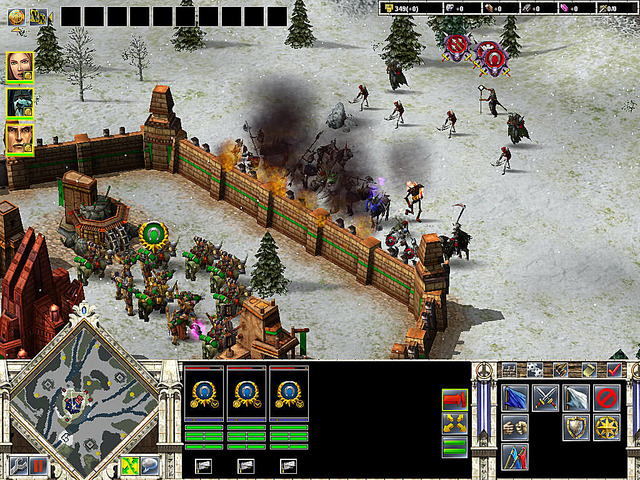
Kohan: Ahriman’s Gift was recently released in November 2001, and is NOT an expansion, but a whole separate game, so you can buy this one instead of the original Kohan: Immortal Sovereigns if you want, since it doesn’t appear that you need one to play/install the other. Game play is essentially the same and has extra units that seem to have balanced out the factions. There are also additional races and improvements in overall game play. The AI seems to be even better in this version of Kohan, and there are, of course, new scenarios.
All in all, I enjoy this game very much because the graphics are quite detailed, down to the random enhancements in the terrain. Venus flytraps in the grasslands snap at you, though in game play they do not affect anything. The story of the Kohan is cheesy, as I said before, but each one has unique abilities and even their own mini-biographies, which makes them interesting enough for me. The one thing I wish I could see is a complete list of possible Kohan, though I suppose this is an incentive to keep playing the game!