
Reviewed by Rebecca Wingandt
During my long quest to comprehend human beings, I’ve found myself baffled more times than I can count how upset you people get over your leisure activities. Dwelling in New York during the Mets-Yankees “subway season” years back was practically taking your life in your hands. Seriously, people, it’s just soccer.
Couple this with the IQ-lowering effects of the Internet and you have a whole bunch of semi-dormant genes waking up to vent impotent savagery on other people about how they play video games. I’m one of those people who’s fortunate enough- and I’m slowly beginning to discover that this is, indeed, a rare sort of wealth- to have a decent number of good friends to play the games that I like, without having to resort to any sort of anonymous, bathhouse-style hookups where strangers fumble awkwardly in the dark mumbling “LFT” from within dingy stalls and leave the lobby one at a time without looking each other in the eye. Plus, I know where all my teammates live, so I can go to their house and kick them in the head when they ruin a game due to friendly fire.
There’s a lot of anger optimistically wrapped up as “passion” about video games, and in this Bizarro Earth that I seem to have slid into, people’s opinions about what they enjoy doing are not only to be taken as global mandates but are undertakings as deadly serious as chucking Patriot missiles into milk factories. I’m saying all this not only because I love the sound of my own voice, but because the subject that brings us here today, Left 4 Dead 2, has in the months leading to its release pitted brother against brother, husband against wife, redrawn national borders, raised the price of gasoline, and made me lose one of my New Rock boots somewhere in the recesses of my closet. I come here not to praise Left 4 Dead 1, but to bury it.
I loved Left 4 Dead. I’ll spare you my lengthy diatribe on the matter, because I’ve already spouted it in a less relevant review. Like a lot of people that come to love an institution, like a favorite television show or movie, I meet the announcement of a sequel with an intense ambivalence: my hypothalamus undergoes a Hulk-like transformation at the thought of “more stuff I like,” but then quickly shrinks to more ladylike proportions at the apprehension of “ruining stuff I like.” Psychiatrists studied an ex-boyfriend of mine who suffered from what is now known as Highlander Syndrome, and from his twitching remains concluded that people will just go and see/play the damn sequel or else forget it exists.
Because none of my reviews are complete without a barely-applicable analogy, I’m going to liken the relationship between games and their sequels to cocaine and crack.
Drug dealer 1: Hey, hey, crack, crack, crack.
Cokehead: Crack? What’s “crack”?
Drug dealer 1: Oh, you’ll love it. It’s like coke, but more.
Cokehead: Awesome. Put me down for 12 kilos. And some party hats.Coca-Cola representative: Everyone! The Coca-Cola company is proud to present New Coke!
Crackhead: (coughs, twitches, vomits on self) New Coke? (passes out, awakens) What’s New Coke?
Coca-Cola representative: You’ll love it! It’s like Coke, but more.
Crackhead: (angry coughing) No way am I falling for THAT twice! (Coca-Cola rep is eaten alive)
Despite my tendency to stockpile canned goods and firearms and bunker myself away from Internet forums, I’ve become aware through the occasional scout party that there was a raging debate over the release of Left 4 Dead 2, and I confess that I was sufficiently exposed to this controversy to form my own uninformed opinion. Hey, hang on there, Valve! I love Left 4 Dead! It’s nearly perfect! I still haven’t beaten every single level on Suicidal solely by whacking people over the head with first aid kits! Don’t mess with perfection!
Actually, this debate was a little more nuanced. The L4D community was understandably nervous that Valve would, upon rolling out L4D2 less than a year after the first one promptly ignore the original, which to be fair was somewhat scant on official content and derived a lot of its replay value from running the same maps countless times and challenging higher difficulty levels and competitive online play. Other people regarded this concern as baffling- after all, everyone loves having another game, and when in the history of the world has a company ever abandoned low-profit support of an existing product line for the crass gains of rolling out a new, incompatible product? Oh, yeah. All the time.
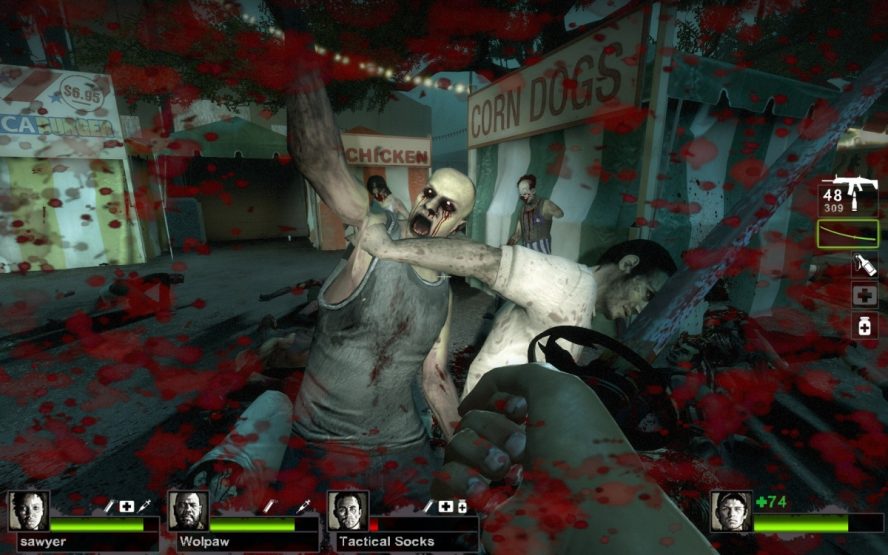
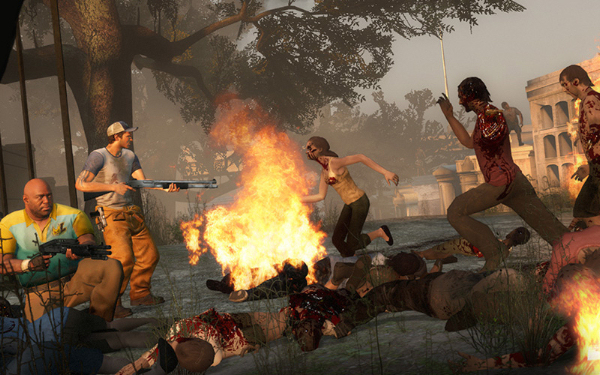
I see a bunch of you are getting up to “go to the bathroom,” so I’ll move on to an analysis of the game itself. L4D2 is set on the Georgia/Louisiana border with four new player characters: Coach, a middle-aged paternal figure; Ellis, a cheerfully optimistic mechanic and good old boy; Nick, a shady gambler and con man in a Miami Vice suit, and Rochelle, a sassy intern reporter in a Depeche Mode T-shirt. The sequel also introduces a few new game elements: melee weapons, ranging from crowbars to frying pans to katana, a few variants on the original firearms (three kinds of automatic rifles, two submachine guns, two scoped rifles, etc.), a new throwable (boomer bile, which allows you to replicate the zombie-attracting effects of its namesake), and adrenaline, which may be carried in lieu of painkiller pills for a burst of energy. Also introduced was a defibrillator, which may be carried instead of a first aid kit to revive a dead player.
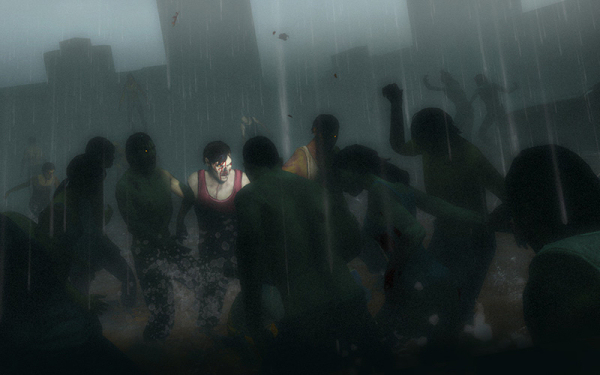
There are a few new play modes, too: any of the cooperative story mode difficulty levels can be additionally modified with “realism mode,” in which dead players must be revived with the aforementioned defib instead of magically respawning, different damage for shooting different body parts of enemies, and the absence of “glowing outlines” of teammate locations when outside of visual range. There’s also a new multiplayer mode, Scavenge, where the infected team attempts to prevent the survivor team from gathering a set number of gas cans and pouring them into an electric generator at “base” within a time limit.
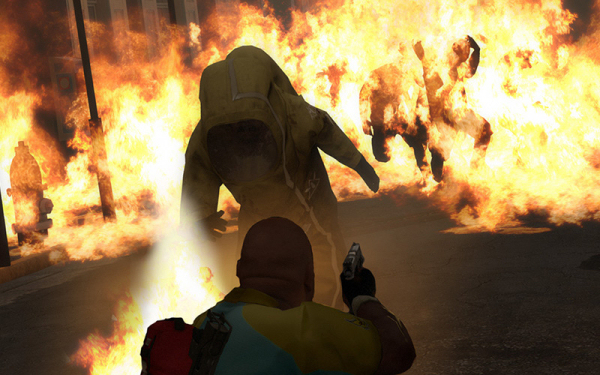
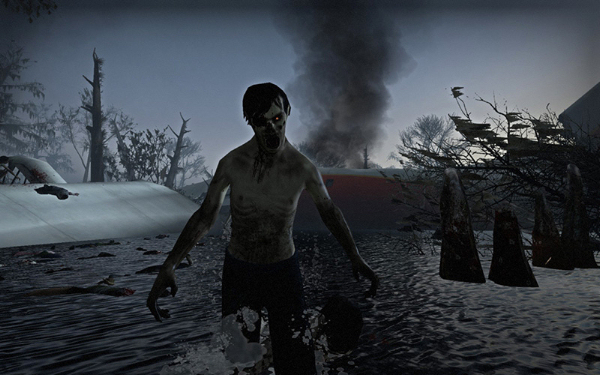
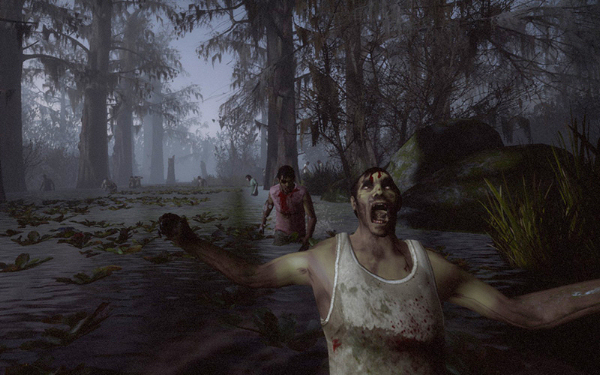
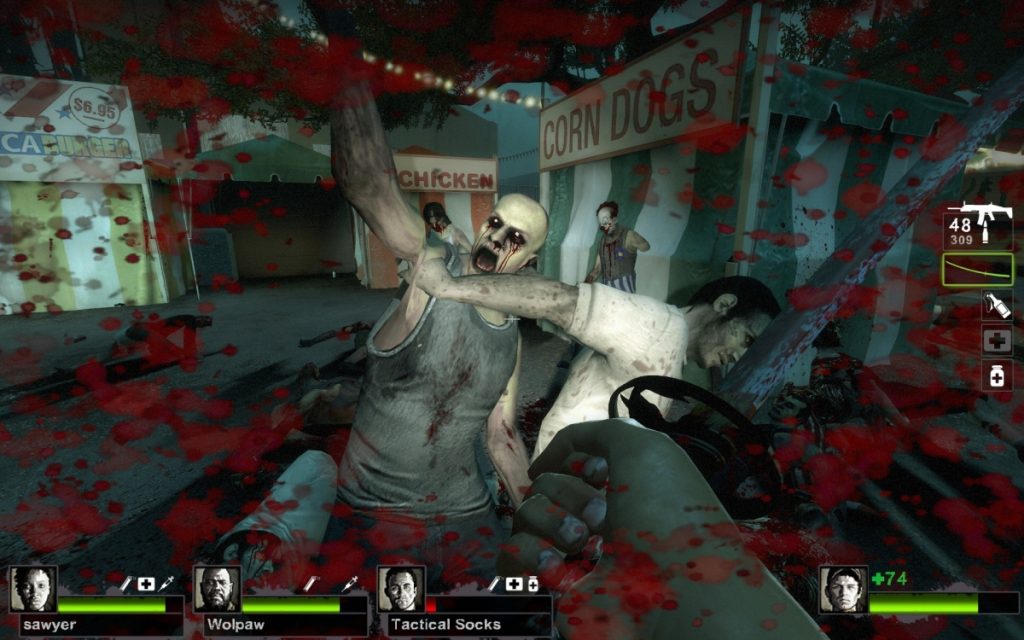
There’s a few new kinds of zombies, too: “uncommon” infected, which are unique to each episode, featuring elements relevant to the environment: downtown, undead riot police still wear their body armor and are impervious to firearms attacks from the front, CEDA agents wear fireproof decontamination suits, and carnival clowns, which are freaking creepy and should be massacred on site and then incinerated to destroy any remains. Oh, and their squeaking shoes attract zombies. There’s mudmen, too. Guess what they do.
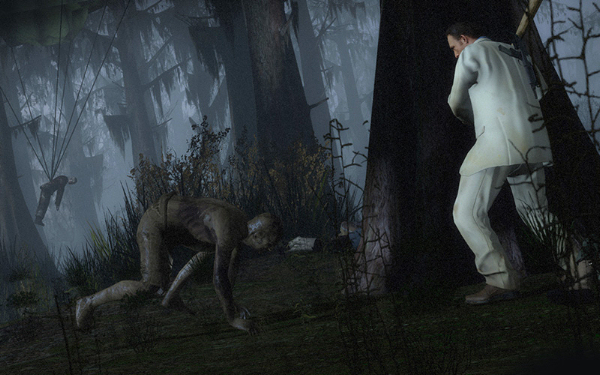
The “rare” infected that drove you absolutely crazy in the original have a few new allies: Spitters shoot ridiculously damaging acid phlegm, Chargers ram you into the nearest wall and pound you until help arrives, and Jockeys act like my goddaughter where they demand piggyback rides and send you careening out of control into danger, like down the stairs or something.
There are also a few variants in level design concerning the “endgame” sequences of each episode. In the original, the end of each episode played out more or less the same: the survivors must hold down a given area and defend it against a continuous horde of zombies until a door opens/help arrives/an alarm stops ringing/the surviving Beatles go on tour again. In L4D2, each episode has its own “escape” mechanic- in one, you must run around a shopping mall, negotiating the aforementioned endless horde, to scavenge fuel cans and gas up a getaway car; in another, you must charge continually forward across a long, semi-collapsed highway bridge to rescue.
There. That’s what’s new to L4D2. You can go now. Do I sound dismissive? I don’t mean to be, but this is where my own personal forum debate begins, and unlike an online forum, everyone uses proper punctuation and grammar and I’m the only one who’s allowed to talk.
I loved L4D. I loved L4D2, also. The survivors were given a lot more personality made manifest in greatly expanded dialogue, interactions, and one-liners. Ellis rambles random bizarre stories if you stand around too long; Rochelle spouts clever non-curses to express physical pain; characters bicker when one or more players hasn’t made it into the safehouse yet. A lot more effort was made to give the survivors enough lines to flesh out their personalities (did ANYONE know Zoe was a film student and horror movie buff without reading it in the promo material somewhere?).
Melee weapons excited the hell out of some of my friends, who were complaining that it was “what was missing” in the original long before they were announced. On the other hand, my other friends ignore them completely, claiming they’re not worth using, and the computer seems to agree- AI-controlled teammates don’t touch the stuff. The greater variety of guns was welcomed by all, but their functional differences weren’t immediately apparent- it took quite a while of monkeying around to realize that the silenced Mac-10 does, in fact, inflict slightly more damage and is slightly less accurate than the Uzi, and so on. Melee weapons were quickly revealed to be identical- the only difference between whacking a zombie with a frying pan and cutting them in half with a katana is that the katana makes me cackle madly and shout in Japanese over the headset and the frying pan makes my friend chuckle and say “spang” a lot. Which is, you know, just fine.
All this, really, brings me to my point. Let’s pretend we’re not talking about any specific game for a moment. Company A releases Game A, to great success. A little while later, Company A releases another product: it features different character skins, new maps, and new weapons to use with Game A’s proven successful gameplay.
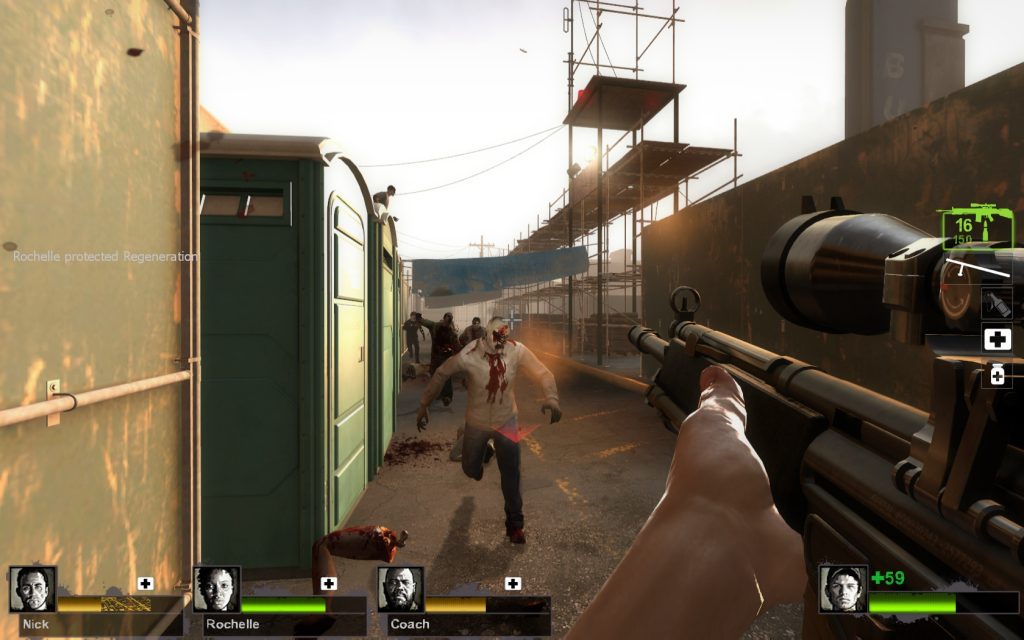
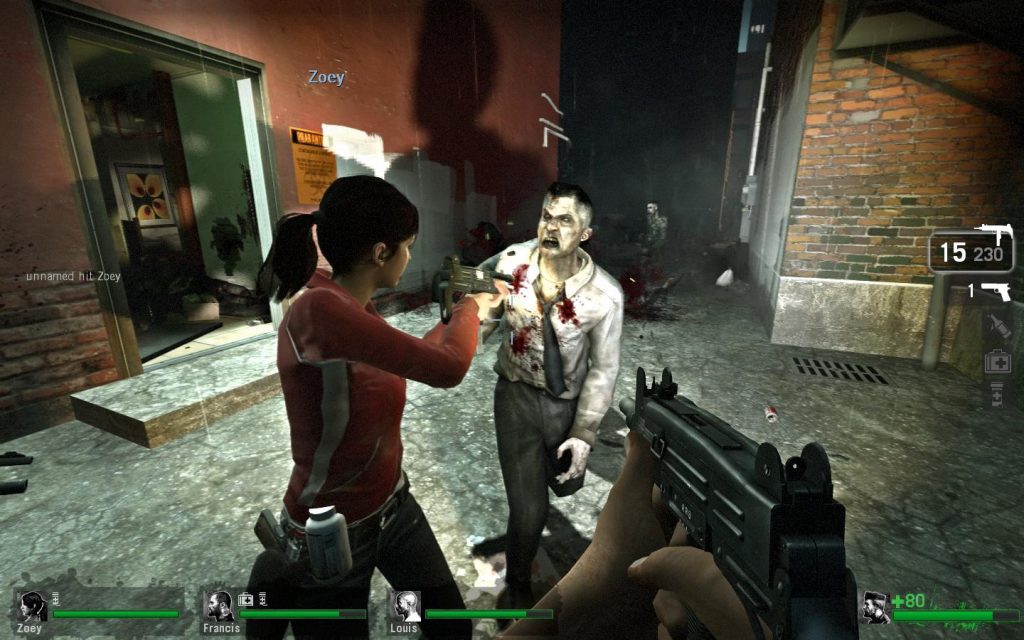
If we were in any other situation, you’d be thinking, “you’re talking about an expansion pack for Game A, right? Or an add-on? Or a couple of premium or possibly even free downloads?”
And that’s the problem. L4D2 feels just like L4D1, because it basically IS more L4D1. It’s awesome, because L4D1 was awesome. It expands on the the stuff people felt was underserved in L4D1, because that’s what new content does. It has a bunch of new maps, because that’s how you keep people interested in the same FPS game for a long time.
L4D2 costs between $40 and $60 USD, just like L4D1 did at release. The average expansion pack for other FPS games, featuring some combination of new maps, new character models, and new weapons, is anywhere from free to $20 at the high end. L4D2 is an expansion pack that makes you buy the core game again, and that’s my only truly negative criticism. Like the Jockey, Steam took me for a $50 ride.
So there you have it. L4D2: it’s like crack, but more. Make of that what you will.