

Reviewed by Brandy Shaul
From what I had learned about Lux-Pain before its launch, that players would take on the role of a member of a secret organization out to stop a plague that was taking over Japanese citizens, I was greatly intrigued. Furthermore, after learning of the game’s graphic novel qualities, I wanted the game even more. However, forgiving the cliche, these pre-release statements wrote a check that the final product ultimately couldn’t cash.
Lux-Pain is indeed about a secret organization, called FORT, that is out to stop a plague that has spread through 10,000 people and counting, but the rest of the storyline is a convoluted mess. If you are daring enough to ignore my warnings against a purchase, you’ll soon learn that people have worms crawling through their bodies, but these worms aren’t the kind you’d stick on the end of a fishing hook; rather, they are more like spiritual blocks of emotions… I think, with the whole disease being referred to as SILENT. Why? I have no flipping idea.
Worms come in different colors to represent various emotions: red worms are for anger, blue for sadness, and so on, but how they ended up inside these people in the first place is a mystery. The game tries to explain their appearance by introducing you to the concept of the “Original,” the first person infected with SILENT, who spread them to everyone else (again, through an unknown process), but that does absolutely nothing to help in your understanding of the story; in fact, it only makes it worse, as it still doesn’t explain how the Original was infected at the beginning of all of this.
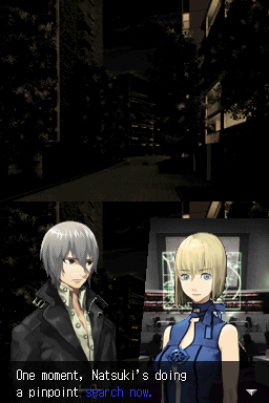
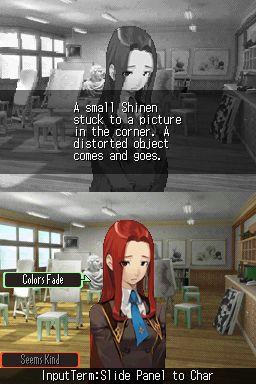
Without so much as a tutorial of the controls or your goals (what few there are), the game sends you through countless blocks of text as you literally read your way through the vast majority of the game, taking very few breaks to actually interact with the title at all.
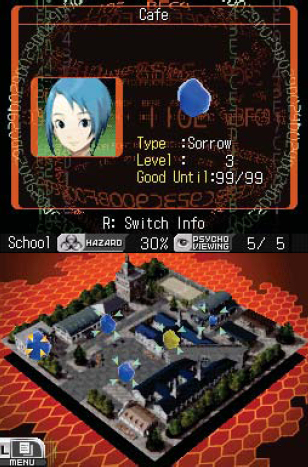
The basics of “gameplay” see you tapping on various locations throughout Kisaragi City as Atsuki, a FORT agent sent undercover in the local high school to figure out why everyone in the school has been infected with SILENT.
Since people aren’t aware that they have been infected (from what I could gather, the disease’s only real side-effect is an increase in violent and/or suicidal tendencies), Atsuki has to use his Sigma System ability to freeze time, scan the person’s body for worms and then transform them into “terms,” thereby translating each block of emotions into words that the reader can understand… in theory.
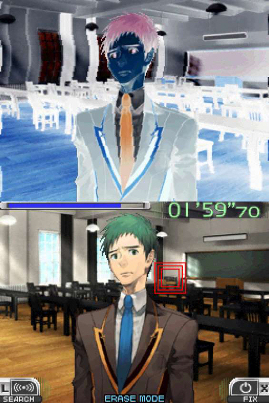
Finding the worms themselves makes up the majority of your own actions within the game. Both screens display either the stationary character or background environment you are currently scanning, with the top screen taking on a sort of ethereal glow which presents clues as to where worms could be hiding, in that they show up as bold circles on the screen. Since these worms are far from stationary, however, you’ll have to spend quite a bit of time searching for them by tapping on the touch screen until your tap causes a red square to pop up, letting you know you’ve found one.
Afterwards, you quickly switch to “Erase Mode” with a press of the L button and literally erase the colorful image on the bottom screen, revealing the same ethereal glow that’s present on the top, along with any worms you are trying to uncover. Once you expose a worm, you simply tap and hold on it for a few seconds until it is transformed into a term, and the scanning segment ends.
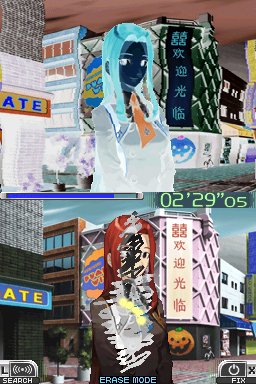
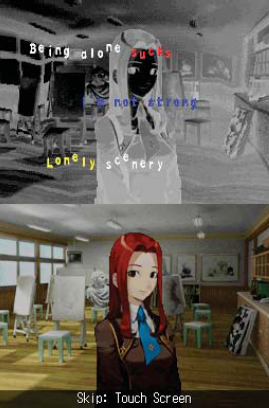

While you have an infinite amount of time to find worms when scanning stationary backgrounds or inanimate objects like computers or notebooks (because, apparently, people who are infected leave worms / emotions behind on items they interact with), when scanning a living creature, you have a limited amount of time to find the worms before you cause irreversible damage to the host, like memory loss or other brain trauma, and receive a game over screen.
As if all of the confusing factors leading up to this moment weren’t enough, once you have converted all of the worms within a person to terms, you are then required to imprint those terms back into the host in order to read them. If you’re keeping track, that means that I just spent the last 3 minutes digging a spiritual worm out of a person only to put it back in. My brain hurts.
More annoying still is the fact that most of these emotions concern insignificant portions of the story, like what the character in question thinks of Atsuki – “he has nice eyes” – and gets you nowhere in the overall scheme of things, at least not within your own mind.
The game seems to think that these interactions are important however, as everything Atsuki learns from them will be spelled out for you in even more text blocks. But, just like everything else within Lux-Pain, how Atsuki deducts anything from his mental scanning is completely lost on me, and after just a few chapters, I was simply going along for the ride, hoping that things would pick up after the game’s terrible introduction (they didn’t).
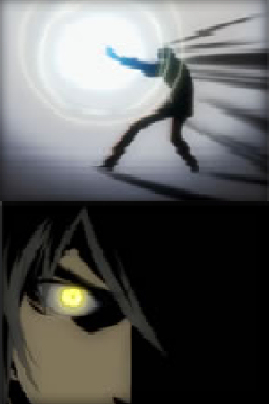
Disappointing “gameplay,” and I use that term lightly, aside, the one thing that Lux-Pain does have going for it is its overall graphical style, that being one of traditional anime stylings, complete with exaggerated facial and bodily features and hair colors that you can normally only find in a bottle. Likewise, the soundtrack is quite good, comprised of dark and gloomy music that is befitting of the game’s focus on emotions, along with voice acting on a large chunk of the dialogue within the game.
However, the above actually causes another large complaint within the title, as the game’s localization is a disappointing flurry of grammatical and punctuation errors, along with a mix-matched assortment of printed text and spoken word that coincide only on occasion. Even though both the written word and the voice acting attempt to convey the same ideas, trying to follow along with both in tandem is downright confusing to say the least.
To put it bluntly, Lux-Pain is a disappointing, torturous, long-winded affair that has very little going for it. If you are a gluten for punishment, by all means, give this one a go. But everyone else should stay very far away.
Special thanks to Danielle Amorin and Ignition for providing a copy of this title.