
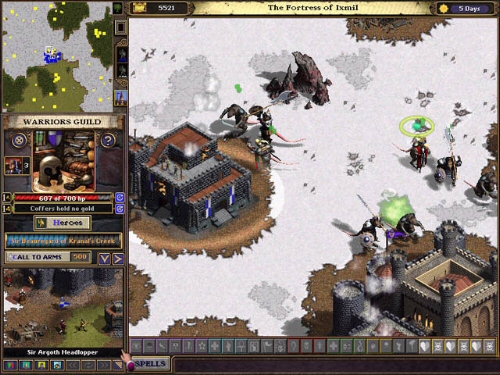
This game has been out for a quite a while, but when the original came out, it was a welcome change from the micromanaging strategy games that I was used to playing (e.g. Starcraft, Age of Empires/Kings). I had pretty much burnt myself out staying up late nights with friends on networked computers with games that lasted for hours because everyone wanted to build their troops to astronomical proportions before delivering the final blow. By that time it would be 2 am and we’d be hopped up on many caffeinated beverages, some of us bored out of our minds with the monotony, especially those who ran out of resources an hour ago.
The point: Majesty takes away the individual unit management, and instead makes you the “sovereign” force behind the loyal troops. Certain buildings create specific units, and also provide you with sovereign spells that act somewhat like the “hand of God” during game play. Your units, on the other hand, have a mind of their own, and wander about the land doing various tasks specific to the unit type. Cyberlore calls Majesty the “Fantasy Kingdom Sim,” to conjure up comparisons to simulation games like Sim City.
The bare bones Majesty game begins with a Level 1 castle that comes with a few castle guards, peasants, and a tax collector. Your peasants build the buildings you request, and the tax collector collects gold from houses that appear according to the population of your town.
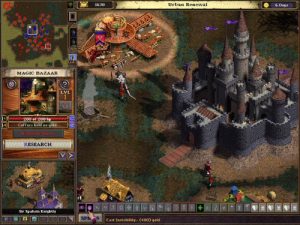 Some of the first buildings you are interested in selecting are guilds, which contain your first combat units: warriors, rangers, thieves. There is a cap on the number of units per building, and it gets exponentially more expensive to build more than one of the same type of building. As your castle advances (up to Level 3), some guilds have the ability to generate secondary unit types, plus you have more building types to play with. Be careful though, there are choices to be made… certain guilds don’t “get along” with each other, so if you build a Healers guild (life), you may not build a Priestess guild (death). Apparently Barbarians don’t get along with anyone, so if you build that guild you cannot build other higher-level guilds.
Other buildings that contain units may help with some combat, but mostly have other uses. Gnomes are available with a Level 1 castle. Basically they are a bunch of little dorks that run around and help peasants with construction, and are not very useful in combat. Also, once you build a gnome hovel, more just start popping up randomly, which can be inconvenient if you were meaning to build in a particular spot. Dwarves and Elves are available starting with a Level 2 castle. Dwarves are slow-moving creatures that assist with building construction, and also are not so bad with combat. Their guild building also has a built-in ballista that shoots at monsters. Having a dwarf’s guild allows you to also build mini-ballistas around your kingdom to aid in self-defense. Elves are quick and fleet-footed and attack with a bow and arrow. However they also generate gambling halls and elven lounges where your units may be more interested in visiting rather than fighting.
Oh, of course each individual unit has individual stats and abilities, and experience that they gain from combat or training, but who really cares? We didn’t want to micromanage them anyway…. However, higher-level units are better able to fend off the nasties with higher hit points and fighting ability, so it’s in your best interest to keep them alive with a watchful eye.
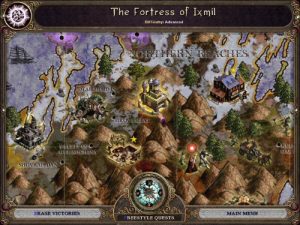 The terrain generally contains creature lairs, which generate the creatures that attack your units and your town. However, sometimes creatures will just appear from off the screen and wander into town, and some may even spontaneously appear in the town itself, which can throw you for a loop if your troops are off wandering the lands looking for creature lairs. Also, as your population grows, so do your sewer systems, which generate stinky rats and sometimes, occasionally, giant ratmen (must be something in the water).
While you may think it’s a bit haphazard to have your units running amuck without direct control over them, you still do have some ability to influence their decisions. You are the sovereign, after all! And don’t forget those spells that you have at your disposal. However, it does cost money to cast spells, so use them sparingly.
Your units also talk, so expect to hear a lot of chatter. It’s generally useful to listen though, because it indicates the status of the unit, especially when it dies. Sometimes they will just sit around and say random comments, which is always fun to catch.
Other than combat, there is an important element of commerce to the game. After all, you do need money to run the kingdom. You can obtain gold from collecting taxes from buildings that generate gold. Sometimes there are treasure chests on the map, which your thieves are quick to spot and loot. Some creature lairs also contain gold for looting. Most creatures also have a certain worth, which gets split between all the units involved in fighting the creature when it dies. Units will bring the gold back to their guild, a portion of which gets collected by the tax collector, or gets spent in commerce-specific buildings, which often have goods (weapons, armor, magic potions, etc.) that your units will buy with their hard-earned cash. By the way, it is in your best interest to keep an eye on the tax collector, because he is vulnerable to attack. The tax collector generally brings gold back to the castle, but you should build some guardhouses around your kingdom, because not only do they generate guards to protect your buildings, but they also provide a place for tax collectors to deposit money from more remote locations.
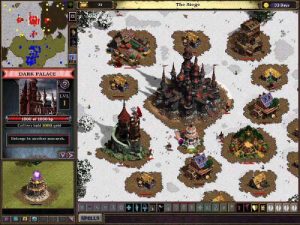 I find that keeping track of the money in the game can be somewhat puzzling, mostly when it comes to looking at how each unit handles their money. Eventually you do will have enough money to sustain yourself easily, but in the beginning of the game you may find yourself running out of money. The Thieves Guild allows you to extort money by getting the tax money available all at once, with a price. The Marketplace also has a “market day” function, which allows you to get money generated from the marketplace immediately, but then the market shuts down for a period of time. It is now getting more complicated! There are many more aspects to the game play itself that I will leave up to you to find out.
There are single-player quests, random map freestyle for both single player and multi-player. Multi-player games are inherently co-operative, though you can decide to attack by setting bounty flags on your opponent’s buildings. There are no computer-controlled sovereigns. In the Northern Expansion, there are more quests, and some more support buildings to add more depth to the game, such as Magic shops that carry potions with different spells that your units can cast on themselves (though you have no control over which ones they choose). It also contains the Freestyle Editor and Build Tree editor (which I have yet to use), where you can create your own quests.
As far as game performance, I noticed that as your kingdom gets larger, game play could be compromised if you don’t have a good amount of memory and a decent video card. I noticed this more in multi-player games than single-player games, which can become painfully choppy when the game advances to a certain point. I recommend going well above the minimum requirements if you are going multi-player.
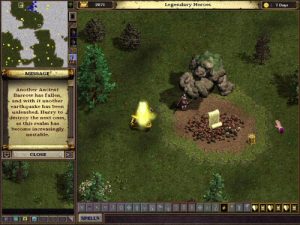 I should emphasize that this sim-like approach to real-time strategy doesn’t necessarily make the game any less complex. In fact, it is quite challenging to try to convince your units that you really want them to attack this creature lair, or to keep track of them dying off… because of decisions that were downright ridiculous. I have seen my mages hurl energy balls for attack against a vampire, but the vampire has the “magic mirror” spell, which reflects magical attacks. Since mages don’t attack hand-to-hand, they die too easily around vampires. Sometimes I will see a level 10 warrior run away from an opponent it could easily take down.
Majesty is a very unique type of game and I think has seen a good following. Their web site has a good amount of information about the game (though it’s not completely updated in some areas), and also demos to download in case you want to try it before you buy. And if you really get into it, you can enter Majesty gaming contests that Cyberlore holds from time to time. I have yet to reach that level of gamer-geek!