
If you’ve read any of my other articles about trading cards, you’ve probably picked up on the fact that I am much more of a trading card collector than a trading card player. That isn’t to say, however, that I don’t enjoy a good beat down using monsters on paper. So when I got the chance to experience the newest set in MapleStory’s iTCG lineup, OMG Bosses!, I was more than willing to oblige.
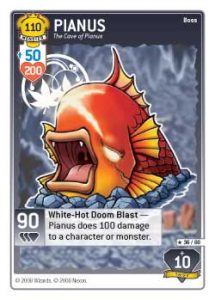 Of course, before you can start any game, whether tabletop or otherwise, you must first understand the rules. In the MapleStory iTCG, cards are split into four categories and four colors. The four categories split the cards into characters, monsters, items and tactics, while the four colors (green, red, grey and blue) further enhance each card by placing it in the line of Bowmen, Magicians, Thieves, and Warriors, respectively. Of course, before you can start any game, whether tabletop or otherwise, you must first understand the rules. In the MapleStory iTCG, cards are split into four categories and four colors. The four categories split the cards into characters, monsters, items and tactics, while the four colors (green, red, grey and blue) further enhance each card by placing it in the line of Bowmen, Magicians, Thieves, and Warriors, respectively.
Character cards are different from the other three categories in that they are not included in each player’s deck. Instead, you choose a character to begin the game with, and place it on the playing surface in front of you as a team leader. After each player has their decks and characters situated, the gameplay begins by drawing cards for your hand. |
You can use cards from your hand to level up your character on each turn, which add HP and abilities to your character’s roster. These abilities are found in the bottom section of each card, with each ability having a minimum level that your character must be in order to use it. Some abilities are a “one time only” deal, while others add different “understood” party members to your team. For instance, if your character is a Warrior and you place a Bowman card under it, you now have access to Bowman and Warrior abilities, as if you added a Bowman to your team.
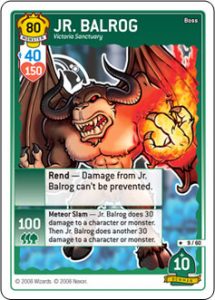 Monster cards come into play in the form of attacking, which can be done once per turn. Your monster cards can attack either your opponent’s monsters or their actual characters. Like in most other trading card games, each character and monster, including boss cards, have a set attack strength and set amount of HP with which to work with (with the character HP being changeable in the manner we discussed earlier). Turn after turn, each player takes their stabs at attacking, leveling up, etc. until one player has eliminated the other’s party leader. Monster cards come into play in the form of attacking, which can be done once per turn. Your monster cards can attack either your opponent’s monsters or their actual characters. Like in most other trading card games, each character and monster, including boss cards, have a set attack strength and set amount of HP with which to work with (with the character HP being changeable in the manner we discussed earlier). Turn after turn, each player takes their stabs at attacking, leveling up, etc. until one player has eliminated the other’s party leader.
There are other complexities to take into account in terms of actual gameplay, and while it may seem like there’s already been a lot to keep in mind, it didn’t take myself and my sister long to get into a good pattern of gameplay. I won, by the way. Adding to your card collection is simple, and can be done by way of the $9.99 starter pack, which includes a complete deck and booster pack as well as two character cards, or by way of booster packs, which sell for $3.99. |
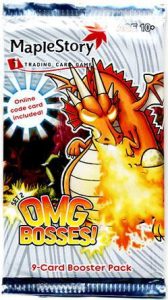 Each booster pack advertises the online gameplay available, by indicating that code cards are inside, but in normal booster pack fashion, there is no way of telling which code card you’ll get. And of course the packages don’t lie; each booster pack contains at least one online code, with “at least” being the key phrase in that statement. Each booster pack advertises the online gameplay available, by indicating that code cards are inside, but in normal booster pack fashion, there is no way of telling which code card you’ll get. And of course the packages don’t lie; each booster pack contains at least one online code, with “at least” being the key phrase in that statement.
With that said, I was a bit apprehensive as to how many times I would actually run into a double code card scenario, but in the end, I am very happy to report that out of my ten packages, six packages had two codes each! Another positive aspect to note is the simplicity of redeeming codes. After logging on to the world of MapleStory, you simply click on Cash Shop on the lower menu bar. Once there, you click on the Code button and are allowed to enter said code. Just like that, you’ve unlocked your special prize, whether it be items, pets or otherwise, and can immediately interact with those items back on the actual gameplay screen. |
All in all, the MapleStory iTCG is great for card collectors and card players alike. The animations are creative and detailed, with fanciful weapons and monsters being presented in full color on the top portion of each card. There may be a lot going on in terms of attacks, info, etc. on each card, but nothing seems too cluttered. Boss cards are especially impressive in that they contain a much larger picture than the other cards, which shows off the menacing stance each boss takes.
Even though the OMG Bosses! expansion may include new material, the cards are presented in the same fashion as their predecessors, allowing them to blend seamlessly into already established decks.
In the end, if you are a newbie to the trading card world, an online interactive game is definitely the way to go. Not only can you continue to enjoy the world of MapleStory online with friends all around the world, but you can take those experiences into the real world with friends in your own back yard. And who knows? After experiencing said gameplay, you might just find yourself hooked.