
Reviewed by Rebecca Wigandt
I loved Mass Effect. So much in fact, that I played it all over again over a frantic three days before the release of ME2, so I could have a good character to import. In those three days, I found about ten more side quests that I missed the first time, and entire chunks of plot development and character background that I’d somehow avoided in my prior play. This, to me, was a tribute to why I loved the game, flaws and all, and whetted my appetite for the pre-ordered, pre-installed copy of ME2 that sat on my hard drive taunting me, like a little red button that says “press this to destroy everything” in a transparent titanium box that won’t open for three weeks.
Everything you were led to believe about ME2 in the lengthy pre-release announcement period (EA was touting ME2 since well before last year’s E3), including the “2” in the title, makes one think “sequel” (by definition, “a literary work, movie, etc., that is complete in itself but continues the narrative of a preceding work”). Your entirely logical reasoning was “oh, this will be another game featuring my personal version of Commander Shepard concerning the events taking place after the stunning but wide-open conclusion of the first one, with lots of familiar faces from the first one with some improvements in graphics technology and some gameplay tweaks to reduce problematic aspects of the first one, like the incessant bugs, the incredibly tedious planetary exploration to gather resources, the catastrophically gigantic inventory of weapons and upgrades you had to pick through, and that horrible mini-game they used for everything from looting dead alien corpses to decrypting electronic locks to surveying minerals.”
Here’s where we come to the crux of my mixed feelings about ME2. It’s a lot like the Star Wars “prequels”: a reboot (what happens to a franchise, mostly movies, when a new director/producer/writer decides to “reimagine” it) disguised as a sequel. There are lots of improvements to the experience, but there’s also a pervasive, nagging sense to lovers of ME that BioWare wants to put as much distance as possible between 2 and 1 short of, well, not making them actually sequential.
Some new things are good, though. Combat was admittedly broken in Mass Effect: it took a minimum of skill to build up your abilities to the level of pointing crosshairs at enemies and holding down the mouse button until they died while your NPC squadmates (in the words of numerous players I’ve discussed this with) “spam the enemies to death with biotic and tech powers.” It was a step removed from, say, World of Warcraft in the sense that it helped to take cover first.
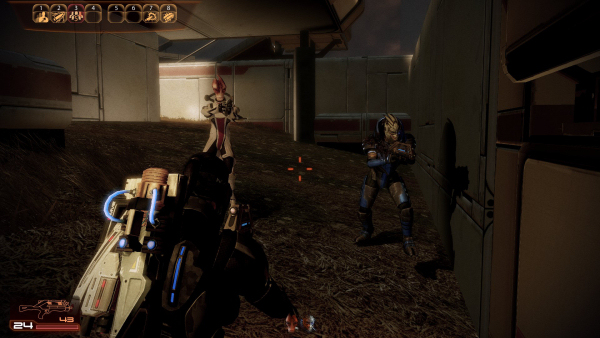
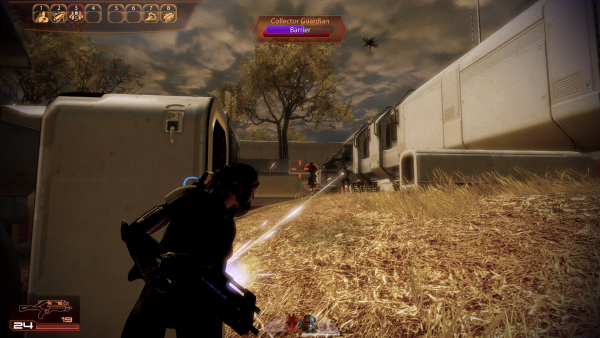
Combat is a lot more fast-paced, actually requires you to switch between your array of weapons for various situations, and is consistently challenging in terms of the skill and scale of your opposition. The downside is, it’s Gears of War 2. Yep, it’s GoW2. This is not a simile or a comparison – you literally import your character’s stats into a Gears mod using models from the Mass Effect universe and play it for a few minutes until the game decides you can go back to the plot.
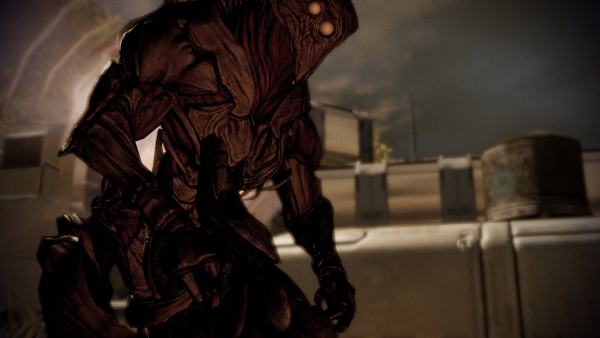
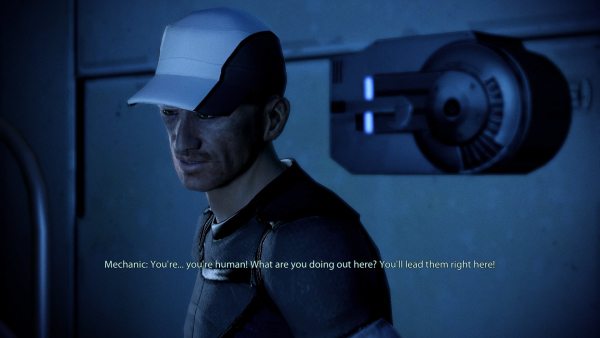
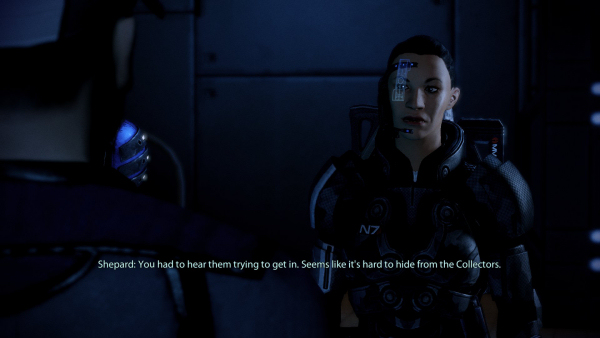
Okay, I’m exaggerating. The gameplay really is identical, though: all your environments are inexplicably littered with cover-shaped objects, just like every other Gears-type game. Sometimes I try to imagine what my home and office would look like if they were laid out with precisely waist and head-high crates, half walls, and barriers jutting out into the middle of the room for no apparent reason. Dinner parties would be a nightmare. My cats would probably need therapy just to get to the front door. Also, just like Gears, the screen starts to get covered with visibility-obscuring “blood splatter” if you begin taking health damage, and if you hide behind cover for five seconds or so, you heal up completely.
Weapons take ammo now. Yep, the idea that all the weapons of the Mass Effect future worked off of little fusion generators that would heat up from extended fire, requiring you to wait until they cool down, has somehow vanished. Now all guns take interchangeable, universal “clips” that “discharge heat” when you eject them. We also find out that biotics are not the result of exposure to element zero, but to midichlorians. You can’t buy these clips, you have to find the pre-arranged piles of them on the ground or as random drops from enemies, whose weapons you can’t take, now that new armor and weapons are only obtained by researching them using, for some reason, exorbitant amounts of minerals.
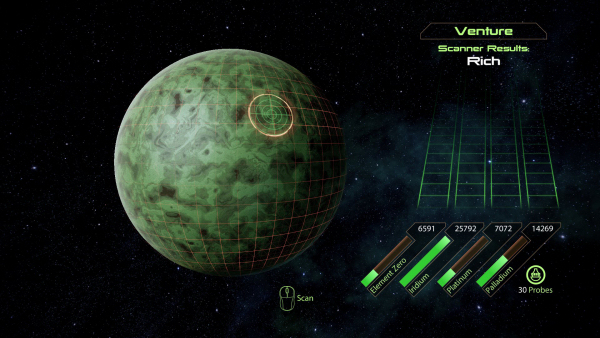
Minerals aren’t just for the XP and credit reward you got for mindlessly driving back and forth in the Mako across the surface of a planet in a spiral search pattern so you wouldn’t miss any of the things that didn’t show up on the map. This is because you don’t explore planets anymore- you only make use of the Kodiak, a drop ship you don’t control, to land on plot points called “anomalies.” Don’t fret, though. There’s a whole new kind of interminable make-work involved in harvesting minerals now: you scan the planet from orbit, holding down the right mouse button whilst dragging a “scanner” pointer over every inch of a globe image of the planet, left-clicking when sensors make funny noises and show you a peaked line graph indicating large amounts of minerals.
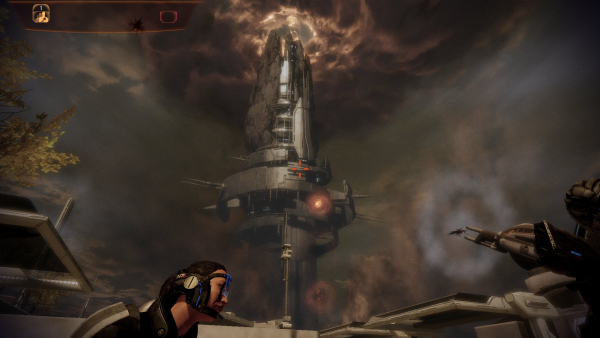
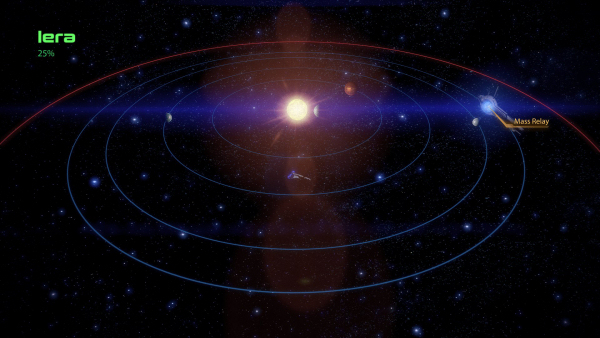
I actually timed how long it took to go through this exhaustive waste of life and compared it to how long it took to make the mind-numbing back-and-forth surface survey in Mass Effect. Turns out it takes almost exactly the same time (about 15 minutes) assuming you’re moving back and forth in the most efficient way possible and trying to cover every inch of the planet’s surface. The difference is, in Mass Effect, this 15 minutes was punctuated with things happening along the way, like stopping to salvage a crashed ship, getting into little battles with hostiles on the surface, and getting to look at the usually very attractive scenery, like the blood-red sunrise on a planet with a funny atmosphere or the multiple moons of another. In ME2, this 15 minute chunk of your life is punctuated by nothing more than the sound of you lifting your mouse and moving it back to the top of your desktop because you’ve tediously swept it from one end to another of an unchanging, meaningless round projector map of the planet with latitude and longitude lines on it.
I’ve also discovered a dramatic flaw in how plot progression happens. It isn’t always clear which of your events will advance the plot, or how the game will handle it. I took one of the many missions to obtain another crewmember, only to discover after my success that the main plot had advanced a “chapter” and another entire mission had been marked “clear” on my quest journal and closed, along with the opportunity to visit that planet, recover resources, and see that portion of the plot.
Though this doesn’t fall into the “sequel vs. reboot” part of the discussion, we’re in a fairly critical stage of this review, so it’s worth mentioning that as I played ME2 on my PC, it was painfully, abundantly clear that I was playing a title written for and ported from a console. Here were a few of my tip-offs: the Gears style combat has ONE button that does everything- crouch, sprint, take cover, use thing. This has led to an “amusing” number of deaths at the hands of my ME1-trained instincts where I try to alternate between crouching and standing behind a piece of cover, only to find myself leaving cover completely and getting my head blown off by a Krogan with an energy shotgun that he then “reloads.”
My second tip-off was so flatly irritating that it deserves its own paragraph. The first tutorial episode of the game completely ignores any changes you’ve made to the keyboard controls in your desperate attempt to make them remotely resemble ME, leading to further “amusing” deaths as you try in vain to “Press Space to slide to cover”, like it says on the screen.
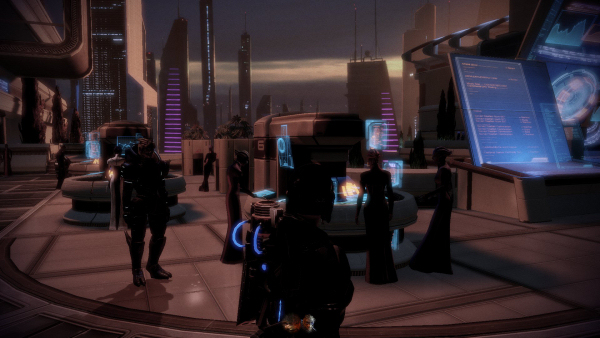
Lastly, there’s just the simplification of everything that hovers dangerously close to “dumbing down.” There’s no more inventory – for better or worse, you no longer find weapons, armor and items on the battlefield, and pick and choose from a heap of salvage. Most locations you visit in the game are “mission style” maps rather than open places. Remember the wonder of the sprawling Presidium of the Citadel? Well, you’ll never wander those open spaces again – you’re allowed into one small room off the Presidium only, where you look at your former stomping grounds on a balcony. Furthermore, those mission-style maps plow you relentlessly forward through your objectives- doors and passages close and seal behind you, prohibiting any backtracking. If you saw a crate down one hallway but decided to check the other one for hostiles first, and you happen to pass through an arbitrary plot checkpoint, that crate is gone forever.
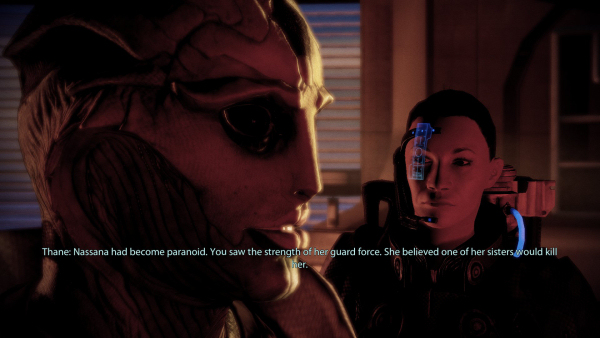
Some change is good, though. One thing that’ll immediately be apparent is that the graphics technology is vastly improved. Even running full-tilt, ME2 runs better than the first on my machine in terms of smooth animation, rendering, and speed. It isn’t bug-free- I saw the smallest incidences of texture collision and one occasion where the new “walk around fidgeting” animations during dialogue sequences caused Garrus to walk through a wall. Still, everything about Mass Effect 2 looks better – better dynamic lighting, more detailed textures, smoothed over everything – and runs better, and how often do those happen at the same time?
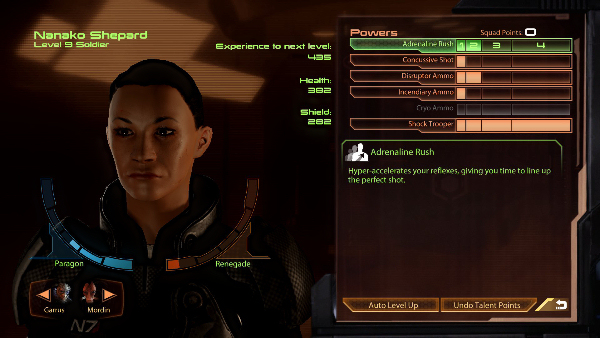
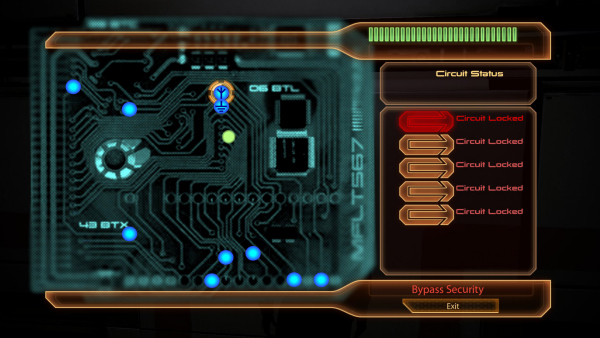
If you played the first chapter, you’ll remember that ubiquitous Frogger minigame, where you slid a cursor around a rotating grid to get to the center. Thankfully, it’s gone, too: two different hacking minigames are used to open locks and decrypt containers. You no longer have to build up skill levels on your various characters to be allowed to open any door or container, but that’s partly because the skill list is dramatically truncated. Each character only has four or five skills compared to the long lists unique to each profession in ME. You no longer have to do one of these tasks to get through the utterly mundane things like frisking a corpse or picking up an artifact as you did previously, which is nice.
A lot more effort was also clearly put into having more and diverse voice acting. There are tons of ambient conversation and dialogue for you to walk through and listen in on, and every crewmember has unique, personalized dialogue in almost all conversation sequences. It added a lot to the sense of immersion to wander through the main floor of the Asari trade world and hear people all around me talking about everything from interstellar commerce to trans-species dating woes.
I’m not done examining ME2’s candidacy as a “sequel”, and I’ll do the best I can without spoilers. Almost from the moment you begin Mass Effect 2, your every experience seems to shout, “don’t worry about that other game. We know you saved the galaxy, but Ms. Smith has these rats in the cellar that you need to kill with a wooden sword for her.” At first, I was even skeptical that any of the original crew members would return – thankfully, though, the plot is not quite that scorched-earth. To their credit, there are a ton of recurring characters from Mass Effect 1, right down to some of the most obscure NPC’s you may have only had cursory contact with. All your former crewmates from the Normandy are out there in the galaxy somewhere, doing their thing, if you make the effort to track them down. There are plenty of references to events and your decisions in the previous episode that only Mass Effect veterans can fully appreciate, and that counted for a hell of a lot to me.
Still, there’s a lingering sense that there was a faction amongst the writers that would really like to start over, but had to make that desire fit into the promise of a persistent main character. It’s a writing challenge, to be sure, and in all fairness to BioWare, there’s probably no way to do it that’ll satisfy everyone. So as to doing the series justice, my opinion of their success is somewhere on the positive side of neutral.
And then there’s the Cerberus Network. God, is there ever. This “innovation” is the integration of yet another of EA’s in-game DLC stores thrown into the main shell. You’ve got to wait for it to fire up and search every time you load up, before ME2 will even let you resume or start a game. This is the only way to get whatever extras you may have been entitled to from preordering or purchasing a special edition, by the way- and EA won’t just give the free stuff to you either. You’ll have to join BioWare’s “social networking” system AND have (or create) an EA account, which made “getting the free stuff I’m entitled to” become an annoying 20-minute slog of filling out forms and figuring out how to get to a download page with almost no assistance. Once you’re done, you’re ready and able to participate in the microtransaction store that seems to dominate every one of EA’s single player games these days. And who doesn’t like DLC provided exclusively through microtransactions?
So, time for the roundup. Mass Effect 2 is a little prettier, a little faster-paced, and integrates well enough into the Mass Effect universe and canon that you already know and love. On the other hand, it’s written for a shorter attention span, railroads you a little more than ME did, and has some of the same problems of tedious busywork as the original dressed a little differently. If you haven’t had enough of the ME world, you’ll probably want to check it out. Personally, I’d wait until the price comes down a little, and I’d definitely check my expectations at the door. Mass Effect 2 is a sequel that wants to be a reboot, and looking for “Mass Effect, but more” will make you want to throw yourself out an airlock by the time you’re done.