
Reviewed by Rebecca Wigandt
Like those of you who have already heard of Mount & Blade, I likely came across it the same way you did: in one of its literally dozens of beta incarnations since 2005.
I came upon M&B about a year and a half ago when it consisted of a “drill instructor” tutorial, a small map of a city and castle on the coast, a few gangs of bandits running around the wilderness, a plotted quest involving something about killing a bandit leader in exchange for a shield, and a slave master who would buy captured bandits. There was a lot of bandit stuff going on. There were also a few towns that you could ride through that were mysteriously empty, but looked like they could be really nice if you added some stuff to do or some signs of life, like New Jersey. And so on. There was real-time combat, most of it involving bandits, and often involving people on horses, and (at least in my early experience) you would usually lose.
At the time I thought M&B had some interesting notions, but obviously had a long way to go. It seemed to have the foundations, though: an incredibly active shareware community (a trial mode is still available since M&B’s commercial release that lets you play the game up to experience level 8 but otherwise unfettered) with busy forums full of brainstorming (I seem to remember pages and pages of discussion about how detailed everyone wanted the horses). It was heralded as the flagship product of the husband and wife team of the Turkey-based TaleWorlds, and overall my impression at the time was “Neat. If this ever gets finished, it could be worth checking out”.
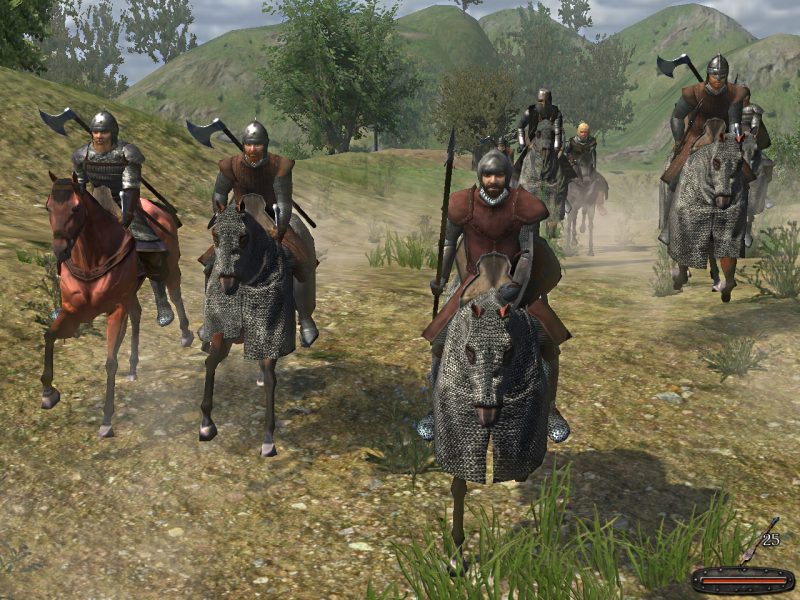
Well, Mount & Blade has finally rolled out for commercial release. The hybrid action/strategy medieval outing puts you in the role of an unknown lone adventurer recently arrived in the war-torn land of Calradia, where five different kingdoms are battling for dominance. Unlike games that include sandbox-style play as simply one element of an offered game structure, M&B is pure sandbox. There is no main quest, a very vague window-dressing history, no specific character type, and no defined win or lose condition. What fundamental structure does exist is this: you must assemble followers – whether by recruiting untrained farmers and peasants from villages, or, more expensively, hiring well-trained and armed mercenaries from the taverns found in major cities – and seek your fortune in one way or another to support what becomes a growing army.
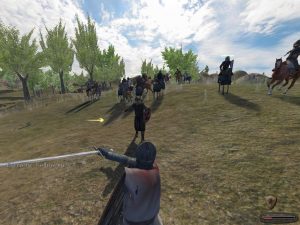 This is the foundation pretty much all gameplay: with rare exception (arena duels and a small number of random events), Mount & Blade is not a game of single combat, but a game of mass battle occurring on varying scales depending on your advancement in the game and play style. While you do assume the role of an individual character (with their own personal statistics, skills, experience points, etc.), your success in Mount & Blade is at the head of an army.
There are lots of ways to make it as a soldier of fortune in Mount & Blade: ingratiate yourself to one of the monarchs of the Big Five kingdoms by running various small (and at times tedious) errands and eventually swear allegiance to them, becoming a vassal lord or lady (who then takes on larger assignments), sign mercenary contracts with whatever kingdoms strike your fancy, looting and pillaging their political enemies in exchange for weekly pay (and, you know, the encouragement to loot and pillage being payment in itself), or operating as a pure independent: hunting down other, weaker bands of neutral parties (such as the many various roving groups of bandits, pirates, etc.) and preying upon merchant caravans for their sweet, sweet booty, whilst dodging the ire of the local lords.
Whichever path you choose, you’ll have to manage the band of followers you’ve recruited/hired/acquired: your soldiers draw weekly salaries from you depending on their level of ability, individual named NPC followers will sometimes have specific requirements for their happiness (and additionally will interact with one another, for better or worse), and everyone eats, every day. Between your battles, missions, and expeditions, you’ll have to devote a fair bit of attention to the numerous factors that impact your troop morale in the field, and respond to changing conditions accordingly: troops can desert, mutiny, and steal all the bagels from the break room. Some of your characters’ or named NPC followers’ skills, such as Leadership, Prisoner Management, and Field Surgery passively impact these dynamics on a continuous basis, but there are still plenty of decisions to be made in the moment: how much cash and inventory to devote to varied kinds of rations, whose side to take in a quarrel between two of your named followers, whether to ransom captured nobles for quick cash or use them as political leverage, etc.
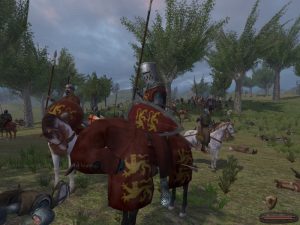 Apart from these managerial decisions, you’ll get into lots of combat. Lots and lots of combat. While it is theoretically possible to play Mount & Blade without ever dealing with the real-time combat, playing it as a purely tactical game, the system really doesn’t lend itself to this very well (and you’ll miss a lot of the more visually attractive aspects of the game as well). Tactical combat mode (sending your soldiers in to fight without you) simply crunches the numbers of your troops, their troops, maybe takes a few of your leader skills into consideration (which ones aren’t clear), and spits out an outcome which usually nets far, far worse casualties than the results of playing out the battle in real time. If you don’t like action games or melee combat at all, don’t even bother: Mount & Blade does not accommodate.
For those of you still here, fill in the seats in the front first and remember to sign out when we take our lunch break: hybrid combat/strategy gamers will be pretty happy with Mount & Blade’s real-time combat. Depending on your chosen performance settings, every single member of the participating armies (this can number into the hundreds of troops) will be individually represented on the battlefield- charging past you, swelling around you in a rush of horses running in formation, sending dozens of arrows flying, or forming piles of bodies as fallen soldiers roll down hills into riverbeds and ravines. Battles take place in a wide variety of interesting terrain- weather, season, and location all impact the battlefield scenery, and all have an impact on mobility and the effectiveness of different kinds of weapons and troops. The landscapes stay varied and interesting – even generic open field battles in open grassland maintain a naturalistic feel with mixed vegetation, subtly rolling land, running streams, and so forth. This holds true for the small villages that scatter the countryside, as well: some of the locations in Mount & Blade are downright pretty, such as a sleepy riverside village in the snowy foothills that reminded me of the tiny towns in Germany’s Schwarzvald that seemed lost in time.
The atmosphere of the battles themselves is well-captured and can be highly immersing: the sheer chaos of hundreds of men, women and horses screaming and yelling, struggling and striking is realistically bewildering, and brings a cinematic sense of “you are there” adrenaline like unto the pandemonium battle scenes of “Saving Private Ryan”, “Rob Roy”, or “Braveheart”. So well captured is this sense of chaos that it can be almost TOO realistic; with hundreds of footmen and knights battling all around you, it won’t be long before you catch a stray arrow out of nowhere or an attack from behind, no matter how attentive and reactive you are.
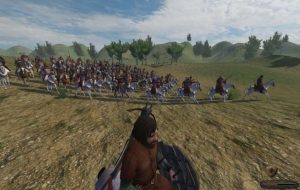 Combat can be played out in either first person or over-the-shoulder third person, and while I’m usually a realism and immersion buff, I found first-person very problematic. Mounted combat is an intricate affair, and it’s very tricky to make the absolutely-necessary judgments of elevation whilst firing a bow or aiming a spear or lance on horseback in the first-person view, since Mount & Blade (like most games with a first-person mode) lacks the realistic range of peripheral vision and limb orientation that we take for granted in real life. Remember how maddeningly time consuming and difficult it is to try moving/arranging objects in games like Oblivion or Fallout 3 because you can’t see your character’s hands? Same idea.
In general, combat in Mount & Blade is very unforgiving, however exciting it may be. Even some of my hard-core action gamer friends had to play with the AI and Difficulty cranked down to Easy for a while. Since the Mount & Blade world is an age of the sword and the longbow, things like weapon length and relative distance become far more critical issues than in modern era gun-centric games (issues that are already hard enough to accurately represent in a 2D world to begin with). Expect to miss outright the first few times you swing a sword or mace, remember to account for things like elevation, wind, and attitude decay (a fancy way of saying “gravity makes Becky’s arrows fall down”) when firing your bow, and don’t be surprised if you lose MANY of your early battles. Fortunately, anyone with a given name in Mount & Blade, your character included, cannot die: lose a battle and you’ll simply be taken prisoner by your opponent, stripped of most of your belongings, and miraculously mount an escape a few days later. While it’s nice to never have to fear permanent death in Mount & Blade, enough defeats can eventually get you to a pretty miserably unplayable state, forcing you to quit on your own: weaponless, unable to hire more troops, and generally wishing you’d paid more attention in high school when the twirling team coach was talking about double-line formation.
Mount & Blade also excels in capturing a lot of the “little things” in a medieval military scenario. As previously mentioned, in addition to the hundreds of unnamed mercenaries and recruits you’ll acquire and train along the way, you round out your party with wandering, named individuals you’ll encounter in the taverns of major cities. These party members are given impressively full “co-star” roles, possessing not only their own character sheets and statistics but back stories they’ll be happy to share and quirks that interact with other NPCs you may have recruited. These characters will argue with one another in your travels, leaving you to mediate their disputes (with a corresponding impact on morale), offer unique insights or perspectives on the places you travel (go near an NPCs hometown or kingdom and they’ll launch into a monologue about their upbringing or take on the political climate).
The game’s attention to broader details gives you a lot of things to consider (or ignore with little penalty, as you choose) during the game. Kingdoms will declare war and sign treaties with each other, nobles will jockey with each other in their national parliaments for title, war and the free flow of trade – or lack thereof – will impact the economy of local villages and cities, and so on. While the initial conditions for these events are practically random, players can, if they are of the mind and means to do so, impact these events and have significant effects on the prosperity and diplomatic relationships of each of the five kingdoms in Calradia.
There are some very specific flaws to Mount & Blade that go beyond personal preference. Overall, the game has a decidedly “unpolished” feel that resonates with its long history as a continually-revised, hammered-out shareware game. The fact is, Mount & Blade still feels very much under development, and overall has a rough-hewn look and feel to its interface and flow. Numerous spelling errors, lack of punctuation, and sometimes crude, oversimple English (perhaps a translation oversight?) often give dialogue a sloppy feel. The out-of-game tutorials (accessed from the main menu, as opposed to the in-game “training grounds” that also advertise themselves as tutorials) are atrociously executed: on several occasions the CPU opponent intending to demonstrate how I should block incoming melee attacks simply walked into a wall for 30 seconds, whereupon the tutorial congratulated me for defending myself so long and ushered me along to the next phase where a single-person “group of archers” proceeded to stand dumbfounded on their bridge when I walked directly under it and out of their line of fire. This led me to believe that Mount & Blade’s combat AI was broken or mentally challenged, which made the last laugh on me when I actually started the game and was randomly placed two steps away from a group of eight bandits who proceeded to maul the crap out of me. The tutorials are preparation for the game in the same sense that grad school is preparation for life, which is to say, a big chunk of time you can’t ever get back.
While it is understandable that a pure sandbox game won’t have a defined beginning or end, or indeed any concrete long-term player objectives other than those you set for yourself, the fact remains that for a game as potentially long as this (I’ve played 40+ hours over the course of a week and have yet to be at sufficient level to independently besiege a castle or city), gameplay is pretty narrow- build an army, go looking for trouble via one of the aforementioned career paths, sell your salvage, replenish/enlarge your force, repeat. After you’ve overcome the fairly steep learning curve, there’s a somewhat poorly-paced midgame waiting for you- you and your army is so experienced and well-equipped that those gangs of bandits are so much fried hoers d’oeuvres, but anything more ambitious is out of your league without the assistance of an NPC noble and their absurdly large armies alongside your own (assuming, of course, they randomly decide to assist you. It’s a very, very long time in Mount & Blade before you’re of sufficient renown to start telling nobles what to do).
While the scenery is quite pretty and rendered atmospherically, most of Mount & Blade’s graphics actually look pretty dated- a friend compared individual character figures to “Morrowind heads on LEGO men”. Body proportions are doughy and a little silly-looking when not contoured by the right armour meshes. Despite the diverse (performance-wise) variety of horses and their enormous importance to the game (you know, going by the title), horses are relatively bland and homogeneous in their appearance – there’s a model of a chestnut horse, a paint horse, a sable horse, and a horse covered with chain barding whose features you can’t really make out but is probably one of the previous varieties with an armour mesh over it, and that’s about all. Having played through Mount & Blade with a very cavalry-centric PC, I would have liked to get as personally attached to my PC’s horse as to the PC herself- at least a little uniqueness in markings or the opportunity to name the individual beast. Once you’ve seen enough of them, horses in Mount & Blade begin to take on a very anonymous, ‘vehicle with legs’ quality, which is a terrible shame considering the very intimate role these animals played in the warfare of the period.
Last but not least among my complaints: for god’s sake, there’s NO “TAKE ALL” button. Anywhere. NONE. And no right-clicking on menu items to auto-select/use them. It is singularly maddening to finish an enormous skirmish and have to click and drag each and every last one of dozens of “average Nord helmet” and “cabbage ration” from one side of the screen to the other. “TAKE ALL”. Zork had mastered this when I was still in elementary school. Look into it, TaleWorlds. It’s the 21st century and there’s a lot of loot to pick up. There’s also no multiplayer, which a sandbox game can only ever benefit from, and wouldn’t be terribly hard to implement. Certainly not much harder than a TAKE ALL button. Geez.
The Female Perspective:
For all my design complaints, Mount & Blade is both inclusive and mindful of female players and PCs- aside from one or two oversights, PC gender is reflected in dialogue and NPC behavior where relevant, and female PCs are afforded play opportunities as diverse as those of their male counterparts. The scans of absolutely beautiful charcoal and pencil sketches used to decorate situational text windows (“you have been captured”, “you meet the field commander”, “you arrive at the Castle Aargh”) have player character gender-matching portraits. Female NPCs appear in a wide variety of roles, from ladies-of-state to mercenary captains and arena warriors to camp followers. Perhaps due to Mount & Blade’s origins as a husband-and-wife project of TaleWorlds, it is made clear that there is a place at the table for the female player.
Summing Up:
You can buy Mount & Blade for between $20-30 online in all the places I looked. This is two to three times less than the price of a typical major-label release these days, and I feel that it’s important to judge a game at least in part by its price point. To be sure, I would not pay $60 for Mount & Blade – there is clearly a lot to be done (if substantial patching and revisions are indeed planned at this point) to make it a well-balanced, replayable game that would generate any kind of serious brand loyalty from its players. For $20 though, it fits my “cheap date” heuristic of game purchase: a matin??e and inexpensive meal run you about $25 where I live, providing about four or five hours worth of entertainment, and the average person would call that a fairly good deal for the money. Well, I’ve played about four or five dates worth of Mount & Blade, and I still have enough fun that friends will say “I’m going to pop down to Becky’s office and watch her play Psycho Mongol Raider for a few minutes”. For the price of Mount & Blade, the life of a medieval mercenary definitely includes at least a few cheap thrills.
Special thanks to Boel Bermann and Paradox Interactive for providing a copy of this title.