
Reviewed by Brandy Shaul
After suffering through the atrocity known as M&M’s Kart Racing on the Wii, an understandable panic consumed me as NASCAR Kart Racing appeared on the scene. Being a huge fan of NASCAR for years, I feared the franchise had been turned into something from the “slap a famous label on a piece of garbage and sell it for $40” template. Fortunately, my fears were unnecessary, as NASCAR Kart Racing not only outperforms the aforementioned M&M’s themed disgrace, but leaves practically every other kart racer (with the exception of Mario Kart) in the dust.
Let’s get something out of the way right now. NASCAR Kart Racing is a Mario Kart clone – that much is obvious from the second you start the first race – but the game comes out better for following such an established brand. Traditional gameplay sees you holding the Wii-mote horizontally, pressing the 2 button to accelerate, the B button to perform power slides around corners, the A button to boost, and the up and down arrows (what would normally be left and right, when holding the Wii-mote vertically) to activate power-ups. All of this should sound pretty familiar to fans of previous kart racers.
Power-ups in NASCAR Kart Racing are not surprisingly similar to those found in Mario Kart, and come in the form of rockets, oil slicks, extra (sometimes temporarily unlimited) boosts, free passes to the front of the pack, and even ad pop-ups that display your character’s main sponsor on other players’ screens, much like Blooper’s ink blocks visibility in Mario Kart.
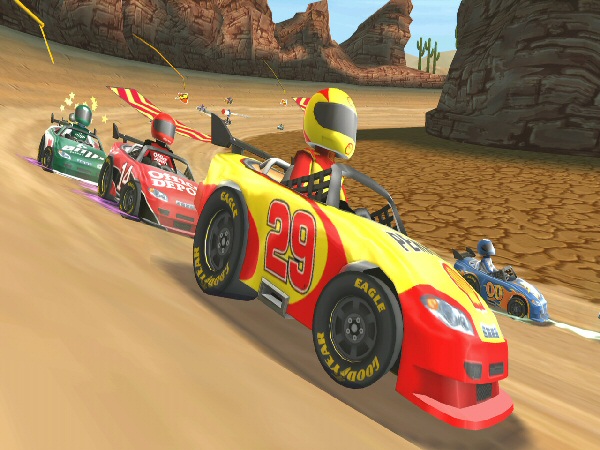
The one major difference between NASCAR Kart Racing and every other kart racer on the market is the addition of an in-depth teammate component, which sees you racing through each event with a teammate of your choosing. Much more important than the teammate system in the real world, that tends to whittle down to little more than occasional drafting partnerships, the teammate system in NASCAR Kart Racing all but forces you to depend on your teammate to win races.
By connecting the two of you (when you are close enough on the track) with a slingshot-like mechanic, the bond between the two cars builds up boost for you and your partner, which, when released, allows you to slingshot around your partner for a greater boost distance than you could achieve on your own. The more slingshots performed in rapid succession, the farther you travel on the track, thus expanding your lead on the field.
This system takes the place of any real drafting that would traditionally take place in NASCAR races, which would force you to practically mount the car in front of you, swing out hard left or right and achieve the same “slingshot” effect. Overall, it’s a nice addition to the system, and a lot easier to perform than drifting in traditional racers.
And while the NASCAR brand has seen a bit of toning down in this release, diehard NASCAR fans will appreciate some of the little touches placed within the game, like references to Carl Edwards’ affinity for performing back flips after winning races, or to the fact that when choosing teammates, real-world teammates (like the pair of Jeff Gordon or Jimmie Johnson) or even spiritual teammates (like Dale Earnhardt Jr. and Tony Stewart) contain some of the highest combined boost ratings within the title, rewarding players who wish to stick with realistic pairings. Kyle Busch even whines as much in the game as he does in real life, proving that at least one writer at EA did their homework.
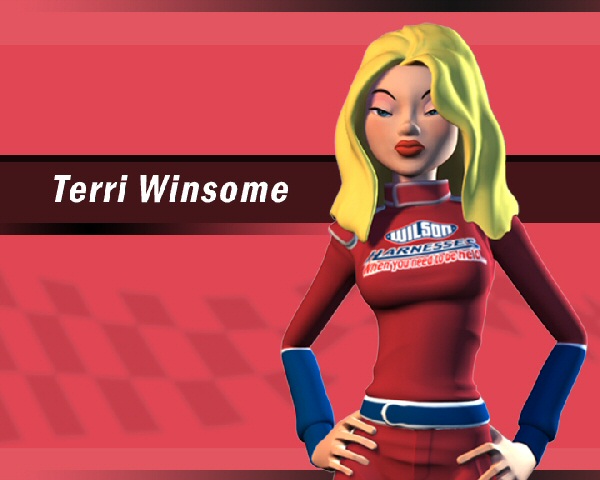
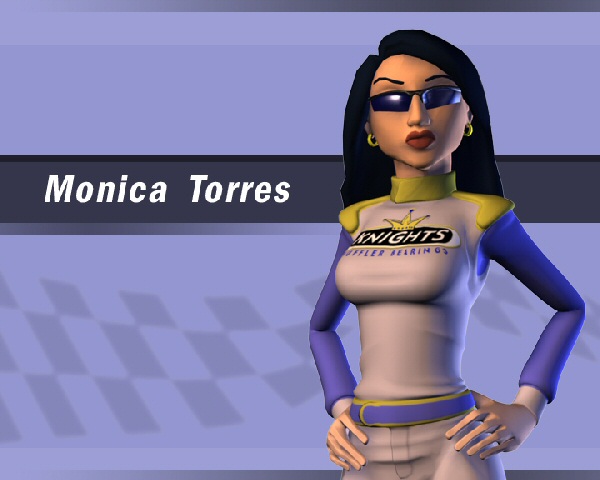
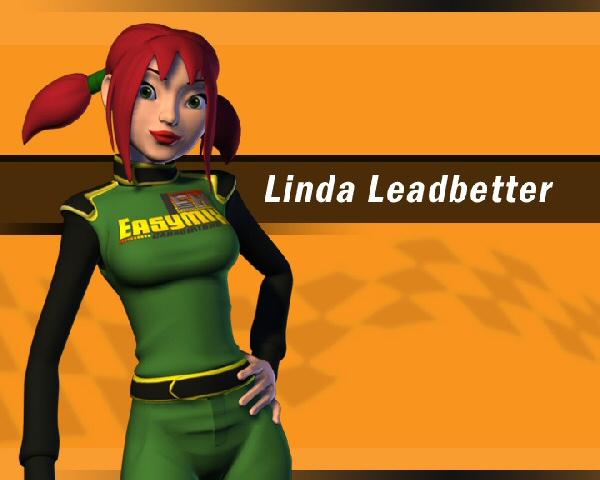
With the Championship Mode containing 12 series of 4 races each, all spread out over 12 tracks (which can be played in either a forward or reverse direction, as both they and additional drivers are unlocked throughout the mode), there’s no lack of content within the title. Likewise, with a list 12 established drivers to choose from in the beginning (Burton, Hamlin, Kahne, Edwards, and Sadler just to name a few) that eventually expands to 24 (with the other drivers being mostly game-created), there are virtually endless teammate, race track, etc. combinations available.
Once you have completed the Championship (story) mode, both the Special Events and Quick Race modes take on a lot more weight and depth. Various Special Events include gate challenges that ask you to drive through more stationary rings than your opponents, time trials that force you to complete a lap with your teammate quicker than a rival team, and distance challenges which task you with traveling a further distance on the track than your rival within a set time limit. The Quick Race mode, then, is exactly that. Pick a team and a track and you are on your way.
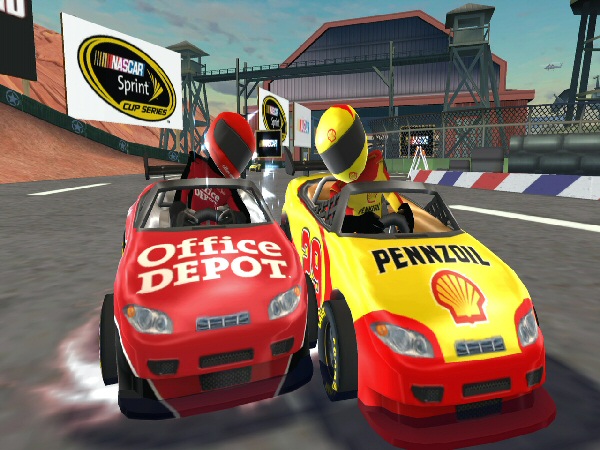
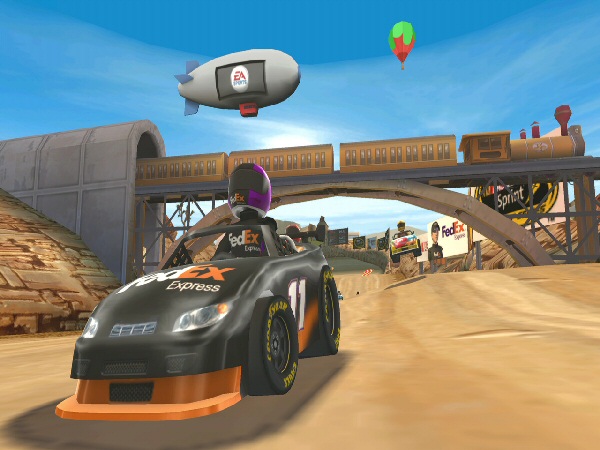
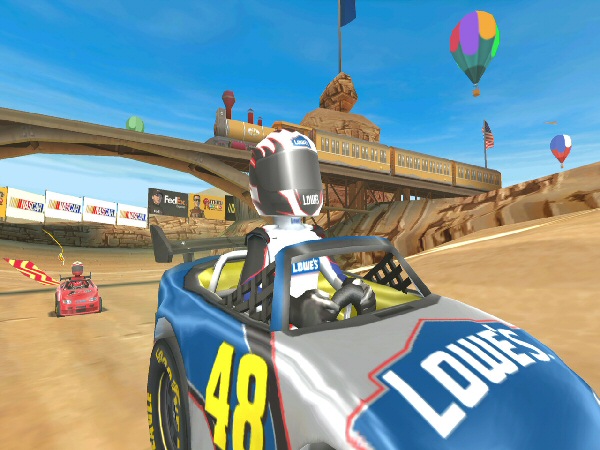
However, it’s in the Championship series that the games few flaws do start to creep in. First and foremost are the visuals. While the race tracks themselves are varied, cartoony romps through both original and real world tracks (that is, real tracks like Dover and Daytona have been tweaked to allow for part of the race to take place on the track proper, only to be completed out on the city streets, underground, and so on), the drivers themselves are a bit bizarre in appearance, and look more like plastic or rubber dolls than their real-life namesakes.
It’s not that I was expecting complete realism in a genre which is normally nowhere close to realistic, but when virtually the only resemblance to the actual drivers is their hair and eye color, it all starts to feel rather off. More annoying still is the fact that the game’s dialogue is texted based (this is not the problem, as I know paying each driver for their voice-overs would have cost a fortune), and is overlaid with a gibberish language even more annoying than Simlish.
Furthermore, the dialogue itself makes most of the drivers seem like pansy-asses, who will run home and cry to mommy anytime they don’t win. Whether this dialogue was meant to offer a satirical representation of the sport, or simply an effort to add humor to a sport where there traditionally is none, all of the whining is a slap in the face to the realism achieved in other portions of the game (even if there are a few real world drivers who would behave as such – see my above line about Kyle Busch).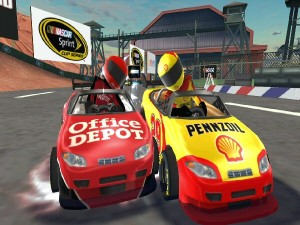
In terms of problems with the actual gameplay, the Wii-mote (even when used in conjunction with a racing wheel) has the occasional tendency of letting you slide into a wall or off of a cliff, especially when boosting anywhere near a sharp corner, but the option for using the Gamecube controller all but eliminates that entirely.
Speaking of, the game’s support of the Gamecube controller was a stellar move on the part of EA, as even though the Wii Remote provides for an adequate level of handling (that will see you easily through to the end of the game), the Gamecube controller offers an amount of maneuverability that the Wii Remote, in my humble opinion, will never be able to match, whether aligned with a Wii Wheel or otherwise.
But perhaps the biggest flaw within the entirety of gameplay is the inability to save your progress in the middle of a four race series, meaning that if you complete one, two or even three of the races and for any reason have to quit the game, you have to start over from the beginning. While not a big factor in either the Rookie or Veteran difficulties (as repeat wins are easy to come by), in the Legend difficulty, winning the race even once may have been a fluke, making winning it again an aggravating prospect.
While that may seem like a lot of complaints, most are purely nit-picks that affect little in terms of the actual gameplay, and as such will probably be overlooked by the average gamer. But where the annoying gibberish of a language, and the lack of realistic character design might drag the overall technical quality down, the soundtrack itself works as a counterbalance, as the music within the game is an appropriate (albeit instrumental) mix of alternative and rock tracks in the same vein as bands like 3 Doors Down and Nickelback.
As an entire package, NASCAR Kart Racing provides a solid, intuitive, and even a bit slapstick racing experience perfect for the Wii’s traditionally “kid friendly” line up, but also offers enough realism in terms of in-game partnerships and sponsorship deals to not totally alienate prior fans of the NASCAR world. For all that could be said about the game being totally unoriginal when compared to other titles in the genre, NASCAR Kart Racing’s teammate component helps establish the brand as more of a separate entity, and in the process, provides for a fun and worthwhile gaming experience for anyone who decides to pick it up.
Special thanks to Julie Michel and EA for providing a copy of this title.