
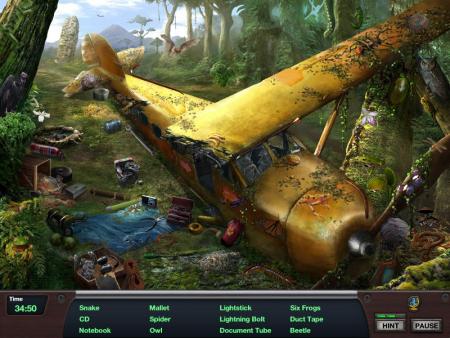
Hidden object games have basically become their own genre within casual games. For the most part, you stare at the screen for what seems like hours and try to spot items that blend in so well that most times this causes more frustration than anything else. Still, it seems like this type of game can get really addictive, and Nightshift Legacy: The Jaguar’s Eye is one of them.
The first thing I noticed in Jaguar’s Eye was actually the art style and theme of the story. It’s much more mature than any other games I’ve played (Dream Day Wedding and Paparazzi for example). As we are already accustomed to in other Playfirst games, the comic-book storyboard introduces us to the plot and characters, and in between stages develops the story quite a bit with more and more details.
Our protagonists are Mike and Isabel embark on an adventure around the world and on occasion, back in time, searching for clues to solve the mystery of the Jaguar’s Eye and the power it possesses.
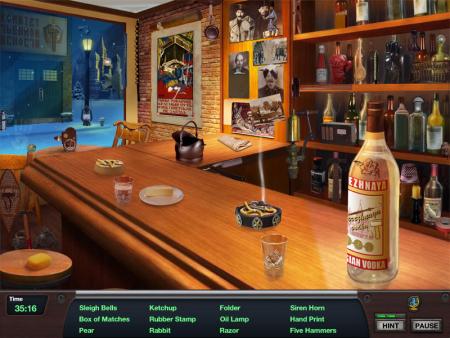
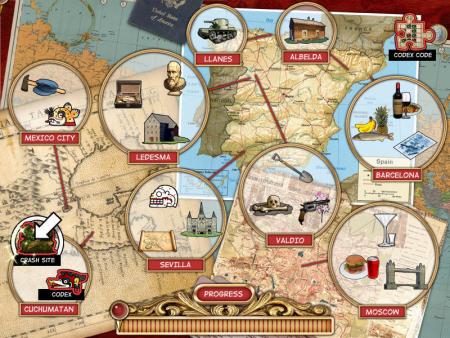
You will visit South American and European locations such as Mexico City, Moscow and Barcelona, while searching for stolen relics. The major portion of the game is spent staring at the different areas searching for the items on the list. You always have a time limit, and clicking wrongly on something will take some time off the clock. Objects are cleverly hidden in the scenes, such as a number 4 camouflaged as a window frame (you have no idea how long it took me to find that one!), a toothbrush blending in with chili peppers in a store display, a cake on a castle tower and other small things hidden – in plain sight actually – in bottle labels, paintings, graffiti, shadows, reflexions and more.
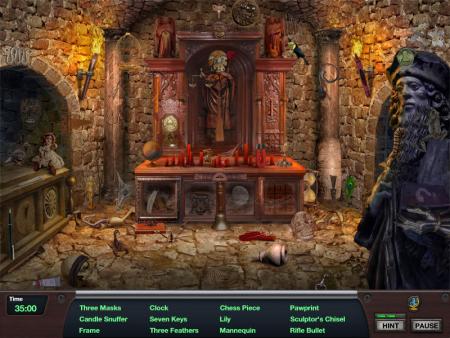
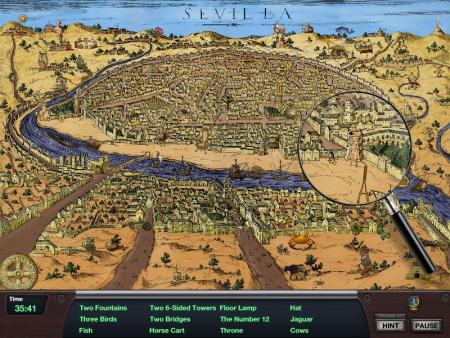
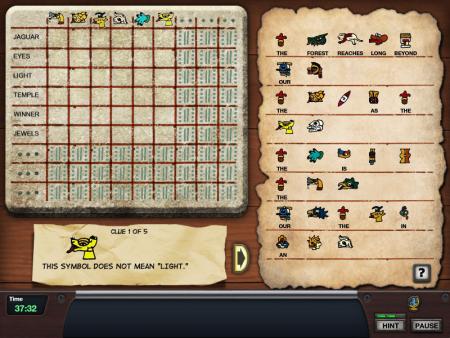
But in between, there are other activities that help keep the game “fresh” and interesting. Deciphering a codex using elimination clues by associating images with their possible meaning, putting together family photos like layered jigsaw pieces, discovering addresses and hidden messages by solving world jumbles on a grid, ordering a sequence of events using the given clues, and putting together the pieces of a key to pick a lock.
The most complicated portion of a given chapter is when all three areas have been visited and you have discovered all objects in them. When that is done, the three areas will be open again, and the new list of objects to find relates to all three. But you don’t know which objects are where, unless you remember seeing them.
You get three hints per stage, but the hint only points to a circular area and sometimes it’s still hard to spot the smallest items. To trick you a little more, sometimes you need to look at the various meanings of a word, for you may not be looking for the right thing; a fork is not just for eating, it can be a pitchfork, and a stamp can be that on a letter or a rubber stamp that you use with ink.
While I think that in the “revisited” areas the items should have been moved around a little, and an indicator should appear saying that you have found all that is for that area, I still enjoyed staring at my screen until my eyes hurt. But I have to admit, my favorite part of the game was actually the different mini-games. They are clever, interesting and quite fun.
If you’re into object finding, Nightshift Legacy: The Jaguar’s Eye is definitely worth a shot.