
Need some help with the game? Check out our Oasis hints and tips!
Here is another game that recently caught my eye for two reasons: first, because it features an Egyptian theme; second, because it looked a lot like the original Civilization (which I love, was one of my first addictions and I still own).
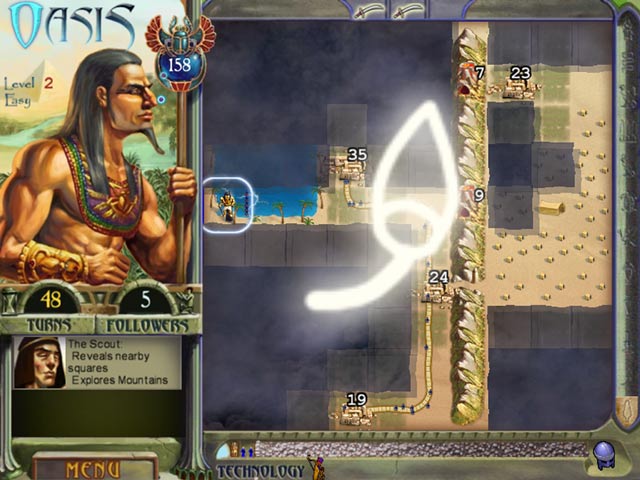
Oasis is a great recipe consisting of one part puzzle and one part strategy. You explore the land, find cities, connect them with roads, and uncover the map to find the Glyph of Power and locate the barbarian cairns (blue rock piles). This isn’t exactly as easy as it sounds, since you have a limited number of turns before the Barbarians attack. When they do, you need to move your troops to the city being attacked first.
 The mechanics of exploring the world map is a bit like playing Minesweeper, except there are no numbers in the adjacent squares to help you make a decision. Instead, there are subtle hints of what may be there. For instance, cities have crops around them. Nomad camps are located in desert areas and they consist of a large central tent, an inner circle of five little tents per square, and an outer circle of three little tents per square. These camps and will give you extra followers, which you will need for building roads, mining and increase your army ranks.
As you explore, you will also find characters that will agree to join you, providing a certain number of cities survive the attacks. These friendly people each have a special skill (they can give you extra followers, let you build roads through mines or allow you to redeploy your army between attacks) but unfortunately they will retire after 5 levels. Still, they are great to have even if for a short while.
 You also have to search for the obelisk, which is basically your last resource weapon against the barbarians if all cities are destroyed. The obelisk is usually located on a lake at the edge of the map. Uncovering the lake tiles will give your staff more power, which means you can kill more barbarians with it. When all cities have been destroyed, if your Scarab Power number is higher than the remaining number of barbarians, then you win and move on to the next level.
Other ways to increase your defenses against the barbarians are by discovering technology improvements. These are unlocked by having a number of your followers work in the mines, and you can watch their progress towards the next discovery on the bottom of the map (they’re shown as little workers digging a tunnel).
 Some of the technology improvements you will have beneficial effects. They can increase your soldiers’ damage done to Barbarians, increase your army ranks, automatically defeat a number of barbarians at the start of a fight and even locate important places on a map.
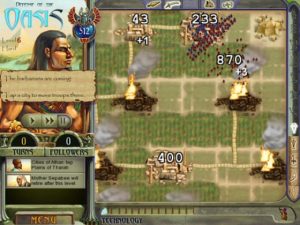
Oasis may seem like a really easy game at first glance, but once you get to higher levels, you will be uncovering maps with tons of cities, no mines and hordes of 400 Barbarians to start the attacks with. Acquiring Scarab Power is basically the only hope here, since after each city that is destroyed, the barbarians gain bonus strength and become pretty much invincible.
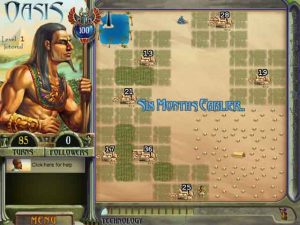 The Pharaoh’s Challenge is very well worth playing for the storyline. As you progress and conquer the different parts of the map, you will find yourself trying to survive the different plagues that fell upon Egypt when Moses tried to free his people.
This is a game that you can choose to play for a couple of minutes on a coffee break (that’s how long a level takes), or immerse yourself for hours in your campaign to defend your kingdom from a barbarian slaughter and become the Scarab King.
If exploring and conquering the world is your kind of game, then grab the trial version at the official PlayFirst site and experience the challenges that Oasis has to offer.
Special thanks to Kirem Weers at Alta PR and PlayFirst for providing the full version of the game.
Minimum System Requirements:
- Supported OS: Windows® 98SE/ME/2000/XP (Oasis does not officially support Windows NT)
- Tested Service Packs: Win XP – Service Packs 1 & 2
- Processor: Pentium® III 600 MHz
- RAM: 128 MB
- Minimum Screen Resolution: 800×600
- Sound Card: recommended
- DirectX® Version: DirectX 7.0
- Hard Drive Space: 12 MB