
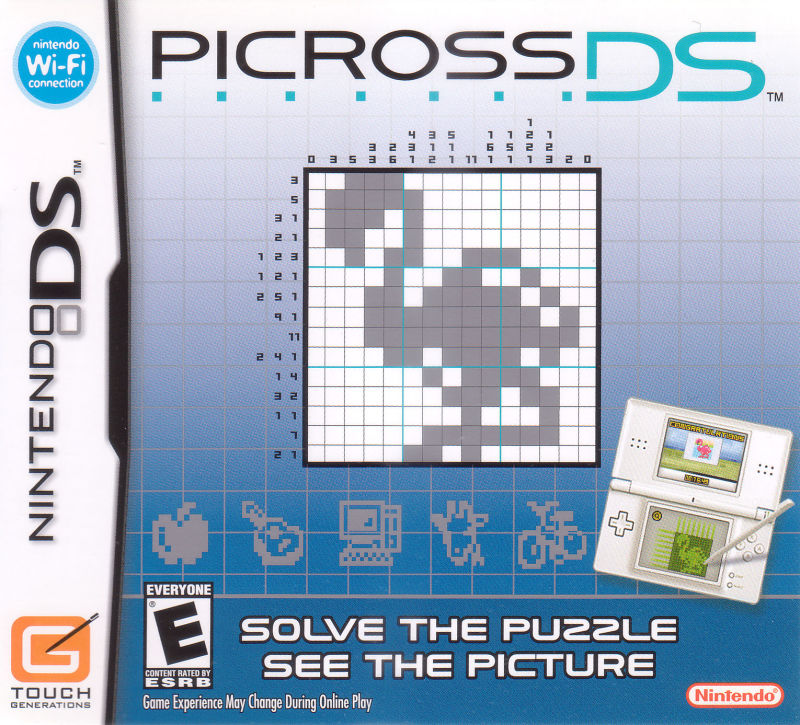
I had never heard of Picross until I received the DS game. Apparently, it has been around for about twenty years… how did I miss it?
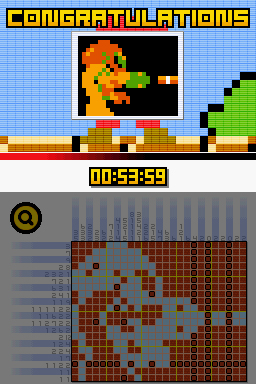
Picross is a logic puzzle game, somewhat similar to Sudoku and Minesweeper. The grid contains a hidden image that you reveal by using numerical clues placed on each row and column that represent the position of the hidden squares.
So if a column has a “3, 3, 4” note, that means you have three groups of squares together; the first with three, the second also with three, the last group with four. Groups are always separated by at least one empty square (you mark those with an X). You then cross-reference the numbers from the columns and rows to figure out where all the pixels will go, as if filling in a Sudoku grid, since it’s an elimination process.
And just like Sudoku, it’s a lot more complicated on paper than when you’re actually playing. Not to worry, there is a tutorial that shows you how it al works and a variety of difficulty settings, since puzzle grids come in three sizes (5×5, 10×10 and 15×15) offering easy, medium and more complicated puzzles to players of all skill levels.
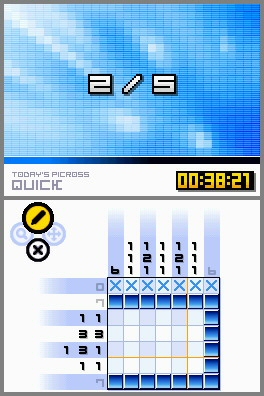
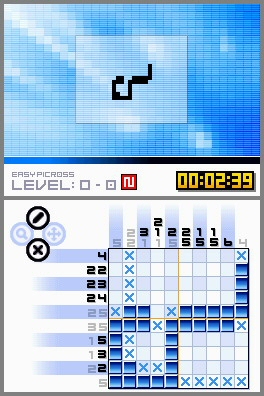
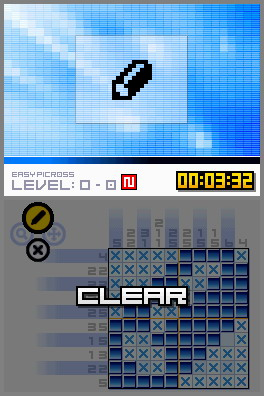
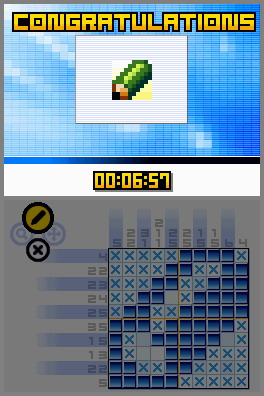
Unfortunately, the 15×15 puzzles become increasingly frustrating since you can only see a portion of the grid at one time, and have to keep zooming in, out and moving the grid around, which ends up in a lot of wasted time.
Each group of five puzzles you solve gives you access to a little mini-game where you must do little activities, such as tap 10 pixels as they appear, disappear and reappear in different positions, or tap moving pixels on the grid. Something for a change of pace, really.
Picross has a few game modes as well, one of them that works as Brain Age. This is called Daily Picross, and it has several activities that will be unlocked as you play. The first one is Nonstop Time Attack, a challenge of speed to see how quick you can solve the five puzzles, but there is also No X Marks (you must solve puzzles without using the X on empty spots), Error Search (you must find the mistake in the puzzle) and more. Daily Picross tracks your progress and time scores over time in a graph.
Then there is My Picross, where you can create your own puzzles by either creating one from scratch, pixel by pixel, or drawing an image and the game converts it automatically. You can even add a “reward picture” which appears after the puzzle is completed, and it’s pretty much a colored drawing of what the pixelized image was. I actually went looking for some of my cross-stitch magazines to create some puzzles with some of the little schemes – yes, I’m weird, but the puzzles look pretty cool!
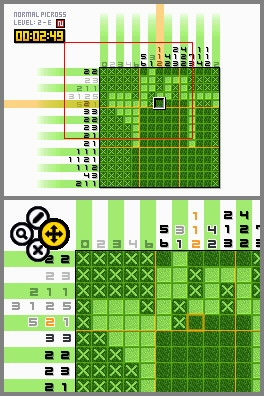
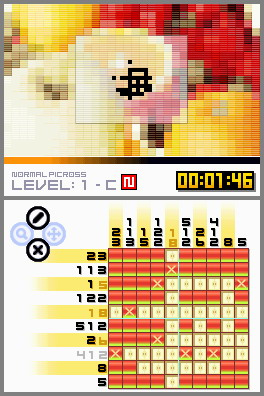
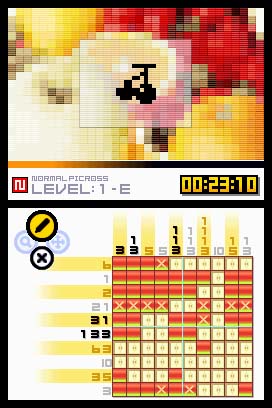
You can upload some of your puzzles into your own storage area and share them with friends (you must have their friend codes though) through the Wi-Fi connection, and you can send a downloadable demo puzzle through local wireless. You can also download more puzzles for yourself.
The Wi-Fi use doesn’t stop there, since you can have matches against players from all over the world and also with someone near you (single-card play for up to five people). The Wi-Fi matchmaking is pretty bad though, since the first few times I played, it paired me with someone that already had over 4500 wins. Not a fair fight at all.
Aside from the zoom/drag mechanics implemented to complete the larger puzzle grids and the complete absence of a skill matchmaking system for Wi-Fi matches, this is an enjoyable and clever game that makes you think. If you’re fond of logic puzzles, you will find plenty of challenges to keep you busy in Picross.
Special thanks to Allison Guillen, Chris Holmestead and Nintendo for providing a copy of this title.