
Reviewed by Brandy Shaul
In gaming today, there are a few formulas that have stood the test of time. World War II first-person-shooters, for instance, will always have an audience, as will every version of Tetris to be released. Fitting into this group of elite game formulas is that of Pipe Mania, originally released by the Assembly Line in 1989. Since then, countless sequels, remakes and clones have been released to varying levels of success. In fact, one of my earliest “play until I can barely keep my eyes open” moments came with the 2000 remake for the PSOne: Pipe Dreams 3D.
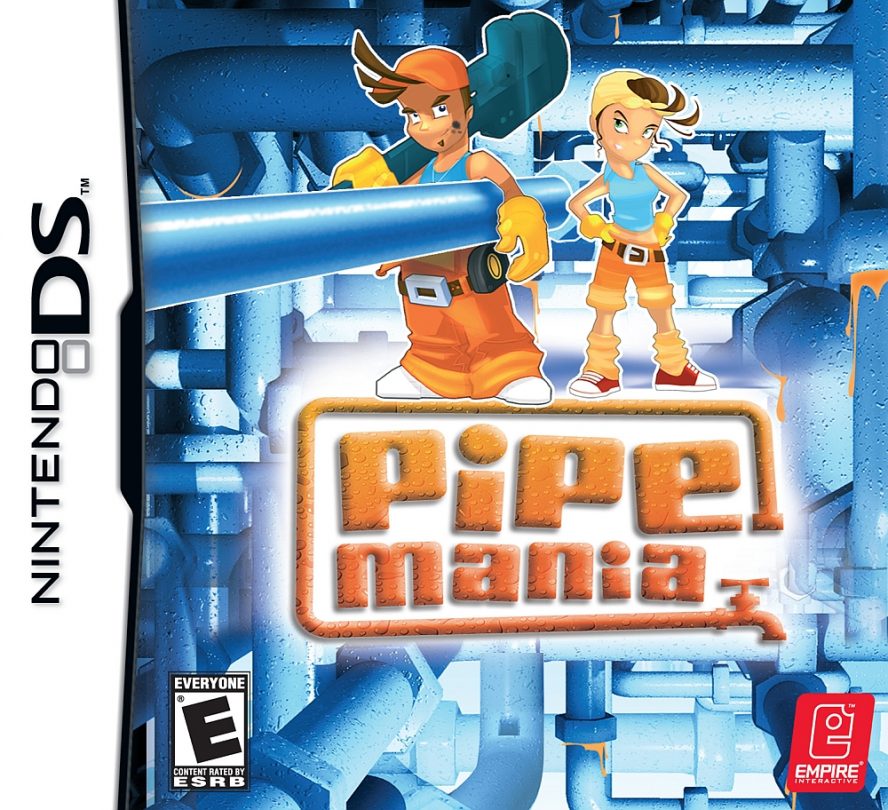
Now in 2008, Nintendo’s newest handheld has proven itself to be a perfect fit for the gameplay of this franchise and so Empire Interactive has once again breathed new life into the system with the release of Pipe Mania for the DS.
 The game is based around a loosely structured story involving Alfonso Senior and his children Fawcett and Junior, as they are tasked with repairing the various pipe systems around Alfonso’s Paradise Island, which were damaged by a cowboy plumber named Buffalo Bonzo.
Through the game’s World Mode, you will travel through various areas of the island repairing both basic pipe systems, as well as railroad tracks, assembly lines and internet cables. The basic gameplay through each system of pipes however is the same.
For those who aren’t familiar with the basic gameplay of the Pipe Mania franchise, each level challenges you to transfer an amount of “flooze”, or slime, if you prefer, from one point in the grid to another. This is accomplished via a series of user-placed pipe pieces, which come in varying shapes, and with varying abilities.
The most basic of pipe pieces are those that run either straight up and down or side-to-side, along with four basic corner pieces (that, if put together, would create a square). While these are the only pieces at your disposal in the early levels, you’ll eventually come across cross pieces that allow flooze to flow both vertically and horizontally, depending on how you wish to place them, as well as double corner pieces that can be used as one of two different corner pieces, depending on how you wish you use them.
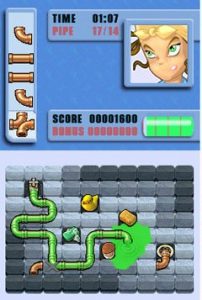 The nicest piece however is the pencil piece, which allows you to draw whatever shape you’d like, which is perfect when you are desperate for a straight piece and all you have are corners.
Like in Tetris and other puzzle games, the next pipes that you will receive are displayed along the top screen, so you can plan up to five moves ahead, adding a great deal of strategy to the title. But really, strategy is the entire name of the game with this one. Even though your first goal in each level should be to build a substantial amount of pipe leading from the starting point, you must also think ahead to the end, to decide how you are going to connect both ports in the level.
The element of strategy comes even more into play once you start to travel to different areas around Paradise Island, since new barriers are placed onto the grids, sometimes forcing you to make loops or squares in order to get anything done. Furthermore, most levels also come with various demands, such as making the flooze travel a certain distance before completing the level, or changing the flooze’s color, using the color-changing pieces pre-placed before beginning those levels.
Each section of the island, whether it is the basic sewer, toy factory, railroad or otherwise contains eight levels, with the final level consisting of a boss battle with one of the various inhabitants of the island. Characters like Ramona, the hypochondriac sewer queen and Penwald, the toy inventor each come equipped with attacks that serve to hinder your progress through the level.
While the basic goal is always the same, that being to transfer the flooze across the 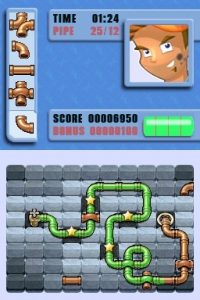 grid, these attacks can really throw a kink into your plans by changing the orientation of pipes, causing others to leak, and by adding barriers to the grid, causing you to have to change the path of your pipes.
While these new boss battles do make the game more complex than previous entries in the Pipe Mania universe, they also add a great deal of difficulty, and at times even cause the game to slow down considerably, especially during more hectic moments when explosions are happening all over the grid and you’ve got flooze flowing out of the end of an unconnected pipe piece. In fact, the game even froze for me on one such occasion, causing me to lose my progress altogether.
This unfortunate technical issue aside, the game does provide a great deal of challenge, which in itself serves as a double edged sword. While the earlier levels draw players in with the addictive gameplay that the series is known for, later levels can actually throw you off entirely, causing extreme frustration and a complete lack of desire to play.
Luckily, if the story mode does become too much of a challenge, the game includes various other modes with which to spend your time. The first is the Arcade mode, which is much more frantic than the basic gameplay of other levels in that this time around, the grid actually moves, forcing you to lay pipe in a way that slows its travel down, in order to not let it fall off the edge of the grid, since flooze flows more quickly than the grid moves.
Next is Bonus mode, which contains extremely fast paced puzzle levels, where most of the grid has been filled in for you and you must quickly figure out where the remaining pieces go, as the flooze flies through each piece at an alarming rate.
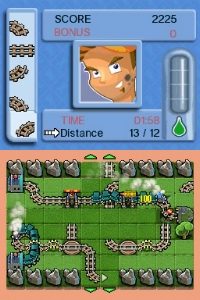 Last is Classic mode, which should come as a relief to many Pipe Mania purists, who may not be so thrilled about the many additions that were added to the World mode in this edition of the game. As classic mode actually lets players play through the original levels of the classic Pipe Mania game, along with the original rules, it serves as a nice change of pace and trip down memory lane for those familiar with the original title.
Continuing in the previous discussion of the technical aspects of the game, aside from the chaotic appearance of some of the boss levels, the rest of the game looks quite nice. Each area of the island contains its own graphical theme, meaning that during the basic sewer levels, things look mighty grimy and dirty, but while in the internet levels, colors are crisp and bright and altogether very fitting of their electronic theme.
Moreover, the sound department also deserves a great deal of praise as it provides a nice range of sound effects throughout, with explosions actually sounding as though they really could damage something, and the movement of the flooze providing a very slimy, gurgling sound – if that makes sense to anyone other than myself.
The music within the game is also appealing, in that it’s not filled with the same repetitive songs over and over again, as found in most puzzle games, and is instead comprised of a large variety of electronica, techno, dance, etc. tracks that fit both the theme of the area of the island where they play, as well as the hectic nature of the title.
All in all, Pipe Mania’s modes offer upwards of 300 levels, and while most are on the more difficult side of the spectrum, that’s definitely not to say that a more casual or even a younger gamer can’t have a lot of fun as well. In the end, for those looking for a game that has definite longevity, Pipe Mania isn’t a bad place to start.
Special thanks to Kate Hancock and Empire Interactive for providing a copy of this title.