
Reviewed by Brandy Shaul
Having been a huge fan of poker for years, I was a bit hesitant to look into Poker for Dummies. After all of my hours spent both watching and playing various kinds of poker in the real world, I’d like to think that I know not only the basics of the game, but definitely more. However, with the “For Dummies” brand’s success being so widespread, I thought it only decent of me to give it a shot.
Poker for Dummies definitely fits the Dummies franchise, in that it targets players with absolutely no experience with poker and gambling in general. Gameplay begins by leading players through various tutorials over three types of poker: Texas Hold ‘Em, Omaha and 7-Card Stud, and in the process, teaches not only the basic rules of each game, but also how to read hands of cards, and even the proper etiquette to employ while sitting at the table (something lots of World Poker Tour pros should probably look into).
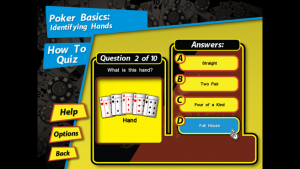
Each tutorial contains lots mostly common knowledge details such as the fact that aces can be played high or low, that laying down your hand is called folding, and other facts that further cement the game’s “For Dummies” status. After each tutorial, you have the option of taking a short quiz over the lesson, where you’ll be asked to identify the names of certain combinations of cards like a full house or straight, and will be quizzed on your understanding of poker terminology, like distinguishing between the flop, turn and river during Texas Hold ‘Em.
 These quizzes are quite helpful especially when explaining the rules of Omaha poker, as it is arguably the most complex of the three, and can easily be misunderstood by those who jump straight into the game thinking it is a clone of Texas Hold ‘Em.
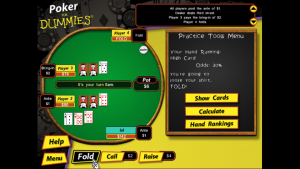
After you make your way through the lengthy tutorial sequences, you can actually begin to play each game in both a practice mode and a general play mode. In practice mode, you are guided through each hand by the game’s Poker Couch, which calculates the odds of you winning a hand based on the cards in your own hand and those on the board, much like television shows do when you watch poker that way.
The coach will also give you a short response as to whether or not you should call, raise or fold your hand, but unfortunately, it seemed to only suggest raising when winning the hand was essentially a sure thing (like when I had a straight or a flush), which is not the way most people would actually play, as many frequently choose to bluff their hand.
The overall AI in the game could use a lot of work. In every real game I played (that is, not a practice game), there always seemed to be one computer controlled player that would either call or raise a bet every time they were given the opportunity to do so, essentially ruining any chance I had of figuring out whether or not they were bluffing, and condemning me to fold unless I had a massive hand, thereby killing any fun I might have had in the process.
 Another problem with the title is the lack of more specific details about each game. While it’s great to teach players the meanings of the words “button”, “turn”, “flop”, and so on, unless you go into further detail and explain the meanings of, for example, “suited connectors” (two cards of the same suit that fall in line numerically) and “tilt” (frustration expressed by a player when they make calls out of pure anger that they, mathematically speaking, shouldn’t have), then they will still be pretty lost when going to watch any professional game played on television.
While the game’s AI may be a bit trying on one’s patience, the technical aspects of the game are not. The graphics themselves are presented in the classic scheme of yellow and black that we are all familiar with from the Dummies franchise, with uncluttered, intuitive menus rounding out the look of the game.
Likewise, the sound department is lacking in complexity, with very simple sound effects for cards being dealt and chips being played, along with fairly light crowd noise, as if you were playing the game in a casino or other crowded room and could hear people walking by and talking in the background.
In the end, Poker for Dummies is little more than a teacher of the absolute basics of poker. And while it may lack in many areas, it is still worth looking into if you know someone who is curious about the hobby, as I can say from experience (I taught both my mother and my sister how to play) that it is definitely a better choice than spending hours trying to teach someone the games by yourself.
Special thanks to Katie Carrico and EA for providing a copy of this title.