
Reviewed by Michelle Thurlow
As June 1st marks not only the one-year anniversary of my position at the site as a contributor, I wanted to review something unique to commemorate the momentous occasion(s). I had intended that the budget-priced brainteaser PQ: Practical Intelligence Quotient be that “something different” I was seeking.
As anyone who’s ever taken an IQ test before is aware, most intelligence exams analyze how proficient candidates perform in the areas of mathematical and written language skills. The puzzles in PQ, however, were designed to complement the research done by psychology professor Masuo Koyasu who argues that the mind functions using at least seven units of perception rather than just two. Scientists who espouse this “modular” theory of learning see our gray matter as the organic equivalent of a Swiss Army Knife – a tool that in actuality stores half a dozen other implements.
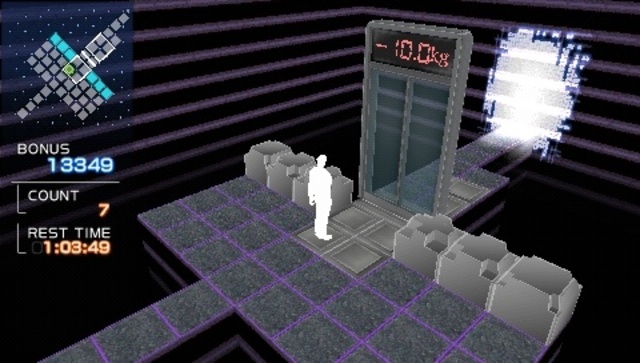
The “questions” in PQ therefore are quite distinct from the insanity-inducing stumpers found in other quizzes that evaluate mental acuity. Principally, players must accomplish the same goal for each level of the stage, which is to reach the chamber’s exit by stacking boxes, schlepping crates, avoiding lasers, and surfing conveyor belts. The developers claim that such 3D logic puzzles calculate one’s quick-wittedness in “life-like situations,” though I can assure you I’ve never walked by a random public water fountain and noticed a set of portable stairs snuggled against it.
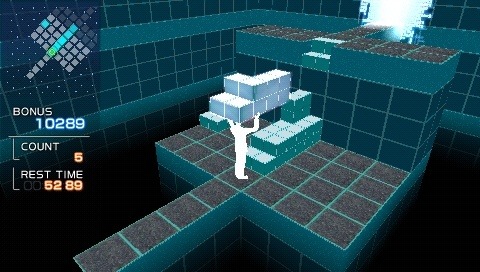
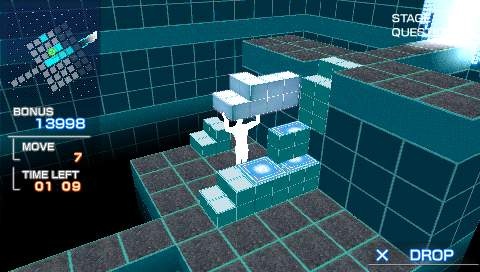
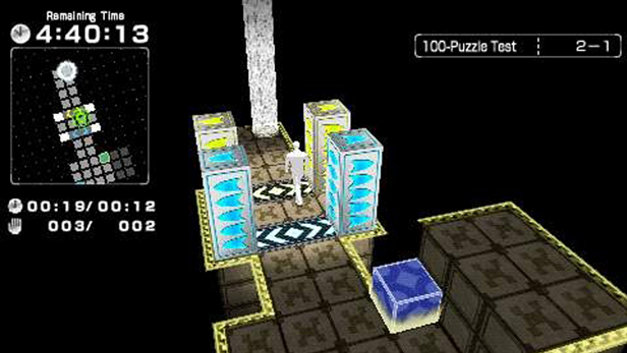
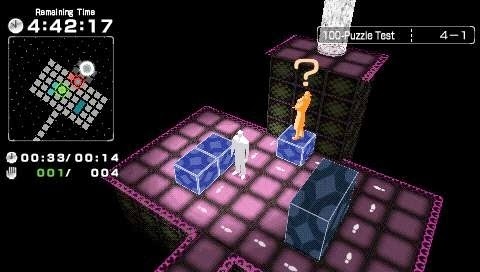
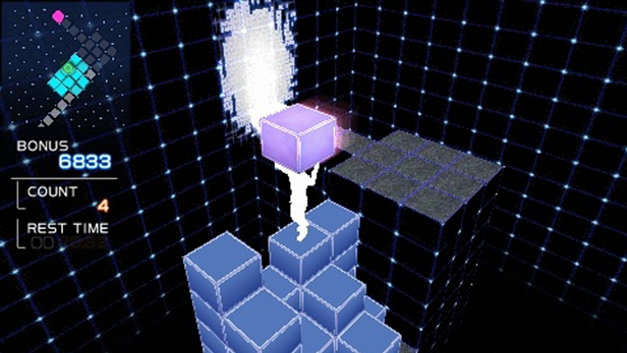
What actually drew me to the game were the graphics that will please as many consumers with their simplicity as they will bore others with their perceived blandness. PQ’s black and white backgrounds contrasted by red laser beams and other rotoscopic lighting effects pay unabashed homage to the “backlit animation” of the stylish science fiction adventure Tron. If, on the other hand, you’re not a fan of Steve Lisgerber’s movie masterpiece, you’ll likely find PQ’s intentionally bleak cyberscapes as repetitive as a recurring decimal. Indeed, it is truly the case in this game that if you’ve seen one box, you’ve seen them all.
The game’s trippy futuristic look and light electronic background music are unfortunately not enough to rescue this game from its flunking entertainment score. Fundamentally, PQ’s flawed gameplay is what prevents this offering from making the grade for several reasons. Foremost, I had anticpated that the levels in this title would be baffling, but my long-suffering neurons weren’t fully prepared for a learning curve steeper than the slope on a world population growth chart. After completing a very basic tutorial, I was thrown into the brain-frying action quite quickly – kind of like how Kevin Flynn in Tron is forced into a jai alai match and… Aww, skip it.
Even worse, the menu system in the game is, bluntly put, moronic: with one hundred levels to beat, it boggles my skull jello that contestants are forbidden to replay individual questions to improve their PQ rankings. You’re only allowed to access to stages for which you have correctly solved all ten questions, otherwise you must take the entire PQ test over again to unlock logic problems you’ve previously skipped or failed!
Though I wasn’t perfectly stupid enough to predict that PQ would be the PSP’s killer app, I was hoping for a much better experience than this. That the release lacks even the requisite multiplayer mode has me more befuddled than a Corgi in a vector calculus class. The ultimate irony in powering-up Practical Intelligence Quotient is that while PQ makes the grand presumption to measure my cleverness, the game itself isn’t exactly what I would deem the brighest box on the shelf.