
Reviewed by Tiffany Craig
On cold and raining evenings, I used to get all stereotypical with the Phish Food and have my thumb poised with anticipation over the pause button during the volleyball scenes in Top Gun. I tell you, there isn’t anything that cheers me more than watching a bunch of attractive actors participating in random acts of sweaty team sports. And almost as exciting were the flying bits with the soothing sounds of Kenny Loggins urging them through. Well, with the sound turned off. Alas, no one has given us a sexy pilot video game to rev our engines so we’ll just have to deal with flying the planes and destroying futuristic tyrannical enemies in Rebel Raiders: Operation Nighthawk.
 The scenario is familiar Sci-Fi. You are in a universe dominated by evil overlord oppressors. You and your band of rag tag rebels must fight them to liberate the good from the fascists. This time, the way you go about it is primarily with air combat. As you go throughout the missions, you unlock the opportunity to provide your revolutionary self with some better kit. Challenges, at the bottom of the level menu, are the trials you must pass. They’re mostly reworkings of the missions with special restrictions, such as a number of enemies or ticking clock. At the end, if you’re successful you also may unlock further missions.
The main problem with the missions and challenges is just what they ask you to do. What they suffer from, as many arcade titles do, is a certain “same-ness” that resonates throughout all play. I don’t mind the same level being cross applied but I’m sure I could have done without the same cut scene 6 times whilst I tried to beat a challenge. What will keep you going is the flying itself. The physics are, at least to my amateurish eye, very good. What works and doesn’t work is consistent and your enemies fly the same way you do if in a limited set of patterns.
 Simple one-press button actions win over complicated controller contortions. The most you’ll have to remember as far as operations go is how to use them practically, which is more challenging than it sounds.
You do get a singularly excellent break in game mechanics. While it might be difficult to predict when to reload, you can dodge the enemy’s missiles easily with L1. A simple press at the right time and you’ve lost the seeker on your tail. Other nagging aspects of flying are also as smooth as the side of newly molded steel. Righting yourself after flipping upside down under a floating destroyer is easy; the game almost does it for you.
Add to that a mark that always points you in the direction of your target and an automatic turn around function when you’ve flown too far and you’ll never be lost.
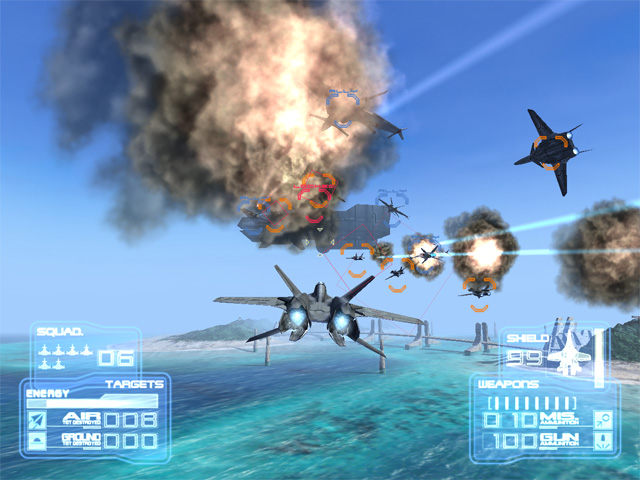
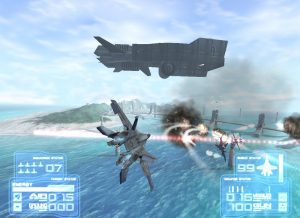
Things to glance at even during the most frenetic battles are the ones that could mean you start the mission all over again. Your shields or your health displays in the right hand corner out of 99 points. The shields replenish after delivering opponents to a fiery, flaming death. If your shields get too low then you’re the one crispy fried. In the bottom left hand corner is a count of how many enemies you’ve destroyed and how many wingmen remain. Unfortunately, though they’re about as useful as a bucket of water in front of a forest fire, the wingmen count is very important. The mission’s success can depend on whether you can keep at least one of your team alive.
Efforts for graphics get good marks for the big picture. You get through amazing scenes of ice, beaches and mountaintops, each well rendered for the style. There is a certain lack of detail, which is suitable for a game where you see most of the environment from a distance. But there were some oversights in places where you might pay attention. Last I heard, when you skim water you splash and not throw up dust. Music glides or thrusts you through the various moods and panoramas. Bombastic symphonic pieces and smooth Jazz-esque tracks hint at the style of level.
 The booming voice of the general commands you into various conflicts in a convincingly authoritarian kind of a way. The others, however, aren’t nearly as good. I’m not usually one to criticize the voice acting of people behind little anime avatars but these are particularly comical. There’s one point where the female seems stunted, as if she tripped over a word in the script. The most frustrating thing out of the dialogue isn’t the passion behind it; it’s the actual meaning. This isn’t a script criticism, what I mean is your character, Ghost Leader, seems to be intent on doing incredibly brave and stupid things. There are many points where you try to get him to agree with the wise general and just turn back, to no avail.
Rebel Raiders: Operation Nighthawk could do with some Navy hotshots just to vary things a little bit. The scope of the game is limited to just flying and shooting your way to liberation. If blowing bogies out of the sky doesn’t start your engines I’d avoid this title. For those unconcerned with variation in game type, repetitive challenges can still interfere with some enjoyment. But that interference would be minimal because they managed to hit the target on the other things that count. The controls are solid and easy to master. Graphics and audio wise they’ve mostly made the mark for the game’s aim. Even when challenges and missions are vein bustlingly difficult, they’re still compulsive flying fun.
Special thanks to Ruth Fraser, Anne Waldron and XS Games for providing a copy of this title.