
Reviewed by Brandy Shaul
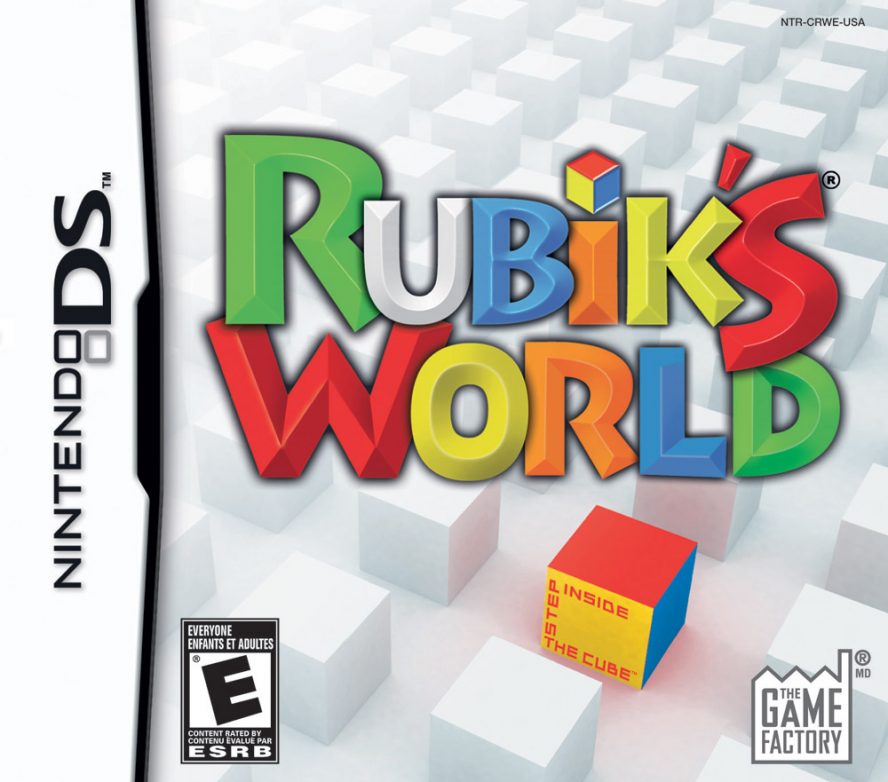
I received a Rubik’s Cube as a present around the time of my 18th birthday. I played with the thing like mad for a few days straight, got frustrated at myself for not being able to solve it, and put it on a shelf where it sits, unsolved, to this day. That humiliating confession aside, I found myself surprisingly excited at the thought of playing The Game Factory’s Rubik’s Cube themed puzzle game, appropriately titled Rubik’s World.
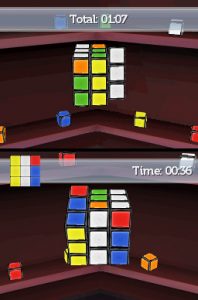 The “World” in Rubik’s World is actually a crisp, white, clean slate of an environment inhabited by “Cubies”, the cubes that come together to form a complete Rubik’s Cube. When you first enter their world, you are told by a faceless, nameless overseer that Cubies are actually shy creatures, and it is only by playing games with them that they might come to know and trust you enough to make their presence truly known.
What little story the game presents is made up for the in the gameplay options at hand. Eight modes are available from the start, all of which rely on the use of the stylus to rotate cubes and otherwise manipulate the world, with extra levels and options for each mode becoming available only after you “make friends” with enough Cubies.
The first game mode is, not surprisingly, one that challenges you to solve a traditional Rubik’s Cube, and in order to help you do so, offers a tutorial feature that supposedly allows you to solve a complete cube in seven steps. I say supposedly as the tutorial itself is a bit cumbersome, and relies too heavily on player’s own actions, meaning that it’s very easy to get lost before you even make it through step one. Of course, that may just be my own frustration with the traditional cube rearing its ugly head again.
 Nevertheless, for Rubik’s Cube purists, the option is there, but for those like myself, who apparently have a lack of three-dimensional thinking skills, there are plenty of other modes with which to occupy one’s time.
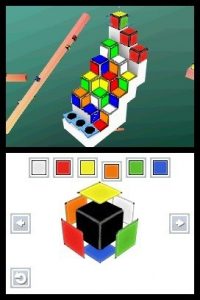
Two of these modes, called Color and Roll, lead you through dozens of individual levels that challenge you with leading an individual Cubie from one side of the level to the other. In Color, you must change the color of each side of the Cubie so that it can avoid sticking to like-colored areas, and in Roll, success is achieved by determining which direction the Cubie should travel next, so that it not only hits some sort of barrier to stop its movement (think Newton’s 1st Law: if there’s nothing to stop it, the Cubie is sent off into the abyss), but also eventually ends up at the finish.
That being said, it’s a bit weird just how much carnage takes place in the game. By personifying these inanimate cubes, the game make players, or at least myself, want to protect them at all costs, making it quite disheartening when you screw up and send one into the void. But I digress.
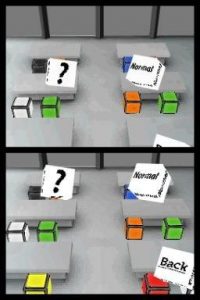 Other game modes include Calculate, which is played on a Cartesian coordinate system, where your answers to basic math problems become the X and Y coordinates and are filled in appropriately with Cubies (creating fun shapes like snowmen and robots once a level is completed), Switch, which asks you to combine groups of five or more like colored Cubies to remove them from the board, and Fit, which challenges you to quickly organize Cubies to fit through a randomly shaped hole in a descending wall.
The final two modes are Compose and Create, which, rather than presenting players with two more puzzle types, instead let you interact personally with the Cubies, by playing music with them or by arranging Cubies into shapes like clouds, trees, etc. based on what shape the game asks you to form.
Aside from these final two modes, most of the gameplay here is fairly difficult, but in a good way. This isn’t a casual puzzle game by any stretch of the imagination, as you can’t randomly tap on buttons in the hope of getting something done. A true thinking man’s (or woman’s, if you prefer) game, Rubik’s World as a whole is presented more as a test of your logical and reasoning abilities than of your reflexes, which is definitely a nice change of pace.
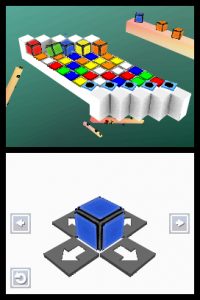 Also impressive are the technical aspects within the game. Being that traditional Rubik’s Cubes are composed of bright and true colors, the game’s pallet is organized as such, with one shade of yellow, red, blue, green, white and orange creating the majority of gameplay. Other shades of gray and black help decorate the backgrounds within the game, and overall create a very modern aesthetic.
Similarly, the game’s soundtrack is just as modern, with a very electronic / technological feel, and more beeps and bops than anything else, which definitely helps to complete the overall theme presented by these cute little Cubies.
In the end, even though I doubt my experience with the game will allow me to have a sudden epiphany and solve the dusty real-world cube that might as well be spot-welded to the shelf, Rubik’s World on its own does provide for one heck of a good time.
Special thanks to Damien Sarrazin and The Game Factory for providing a copy of this title.