
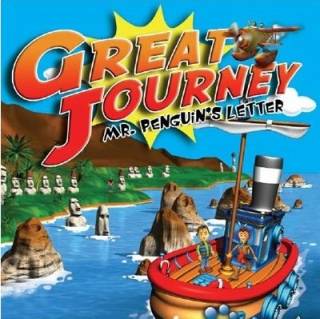
I’ve had this review on hold since shortly after reviewing Daemonica. Not only did my “game queue” keep getting bigger, but I was a bit reluctant about playing a children-oriented game right after Daemonica (another Meridian 4 / Rebelmind title), which is completely the opposite in terms of content. However, shortly after picking up Noddy: A Day in Toyland, my kid side came out and I had no problem hopping right into The Great Journey: Mr. Penguin’s Letter. And I was actually pleased with what I found through my experience.
The Great Journey is a story with an environmental concern. You play as either Annie or Tony, who receive a letter from their friend Penguin. The letter asks for help catching whoever has been pollutting the Arctic, since the penguins don’t have a vehicle of their own to go in the pursuit of the offender. Annie or Tony have to find Professor Glass in the South Seas and ask to use his plane.
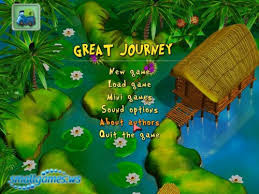
Once you pick your character, you also pick your symbol. This symbol is how you will later recognize your game save (in case there is more than one game in progress). Recommended to ages 6 to 10, this is the kind of game that children can easily pick up and play. It’s a point-and-click adventure with fairly simple controls: a few mouse clicks here to move and explore, and some keyboard arrows and spacebar there to play the mini-games.
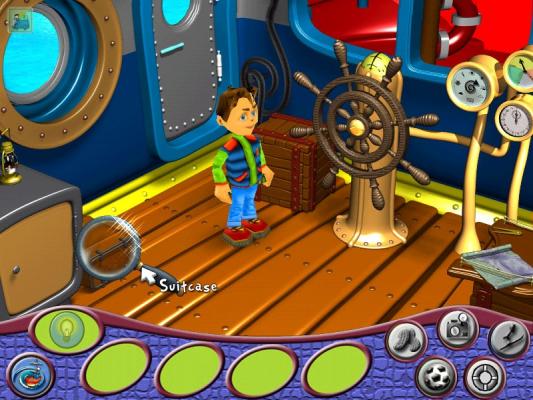
The interface is very simple. On the right side there are some greyed-out buttons representing the mini-games. As you progress in your journey you will play different games, which can then be accessed through these buttons. These mini-games are very simple and a lot of fun, and they fit well in the game’s story.
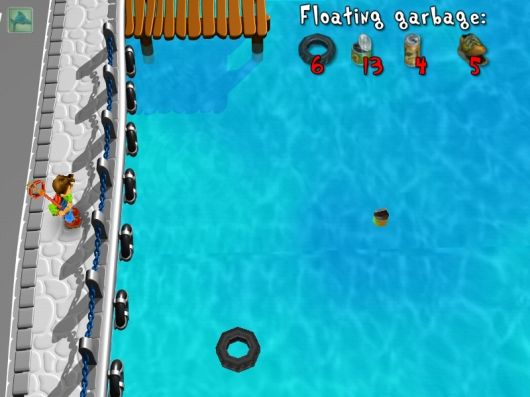
For example, before leaving the port, Annie has to clean up the garbage that is floating in the water. You do this by moving Annie up and down along the shore, using the spacebar to pick up the garbage on a net. Another cute game is the boat travel. You are placed on a vertical-scrolling screen and have to steer the ship left or right avoiding islands and buoys. You even get to play soccer with a native from an African tribe.
The green bubbles on the left represent inventory space, where you place any items you might need. The light bulb represents hints, which you discover as you explore. You explore by using the magnifying glass and finding spots that glitter. Clicking with the magnifying glass in one of these spots causes a little animation and sometimes unveils hidden items or hints.
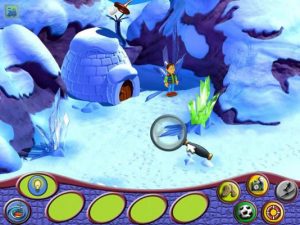
Hints can be used in spots where a light bulb appears. In the Africa chapter, there was a rock where Annie insisted she could do something else here. When using a hint (I erally had no clue what to do with the rock) she said that the rock was about to fall. I still had no idea what to do there, and by accident I jumped and made the rock tremble. After a few jumps, the rock finally fell. So, even if the hints aren’t that helpful at times, experiement with everything, explore every clickable place, jump around and eventually you will figure out what else to do. Maybe implementing more than one hint to the same spot would have been a good idea, since this may be the only situation where children might need parents’ help to progress.
An adventure wouldn’t be complete without obstacles. There will be several occasions where Annie (or Tony) will have to find solutions to progress. Right in the beginning of the game you need to find the maps, which are locked in a chest in a warehouse from which the key is missing. You have to search around the port for the key to the door and then in the warehouse for the chest key. Story progression is always a succession of little tasks based on exploration and a little thinking.
Should you find yourself stuck or not able to complete a mini-game successfully, there is no Game Over event. Instead, you simply start that sequence again. Completing something successfully grants you some cheerful encouragement words.
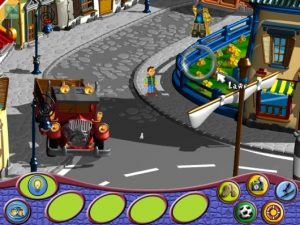 The dialogs are presented through text as well as voice acting. The voices are clear and the dialog boxes have easy to read fonts. Although I must admit didn’t quite like Annie’s voice, she sounded too old for the part, bored most of the time and came across as rude at times. Not at all like a young girl like Annie should have been. I actually ended up growing fond of the old sea captain instead.
The graphics are vibrant and clear, and there are lots of little details in the cartoony environments. The character models seem a little blocky, but other than that everything looks gorgeous. After playing Daemonica, this is one hell of a change. It’s amazing how the same company manages to produce such opposite games and still have great results in both.
What might be behind of The Great Journey being such a great game for kids is the fact that the company actually used feedback from children in the making of the game. Maybe this is the example the entire gaming industry should follow to create other equally fun and entertaining titles for the young ones.
Special thanks to Steve and Meridian 4 for providing a copy of this title.