
Reviewed by Brandy Shaul
Not satisfied with simply providing a PS2 version of the Orochi Saga collection to fans, SNK has also released the title on the Wii, with the same content and endless replayability, but will enough of a twist on the controls to make the overall title (regardless of platform) worth a second look.
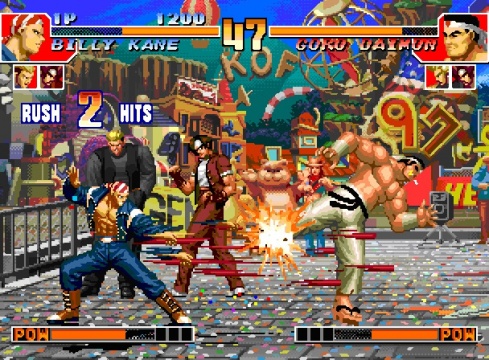
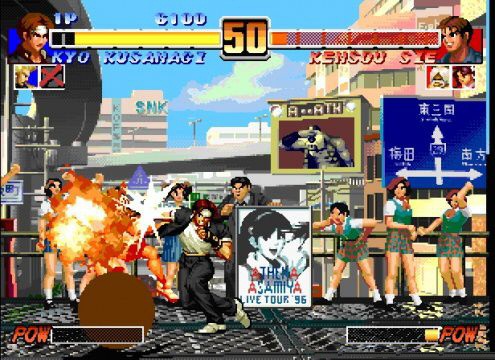
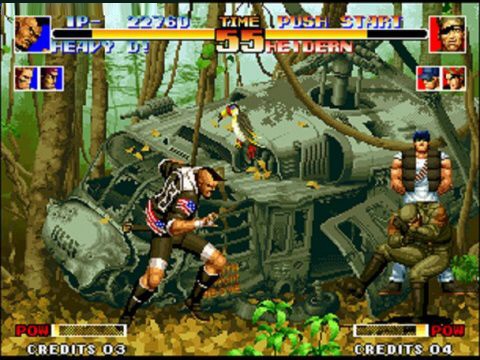
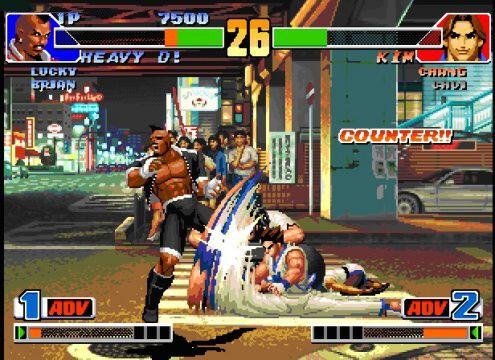
The Orochi Saga brings together King of Fighters ’94, ’95, ’96, ’97, and ’98 and returns them to their former arcade and Neo-Geo glory by including not only five complete games, but various extras as well.
As for the games themselves, ’95-’97 play as different chapters in the story of Orochi, an ancient demon that was released from its tomb and begins to create havoc in the world. In each game, the overall franchise’s main character, Kyo Kusanagi, is tasked with the ultimate goal of defeating Orochi and to seal the demon away again, along with winning each year’s King of Fighters tournament in the process.
No matter which of the five games you choose, each plays as a three-on-three competition between various teams from around the world. Throughout the compilation, you have access to a fairly large roster of fighters, and have the opportunity, if you so choose, to play as certain fighters from the first game all the way to the last. Not only does this add a sense of continuity to the compilation, but also allows you to become incredibly familiar with the move set of your chosen fighters, giving you an edge in later games.
The one major difference between the PS2 version and the Wii version of the game is of course the controls. While you are allowed to play the Wii version with a classic controller, if you stick with the Wii-mote, you’re in for a very awkward experience.
Holding the remote horizontally, character movement is controlled by pressing the up and down buttons on the directional pad, as they now point in the left and right directions (respectively) due to the Wii-mote’s new orientation. Punches are performed with the A (light punch) and B (strong punch) buttons, while kicks utilize the 1 (light kick) and 2 (strong kick) buttons.
While the kicking controls work well, being controlled by your right hand, light punches are quite the opposite, in that you will have to sacrifice either movement or kicking in order to reach the A button to throw said punch. Granted, one could spend the entirety of gameplay either solely kicking or strong punching their way through matches, but for those who like pulling off intricate combos, it becomes next to impossible to enter them in a timely manner. In the end, your opponent very well may beat you to death while you sit there, frantically fumbling with the controls.
Even offering the option of changing the button configuration does little to help matters, as the A button is always used for something, so the customization really just allows you to choose which move must be sacrificed.
Aside from the five games, the title also comes with various challenges, separated into numerous difficulty levels, which set up specific battles with various exceptions, advantages or disadvantages. These changes include simple visual alterations like the removal of the health and power up bars, as well as the timer, from the screen, or can be more impactful, requiring you to use only one attack button for the entirety of the three-on-three match.
After completing each challenge, you’ll unlock an assortment of game art, music, and even secret characters for certain games within the quintet. And while these challenges are identical to those you’ll find in other versions of the game, they are made all the more difficult by the lackluster controls.
Said controls also make the tutorial feature quite welcome in allowing both new players and pros alike to practice their moves without the fear of losing their progress within each game’s story. In addition, the entire compilation can be set to a specific difficulty level ranging from 1 (easiest) to 8, giving the game great playability no matter how in tune your fighting skills may be. Lastly, you can also target real world opponents by taking advantage of the compilation’s head-to-head two player matches with a friend.
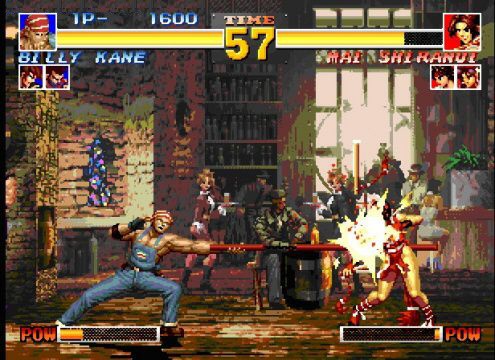
With hyper-defined muscles being about as detailed as the graphics get, and seeing as how each game within the compilation is at least ten years old, the game’s graphics are unlikely to impress. On the flip side of that coin however, the game’s soundtrack is still as intense and addictive as ever. Even the compilation’s main menu theme had me humming along in a matter of seconds.
Luckily, as I mentioned before, one can play the game with the Wii’s classic controller, returning the controls to “normal”, but for those who don’t own one, the control scheme you’re stuck with is definitely disappointing, and in the end, causes me to throw my support to the PS2 version of the game, if you have said console available to you.
Special thanks to David Bruno and SNK Playmore for providing a copy of this title.