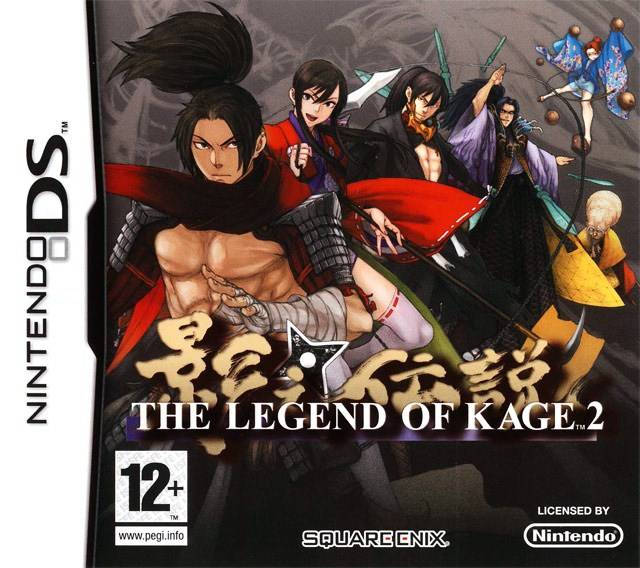
The Legend of Kage was from long before my gaming years. In fact, I must have been about 7 at the time the game was making its arcade debut, and was shortly after released on the NES. Nowadays, you can find it available for download on the Wii Virtual Console. Fortunately, no prior knowledge of the original is required to play this “sequel”.
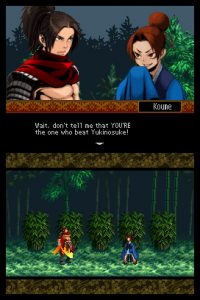 In The Legend of Kage 2, you can play as either Kage or Chihiro, respectively your male and female protagonists. The basic (and may I add, cliche) storyline is still the same regardless of who you pick to play as – Kirihime, a princess possessing extraordinary powers, is kidnapped – but for each character, there will be different events as well. It’s your job as either Ninja to face the never ending hordes of enemies and win challenging boss fights as you attempt to find Kirihime and get her back.
The Legend of Kage 2 is a side-scrolling action/platformer, just like its predecessor. The game is divided into a series of stages, usually beginning with a dialog sequence, moving on to the action, and ending in a boss fight and some more dialog.
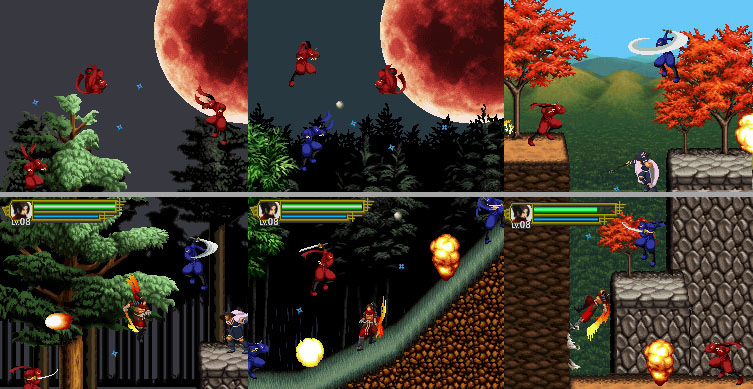
The characters are armed with close and ranged combat weapons: Kage has a katana and shuriken, Chihiro uses a kama and fundo. They can jump unusually high, which usually discovers an entire other area of platforms, for example in treetops, which is where the dual screens come in. While you’re actively playing on the touch screen, you can always see what’s above you by peeking at the top screen. But that doesn’t mean that constant jumping or picking the highest path to progress will be easier, since there are still enemies strategically placed, and a single shuriken can send you right back down, landing in a pile of awaiting enemies.
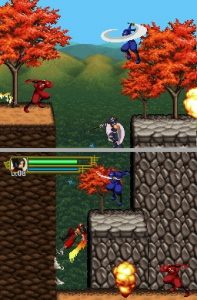 You can jump incredible heights or distances, run really fast, dash while in the air, climb and cling onto walls in ways that only a Ninja would be able to do. However, controlling the jumps isn’t all that easy, since the harder and longer you press the button, the higher you will jump, which makes a small hop nearly impossible. In the most action-packed scenes you will find that the controls don’t seem to respond as quickly as you would like them do, resulting in failed attacks or block attempts.
Exploration is encouraged, since there are special orbs placed in unusual spots throughout the stages. When placed on the grid and combined with each other, these elemental orbs will allow you to use special Ninjutsu techniques (sort of like magic) such as lightning bolt attacks or a protective ice shield.
At the end of each stage, you are graded depending on your success, so according to how well you did, you may be awarded a new move, such as sequential attacks or even higher jumping ability.
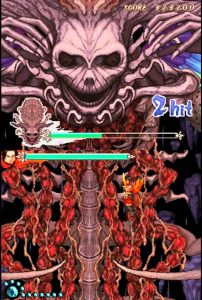 The boss fights are… interesting. You will definitely encounter some strange, colorful characters to battle against! Their health bars span across the entirety of the top screen, which at first is pretty discouraging. Each boss usually has a few attacks, each attack with a specific pattern, but for each time you fight that same boss, the battle will be different. If that didn’t make sense, think of it as not being scripted. Nothing guarantees that this particular boss will do the same attacks in the exact same order as before. You need to pay attention to their movements and recognize the signs for what they are about to do.
While mindless, fast-paced running, jumping and slashing is usually fun, there will come a time where you will grow extremely frustrated at the game’s difficulty level. Mostly during boss fights, where there is little to no room for error.
As far as the presentation goes, The Legend of Kage 2 looks quite nice. The environments are quite detailed (I especially liked the blooming cherry trees), but the backgrounds themselves were fairly plain. Both the graphics are music are Asian-inspired and complement each other extremely well.
To make a long story short, The Legend of Kage 2 is one of those old-school games that makes you feel invincible at times, but shortly after will make you want to crush your DS against the wall or throw it out the window. But if a game can turn you mildly bipolar like this after a few stages, that could only possibly mean that you’re really into it.
Special thanks to Klee Kuo and Square Enix for providing a copy of this title.