
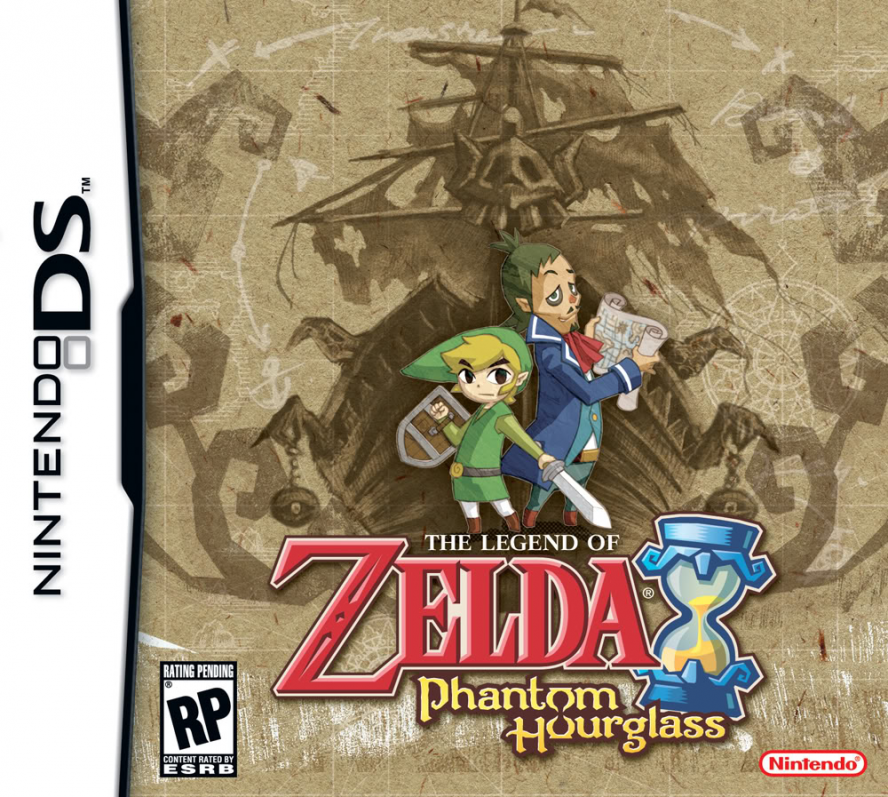
I have never been too keeng on Zelda. Maybe it’s because I’ve always been that bad at it and die a lot, I don’t know, I never play the games for too long. But Phantom Hourglass had my full attention at E3, and the demo left me wanting more.
In The Legend of Zelda: Phantom Hourglass, Link is sailing away with his friend Tetra when they discover a portion of the ocean covered with thick fog. As they enter it, they come across a ghost ship. Tetra decides to board it to explore, but she disappears and Link falls in the water when attempting to rescue her, only to wash up on shore of a strange island, awakened by a fairy. For there on, Link’s quest is to find the missing girl, aided by fairies with different powers.
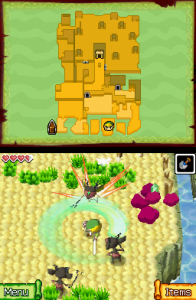 The game is entirely controlled via the touch sceen with the stylus, and in some cases, the microphone. Talking to a character or interacting with an object is as simple as tapping it. Touching the screen indicates where you want Link to move while drawing lines and circles makes him swing his sword. But the interactivity doesn’t stop there.
The boomerang is controlled by drawing a path, the bow is aimed by dragging the stylus in the direction you want to shoot the arrow, even your ship’s route is decided by the path you draw with the stylus. You even get to the point of manually steering your ship through the fog. You can even use the mic for things such as stunning foes or blowing out candles. Other items you will find are the traditional fishing rod and a shovel to dig for treasure and hidden passages.
As the title indicates, the Phantom Hourglass is the powerful artifact Link will have to hunt for. The Hourglass is filled with magical sand that gives him the ability to walk through otherwise dangerous areas. You will find it in the Temple of the Ocean King, and every time you defeat a boss you will gain extra sand, giving you more time to explore and progress deeper into these dangerous dungeons that would otherwise drain your health.
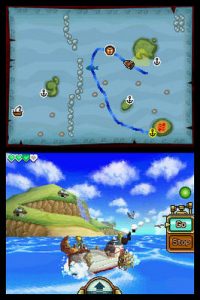 The action takes place on the touch screen, with the top screen showing your map. You can open area maps and seacharts at any time and write notes on them. Your writing and markings are saved and you can see them on the top screen.
Finding parts for your ship is actually a pretty big thing in the game. Your ship isn’t just a means of transportation, it’s a defense mechanism against creatures of the sea and a treasure hunter as well. But you need the right parts to customize it with. As you progress, you will come across a cannon to defend yourself and a crane to salvage treasure from the bottom of the ocean. However, you need to find the treasure maps first, so explore everything.
Salvage is a mini-game where you control the crane to pull up whatever treasure from the depths of the ocean. You don’t control it directly though, you must touch the button and slide it in the direction you want it to go, avoiding rocks and enemies. Your crane takes damage too, so you must watch out and be precise in your movements. The goodies you retreive are totally worth it, especially the ship part upgrades and power gems.
There are also shortcuts on the ocean charts. If you see a golden frog hopping in and out of the water, stop your ship and shoot it! These frogs represent tornado points that transport you to other spots on the map. For each spot there is a symbol you must draw on a special tablet (another of the many useful items you come across) in order to call the tornado. Pretty handy when you’re sailing back and forth.
With all the interactivity in the control system and the several items Link can use, 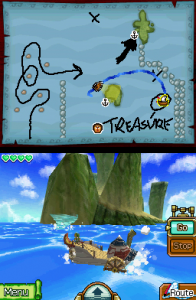 there is a lot of clever puzzles to solve. For example, there are eyes that you shoot with arrows, switches that you can hit with the boomerang, buttons to step on, cracked walls to blow up and blocks to push or pull around. Some riddles go as far as requiring you to trace lines on the map. Add to that several enemies to slash and many traps to avoid.
Phantom Hourglass has a multiplayer feature as well (via local wireless or Wi-Fi), a two-player battle mode. It’s like playing cat and mouse, one player controls Link and tries to get the Power Gems, the other tries to stop him.
As far as presentation, the game looks and sounds great. The artwork is cute and very colorful, the animations are very smooth, the cutscenes look especially great, while the music and sound effects are all too familiar and fit right in.
The two downsides are the ship’s camera control and the saving system. Although you can save anywhere, anytime, if you save your progress inside a dungeon and quit your game, you will come back at the entrance. But everything you did (such as activating switches or opening doors) will be left intact.
But with so many great features packed into a single cartridge, in the end what you get is an action-packed game with plenty of variety in gameplay that will keep the most perfectionist gamer going at it for a very long time.
No doubt about it, The Legend of Zelda: Phantom Hourglass is brilliant.
Special thanks to Allison Guillen and Nintendo for providing a copy of this title.