
Need some help with the game? Check out our Virtual Villagers Gameplay Hints and Puzzle Solutions!
Life simulation games are as popular as ever, but they all have one thing in common: the commodities of our present time.
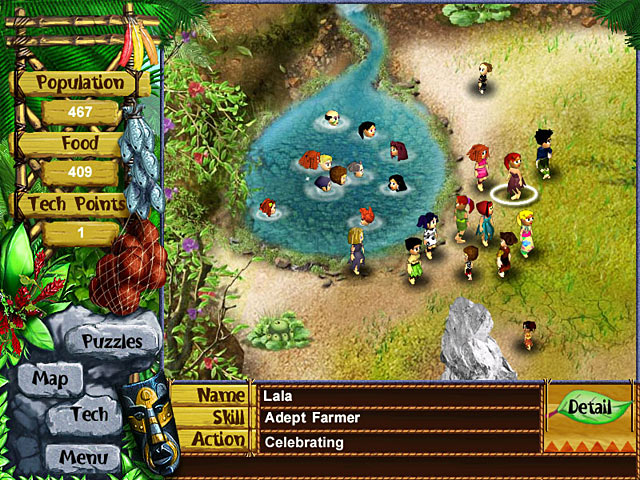
Virtual Villagers sets itself apart from other life sims because of its premise: a group of seven people survive a volcanic eruption and wash ashore on the deserted island of Isola. Your task is to manage and educate your villagers, discover new technology, solve some interesting puzzles in the process and ultimate reach a population of 90 villagers.
The basic needs for your villagers are food, water and shelter. According to your villagers’ skills, you will be able to provide all of these and more. Villagers can develop five skills: farming, breeding, building, researching and healing. They will specialize in one, but can raise all of the skills the more they practice them. For example, have someone fix the huts to raise their building skill, or someone constantly foraging to raise farming skill. It’s a simple drag and drop process for whatever you want the villagers to do. Villagers will always do tasks related to their highest skill, so it’s a good idea to train a master in each skill, otherwise you will have to keep forcing them to do whatever you want them to.
It’s important to have researchers because that’s how you gain tech points, which allow you to “buy” new technology advancements. This in turn allows your villagers to solve more complicated puzzles.
But what kind of puzzles? If you pay attention to your villagers curiosity and what they are inspecting, you will find clues to what’s involved in a puzzle. There is a grassy field on the eastern side of the map with dead flowers, and I found out some clues by watching what people were saying. Someone clued in that I would need to water it with better quality water, which meant that there was another source other than the well. It took me a while, but eventually I found it. There are 16 puzzles waiting to be solved, and most of them involve your villagers’ skills and technology advancements.
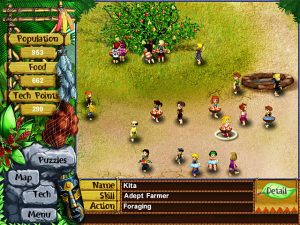
Managing these little pixelated people takes patience. It will take a while to build a hut, it will take too long to water that grassy patch, but the good part is that the villagers keep on doing things even when the game is off. That’s right, it works like Fish Tycoon. You can manage it actively for however long you have the game running, but you can turn it off and expect to see progress in a few hours or in the next day.
Sometimes you come back to pleasant surprises, other times they won’t be so pleasant. I left my game at double speed overnight to come back to a bunch of skeletons. Apparently, there had been a baby boom in my absence and no one took care of the food supplies, which resulted in a bunch of children being buried. But even in this aspect the game is endearing, as villagers gather and pick up the remains of their loved ones, carry them to the burial site, create tombstones and place some flowers.
So yes, if you’re planning on letting your kids play this game, keep in mind that villagers die. In fact, it’s a major part of the game, since you go through generations and generations of villagers. The cemetery will keep little tombstones with the names, ages and main skill of the deceased, which is adds a very nice little touch.
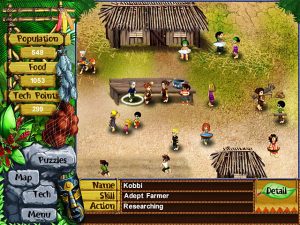
As some die, new villagers are born. Breeding is not easy at first, since villagers have no skill in it. It’s funny to see what happens when you put two people of the opposite sex together. Sometimes they will actually run away from each other, other times they will embrace and go inside the hut, and that’s what gives you a chance to have a baby. It may take quite a few tries to get a baby, and when you do, expect another mouth to feed and a mom not doing anything for two years of game time.
Don’t go crazy breeding everyone to raise their skill, or they will sneak up on you with a ton of babies one day (like it happened to me). Have a couple of selected breeders, because you want your species to continue but you don’t want to be overpopulated when you don’t have the resources to sustain everyone.
Virtual Villagers: A New Home makes you look at things from survival point of view. It’s a slow-paced game, mostly relaxing except for those times when you want everyone to work on the same goal together and they insist on doing something else. They may do your bidding while you’re watching, but turn around and they will do whatever they enjoy, and I think this is what makes reaching a goal more enjoyable.
If this sounds like your type of game, download the trial and learn the basics of this survivor society. You might be surprised with the simple yet complex concept.
