
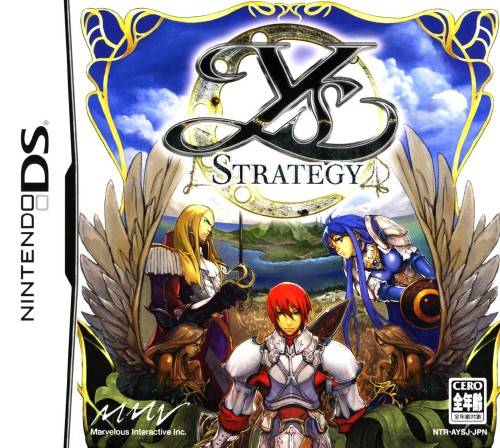
I rarely pick up a game just because I want it in my collection and without having read any kind of information about it before. Oddly enough, that’s just what I did when I saw a single copy of Ys Strategy on a shelf of a Wal-Mart type of store during my stay in Portugal.
I had no idea what it was, but I had never seen it before here in Canada, and even though the price was a bit too much (30 Euro, but then again all games out there seem to be overly expensive), I took it.
I couldn’t even read the back of the box properly, since the game was in a sealed plastic casing with a bunch of stickers covering the game’s description. So all I could make out was this game was part of the Ys series and it was a strategy game. However, when I started playing, it wasn’t exactly the type of strategy I had in mind.
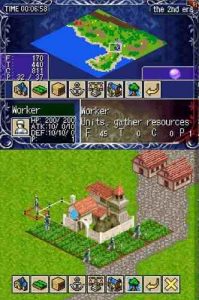 Initially, I thought I had come home with a Shining Force type of game, turn-based strategy RPG. But I soon discovered that this was more of a portable version of Warcraft and other games of the genre: Ys Strategy focus on real-time strategy, gathering resources and building up.
There are two modes to play in this game. One serves as a tutorial, giving you a series of levels where you learn about resources, buildings, troops and all kind of little important things. The problem with this is the complete absence of a save feature, so in stages that will last you for a long time, all you have to do is complete it to save your game. There’s no other option whatsoever.
The actual story mode begins in a very slow and annoyingly limited way, also with a tutorial but with the actual plot going on.
You play as Abel Lenford, a swordsman suffering from amnesia (how cliche) who looks remarkably like Adol, outfit, red hair and all. You start by learning how to move your character and approach town, where someone seems to be asking for help. Soon enough, you find that the nations of Ys are at war, fighting for possession of magic gems with immense power. Shortly after that, the princess is kidnapped (how cliche, yet again) and you will embark on a quest to rescue the princess, form alliances with other nations and gather the gems before the evil-doers get their hands on them.
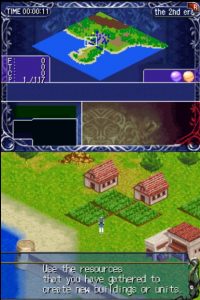 The game makes great use of the dual screens and the stylus, making the controls very simple and the interface accessible… once you learn what all the little icons mean, that is. On the top screen you can see an overview of the map and the land’s resources, while on the bottom screen you have a close-up of your game field and the icons for all the actions you can take. Pressing the L button lets you switch the top and bottom views, so you can click and navigate the map as you wish.
The stylus is used to scroll the map, pick objects, people and choose actions.
In the traditional RTS manner, you begin with a town hall, some resources (timber, food and gold) and a couple of workers. The purpose is to always strike a balance between harvesting resources, building new structures and gathering an army to storm the enemy.
There are several different infrastructures available, each with specific functions. Warehouses to store resources, temples to produce healers, walls and archer towers to defend your city, barracks to train troops and heroes.
Heroes are these powerful warriors, wizards, healers and even some magical creatures that have some insane defense and are usually defeated by either very large numbers of troops or turrets. They move fast and can do some serious damage to an unsuspecting population all by themselves.
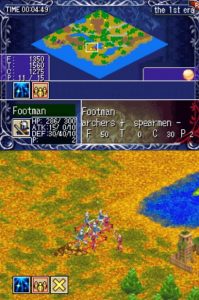 The workers have a few tricks up their sleeves too, so if you have no trees, fear not, they can plant them. If you have no food resources, they can build some too. And they can always dig a few pits for the enemy to fall in, but watch out, since your guys can fall in them too.
There are two ways to win a scenario: defensive victory and offensive victory. The offensive victory consists in gathering a huge army force and killing every single enemy. The defensive victory is obtained by advancing to the Third Era, building an Emelas Tower and protecting it from attacks for a certain period of time.
The real downfall of Ys Strategy, even in the story mode, is the lack of a save feature. You can only save your game after you complete a story chapter, and some of them may take over an hour. Since the gameplay is rather slow and tailored for the patient gamer, chances are you might feel tired – bored, even – halfway through a chapter. Though luck if you turn off your DS, your progress goes to waste.
Although Ys Strategy isn’t a bad game, a lot could have been better. The graphics aren’t too spectacular during gameplay, but the artwork is great. The story is well presented, but at times I felt like there was just too much reading and not enough gameplay. The music is good but needed more variety, since the tunes got to my nerves during long playing sessions.
There is also multiplayer option that adds to the replayability value and there are plenty of scenarios to go through. But in the end, it is the lack of a convenient “save anywhere” feature (which is always a plus for handheld titles that we usually play on the go) that greatly takes away from what could have been an awesome portable RTS.