
Reviewed by Dawn Burnell
“Ride Your Music” is the tag line for Audio Surf and the game lives up to the line. Long time fans of the exploding rhythm genre who recall Frequency by Harmonix (of Guitar Hero & Rock Band Fame) and/or Rez (cult classic for the Dreamcast, then re-released on PS2 and now available on XBLA) will easily fall in love with this game. Audio Surf is the core and soul of a rhythm game polished to a fine sheen and amazingly flexible.
Whereas Guitar Hero and its ilk have a set list of songs upon release and the players must purchase any additional songs through downloadable content, Audio Surf can play any song you already own in digital format. The only exceptions are songs that are heavily copyright protected, but that is due to the song provider’s choice rather than Audio Surf. The freedom this grants is truly amazing and allows one to really rediscover one’s music collection.
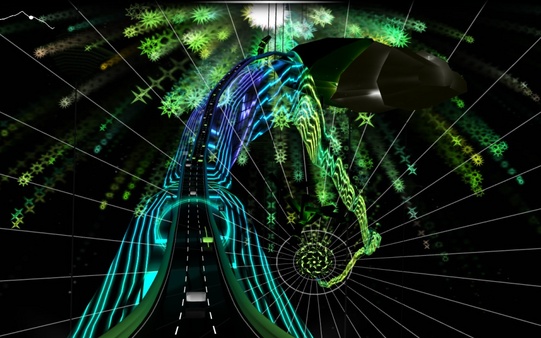
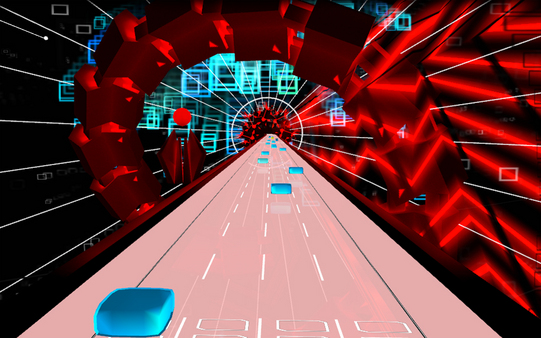

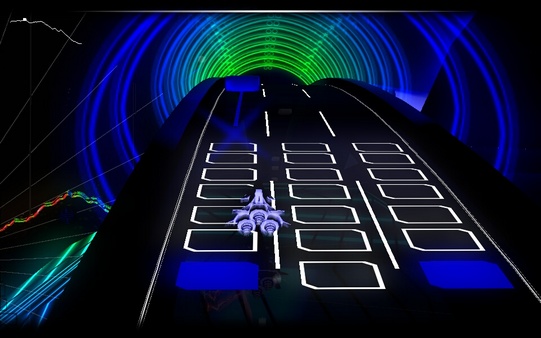
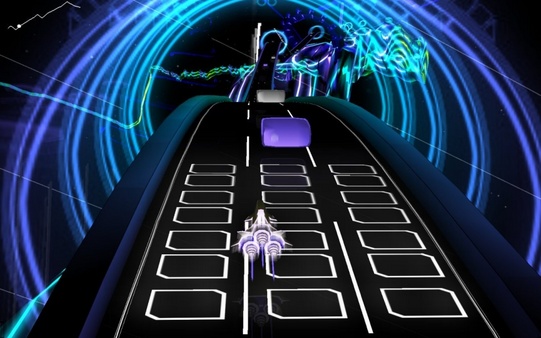
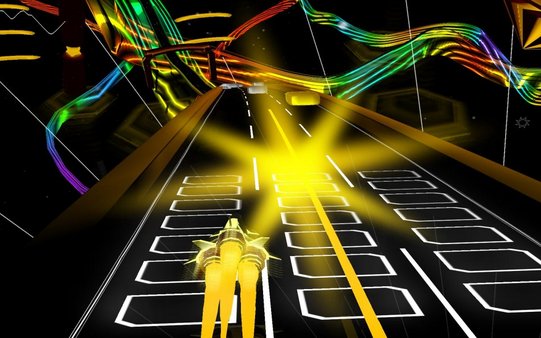
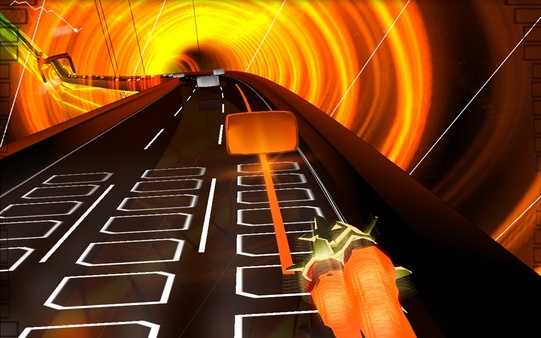
Each song is analyzed by Audio Surf prior to play, and playing a song you’ve done before is quicker than the initial analysis. You can choose a variety of avatars with different power ups and abilities to play through the song. The game consists of guiding your avatar in a horizontal fashion across several rails, picking up the colored blocks that represent beats in the song. The faster the song, the quicker the blocks come and the ‘hotter’ the color. Grab enough blocks to create a shape and you score points. If you play in ‘Mono’ mode, you only have to worry about picking up all colored blocks and avoiding the grey blocks. However, most of the avatars exist in Color Mode, where you have to match the same color blocks in groups of three or more to get them to disappear. This is more challenging than it may seem on a first glance.
While you play through the game, your score goes up and you can see if you are earning a bronze, silver or gold rating, which are set depending on the song. The larger your combos, the more points you score, and points are taken away for hitting grey blocks (in Mono) or for overfilling columns (in Color). However, after the song is over you can get a large jump in score due to the various mulitipliers available for completely certain goals. Having zero blocks left in your staging area when the song finishes, for instance, is worth a “Clean Finish” for a 25% bonus. Matching a block of 7, 11 or 21 squares nets you an additional percentage of the same amount.
You can save your score and see how well you are doing against your friends, other players in the nearby geographical area, or against everyone in the world. There is a scoreboard for each song, which makes for an interesting choice. Do you play the same songs everyone else is playing, or do you chose your secret esoteric songs and play those? Competition is fierce amongst the included Orange Box Soundtrack (worth the $9.95 purchase price alone, if you ask me), especially on “Still Alive” from the puzzle hit Portal. But being #1 worldwide (even if you are also the only one) is a neat change from the grind of leaderboards. Two caveats, though, regarding the score comparison. The game requires an additional user profile to be created beyond your steam profile, which means your steam friends are not auto-imported. Having to try to and add all your friends again is annoying. Furthermore, the game only retains your highest score on a given song, rather than your highest score on a song with that avatar. Different avatars power-ups are overpowered on certain songs, so even if you play a perfect game you can have a lesser score with an underpowered avatar.


The worldwide competition is the main multiplayer aspect, though there is a specific avatar that can be controlled by two people or one talented person. I didn’t test how well it works for two people, but the idea is that one person uses the keyboard and the other the mouse to collect blocks in concert. However, this is truly more of a gimmick than a true multiplayer portion of the game. That said, the game does not suffer from a lack of multiplayer, as it is designed for one person to enjoy their music.
The graphics are amazing. You just want to sit back, relax and chill with your song (which you can do in a freeplay form without worry about scores or abilities). The game is an interactive visualizer that reacts to your performance. Fireworks and other boom effects occur for each block caught. The track weaves up and down, whirls right and left, and carries you across a trippy field of lights and colors. But each visual effect is 100% related to the song. More beats are uphill climbs. Really intense portions are tunneled. Retardandos are a gentle slope. A wordy chorus becomes a flurry of multicolored blocks, while classical instrumental pieces have gaps for rests. Experiencing the music is what Audio Surf is truly about and the developer has done a phenomenal job at translating the audio to a kinetic and visual representation.
A final note: Audio Surf was developed independently by one main programmer and a few close friends. While this project took years and went through several iterations and prototypes, it is clearly a labor of love. The team behind this game should take pride in their accomplishments and truly deserve the accolades being given out for this unique take on the ever over populated rhythm genre.