
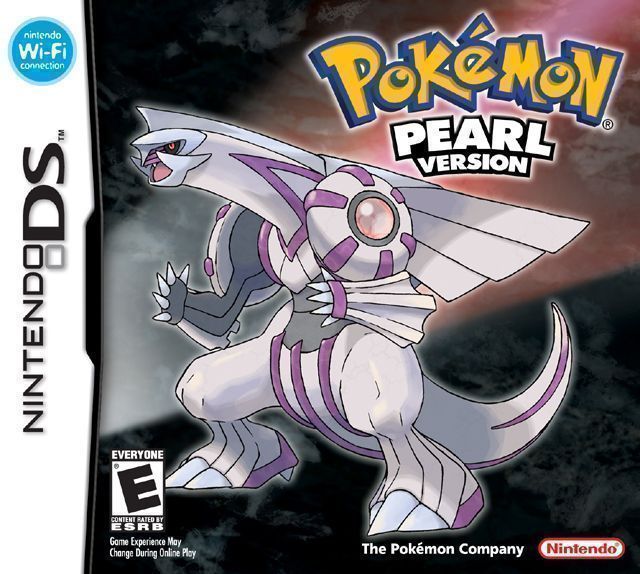
Reviewed by Brandy Shaul
Following in the footsteps of its Poké-brethren, Pokémon Pearl and its sister game (or brother, if you prefer), Pokémon Diamond, have arrived and have already taken the world by storm. It’s been quite some time since we last had a brand new adventure to pour hours of our lives into, and the fact that both Diamond and Pearl come fully equipped with all of the standards plus tons of DS extras (complete touch screen compatibility, etc.) just proves that the people at Game Freak really know how to please fans of the now decade old franchise.
Even though both Diamond and Pearl share most things in terms of gameplay and storyline, they do differ in the variety and availability of some of our imaginary Poké-friends. Since they are so similar, it should be known that this review would function similarly for both games, but for the sake of argument, I got my hands on the Pearl version for this outing in the new land of Sinnoh.
Starting as most Poké-RPGs do, you begin your adventure as a would-be trainer assigned by professor Rowan to scour the countryside and all other regions of Sinnoh in an attempt to fill your Pokédex (think of it as a notepad with a brain) with data about all of the pokémon there are to be seen. But to help you find pokémon to capture/study you obviously need one of your own and are given a choice of three: Chimchar the monkey, Turtwig the turtle and Piplup the penguin.
 Your in-game rival (whom you get to name) will pick whichever of the three that yours has a weakness against. For instance, if you choose Turtwig, the grass pokémon, your rival will pick Chimchar, a fire type, since flames can easily burn leaves, grass, etc. There are many other pokémon “types” ranging from ice and steel to poison and flying, and it’d be in your best interest to become familiar with all of them if you plan on becoming the next Pokémon Master.
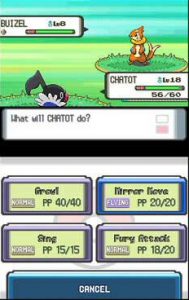
One of the biggest aspects of the game apart from the “catch ’em all” tagline is the battling system, which allows you to not only battle and train against other trainers but also catch new additions to your lineup. Pokémon gain EXP and levels through battling, with battles becoming much more difficult as you progress through the game. You will spend about half of your total gameplay time in such battles; so don’t feel bad if you don’t understand the weakness system at first. Just know that most of the weaknesses are pretty straight forward – water is stronger than fire, since it is used to put them out, and flyers are stronger than bugs since they would rather eat them than play nice, and so on.
Strategy can be taken either simply or complexly in battles. If your pokémon is at a far higher level than your opponent, you may only need one strong move like Thundershock or Bubblebeam to take them out. However, gym matches and other boss battles often take numerous rounds to complete, which makes the “weakness, immune, etc.” qualities have a lot more bearing on the overall game.
Gym matches are those that find you challenging the leader of eight gyms (one at a time, of course) in a battle against pokémon of their specialty. For instance, Gardenia, the gym leader from Eterna City uses grass pokémon, so you would need to plan accordingly and use either flying or fire based attacks. After defeating each gym leader, you earn a badge which not only grants you respect from your in-game peers, but also makes stronger pokémon look up to you longer, even as they grow in level.
 Another great thing about gym battles is that they seem to offer a much higher reward after completing each round of play. This extra EXP comes in very handy when it comes to evolving your pokémon. Similarly to humans, where we are first considered a child and then an adult, so too do pokémon grow, only instead of calling them child and adult, they change form completely (IE: Piplup evolves in Prinplup). Most pokémon evolve after reaching a certain level, but some require magical items to do so.
Just like choosing the pokémon you currently have on your team, the game offers much more in the way of game customization. Some of this comes in the form of TM’s (technical machines) and HM’s (hidden machines) that allow you to teach certain techniques to pok??mon that they otherwise wouldn’t learn on their own. Where HM’s are more basic moves like “Fly” (fast transportation from town to town) and “Cut” (clear paths easily), the TM’s are more specialty techniques like Taunt and Rock Slide. If and when you use these machines is up to you, and this fact alone allows for an almost infinite number of outcomes, depending on the strengths and weaknesses of the ultimate team of six you plan to form.
But if the game were solely about battling, it would be easy to get frustrated by the lack of variety in gameplay. Luckily, there are dozens of side quests at your disposal, most of which concern taking down a certain Team Galactic and stopping their plan of using pokémon for their own evil deeds. While some of these quests do still require an occasional battle, there are some aspects that are completely violence free.
For the future fashion-istas out there, there is an extensive “dress up” aspect of Pokémon Pearl that allows you to literally dress up any number of pokémon and enter them in beauty, acting, and coolness contests, among others. Other options for battle-free fun include gardening, mining, cycling and spelunking. These are just the tip of the iceberg when it comes to all of the different activities available to you in the land of Sinnoh; I could go on forever describing them all.
But since I don’t have forever, I’ll go onto what makes this DS version of Pokémon so special. The touch screen has been implemented in practically every aspect of the game. During battling, instead of having the bottom of the action cut off by the menu, instead the battles now take place on the top screen with all of the options like “Fight” and “Run” now taking up residence on the touch screen. Likewise, when you open your bag of goodies (Pokéballs, healing potions, TM’s, HM’s, key items, etc.), symbols for each category appear on the touch screen which allows for rapid navigation to the exact place you want to go, unlike in other games when accomplishing much of anything seemed to take forever.
Other improvements come in the form of an upgraded Pokédex which is now a lot easier to search through, and the fact that the night and day system last seen in Pokémon Gold has once again returned. In a nutshell, this means that certain pokémon, like Hoot Hoot the owl, are only going to be around at night, with the clock running in real time.
Other differences from past games include an extensive Wi-Fi community that allows you to battle against and trade with friends and strangers from all over the world. Since some Pok??mon only evolve after being traded to another person, the Wi-Fi world of Pok??mon Pearl makes completing that section of your Pok??dex that much easier. If Wi-Fi is something that still eludes you, take solace in the fact that you can also trade between any of your old GBA poke games (Fire Red, Leaf Green, Emerald, etc.) as well, through the GBA slot on your DS.
As for the more technical aspects of the title, the graphics and sound departments both perform superbly. Dialogue in the game is through text bubbles, but the flowing and constantly changing background score makes up for any annoyance that that fact may cause. The sound effects in battle are pretty standard for a handheld title, but are far from a disappointment. Likewise, the graphics are also far from disappointing, and seem to have received one of the biggest upgrades of them all.
Buildings and landscapes are crisp, bright, and colorful, and the angled overhead view offers a unique 3-D environment to players. The pokémon themselves are easily identifiable, even when looking at their miniature versions when they are in storage. Now just remembering all of their names becomes the hard part.
All in all, Pokémon Pearl doesn’t completely revolutionize the Pokémon universe; it simply improves on a system that has been proven to work. With thousands and even millions of copies already flying off of store shelves, that much is apparent. Even after beating all eight gym leaders and completing the main storyline, the game never truly ends. With a National Pokédex that allows you to document every pokémon ever created, you could literally spend a lifetime trying to complete everything, especially if this is your first outing with the franchise.
Overall, Pokémon Pearl is another fantastic game that should be in every Poké-fan’s collection. Be prepared to “catch ’em all,” because this game will make you want to do just that.