
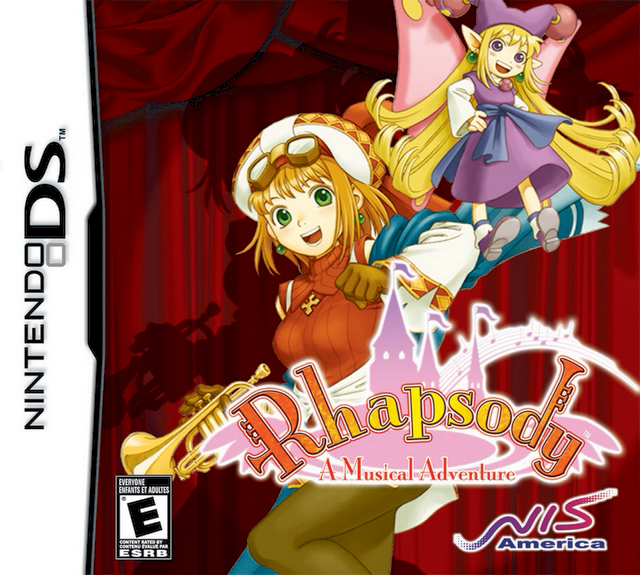
Originally a Playstation game released in 2000, Rhapsody is a RPG that relies on music and vocals to convey its story. As I have never played the original, I can’t tell you how it compares, but I can definitely tell how you it fares as a DS game.
In Rhapsody: A Musical Adventure you play as Cornet, a girl who carries around a magical horn and is able to talk to puppets. Cornet lives a simple life in a small village, dreaming about the day where she will live happily ever after with her charming prince. Cornet doesn’t go anywhere without her puppet friend Kururu, who usually ends up getting them both in trouble.
 Kururu’s sometimes not-so-brilliant ideas create all kinds of comedic relief, one of the first moments being a contest during which Prince Ferdinand will choose his bride-to-be. Strange outfit aside, Cornet manages to pass all the challenges, but on the day of the final task, the Prince is turned to stone and kidnapped by a witch and her very strange crew. Cornet later decides to set out in search of Ferdinand, embarking on the adventure of her life.
The gameplay in Rhapsody is very simple. The story progresses chapter by chapter, and everything can be controlled entirely with the stylus, with the exception of the horn mini-game, in which you must blow into the microphone to maintain the indicator on “good” for as long as possible.
The top screen shows the world map or area map, while on the bottom screen you can travel between the different locations with a simple tap, or move within an area by holding the stylus in the direction you want to go. New locations will open up on the world map as the story advances, but a dungeon layout will be fully revealed on the top screen as soon as you enter it, making the exploration very straight-forward (and impossible to get lost).
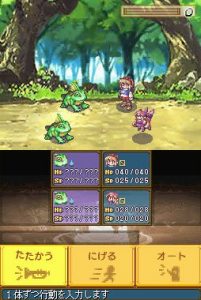
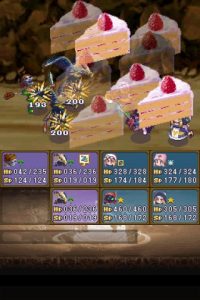 Battles occur randomly in dungeons. Once you enter a battle, the top screen shows the action while the touch screen presents your attack options and party member stats. Your party can contain four active members, but you can swap them with others once you have gathered more puppets. Party members who are not in active battle won’t gain experience though, and you can only swap members and rearrange their position in the battlefield outside of combat.
For each time Cornet uses her horn on the group, she gains one appreciation point per puppet affected. Once she has enough points, Rewards become available to either heal the party or attack all enemies. The Kansha Gauge on the top right corner (with the music notes) shows the progress of the puppets’ appreciation.
For the most part, this is Rhapsody. Music is a very important part of the game, as the original Japanese vocals were left in (with English subtitles) when there are special cutscenes for example when Cornet sings to Kururu or at the castle in front of the Prince. They come in crystal clear, with fantastic sound quality, but you can skip these scenes if you wish. And while the music is an important part of the game, the sound effects don’t seem to have much of a significant presence anywhere.
Rhapsody has a super-cute presentation that it’s hard not to talk about it. Aside from plenty of humorous situations, some crazy, weird dialogs, and adorable characters, the entire game seems to be soft, cuddly and colorful. Some of the environments seem very fairytale-like and all the character sprites are oh-so-adorable – even the evil witch Marjoly with her super bouncy tiny sprite breasts.
As far as extras, completing the game will award you with an extra scenario, character bios and the ability to view all the musical cutscenes in an encore mode.
Rhapsody may have little depth for an RPG, but it’s the wacky charm that makes it so appealing and definitely worth playing.
Special thanks to Nao Zook and NIS America for providing a copy of this title.