
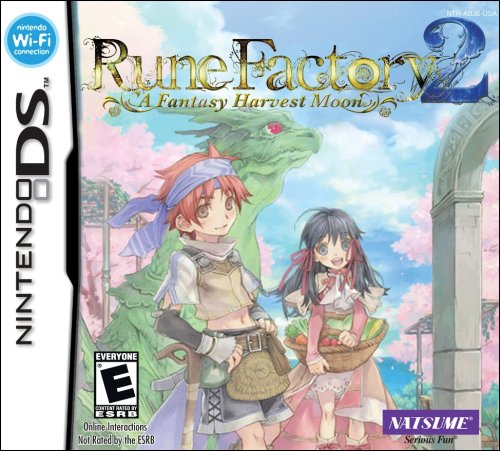
Reviewed by Brandy Shaul
I doubt many would have guessed in 1997 that the unassuming SNES title Harvest Moon would explode into a franchise that players today just can’t wait to sink their teeth into. Eleven years later, the series has changed little and still offers the same farm-tending gameplay that we all fell in love with so many years ago. One exception to this fact is the line of Rune Factory games released on the Nintendo DS that have sought to take the series one step further, by combining the established “love thy neighbor” ideology with RPG elements and in-depth character development.
The second Rune Factory title plays more like a clone of the first game than I initially expected, rather than a true sequel, but since the first game was so great, this isn’t necessarily a bad thing. After all, with such little expansion from the original formula seen throughout the series’ run, this shouldn’t come as a surprise, and in fact helps the series continue to stay true to the credo of “If it ain’t broke, don”t fix it”.
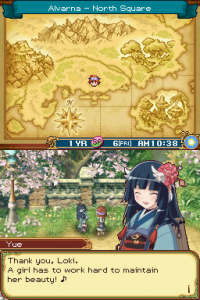 The story is one that should be familiar to players of the previous Rune Factory title. You play as a young boy named Kyle, who mysteriously finds himself in the land of Alvarna with total amnesia and is offered shelter in an abandoned farmhouse by the town’s shopkeeper in exchange for his agreeing to tend to the farm’s large field and to help better the lives of his neighbors in various ways.
The shopkeeper’s daughter Mana offers you a hoe and watering can, and sends you on your way. Instead of determining why he has been stricken with amnesia or how he arrived in Alvarna to begin with, Kyle instead immediately takes to life in the country, and with your help, seeks to become a master farmer and friend to all.
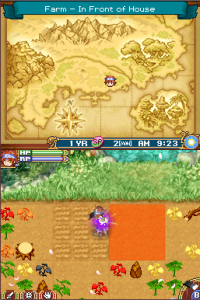
The majority of gameplay in Rune Factory 2 will be familiar to those who have played any of the previously released games in the Harvest Moon franchise. The game contains a day and night cycle, along with four complete seasons: winter, spring, summer and fall. As the weather changes in each season, the availability of crops changes with it, and in fact stems your growing potential in winter altogether, as the land is too cold to till.
For the majority of the game’s years however, you’ll undoubtedly spend hours in your field, tilling the land, planting seeds (which are either given to you by neighbors or purchased from Mana and her father Douglas), watering crops and subsequently harvesting them, along with removing all manner of grasses, rogue weeds, stumps and boulders from the land. With very few exceptions, anything that isn’t bolted to the ground can be collected and sold by dropping it in the chest outside your home, where Mana collects it daily.
For the winter season, when farming at your own home isn’t a possibility, you can either spend your days chatting with the locals, or taking advantage of the game’s one true change from standard Harvest Moon lore, the dungeons.
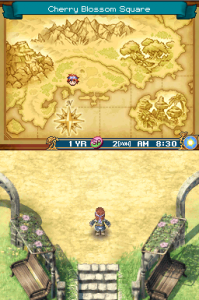 There are four dungeons in the game, one for each season, with each being filled with various monsters that you can either defeat for experience points (thereby gaining levels and becoming a stronger warrior) or befriend with the use of the Pet Glove. Once befriended, monsters travel back to your Monster Barn, and, if properly raised, can be asked to water and even harvest your crops for you while you take care of other errands, thereby saving the Rune Points that you might have expended in doing so yourself.
Each dungeon also contains a few smaller plots of land which can be tilled in the same way that your own field can, allowing you to grow numerous out-of-season crops at one time, which are especially helpful in winter, when your own land becomes useless.
As with most RPG’s, Kyle comes equipped with a HP (hit points) bar, along with a bar for Rune Points, or energy points, which allow you to not only enter into real-time combat with monsters, but also fulfill most of your routine responsibilities such as watering crops, chopping down stumps, destroying boulders, fishing, mining (smashing rocks with a hammer often yields gems and other minerals) and so on.
More character development occurs as you become increasingly proficient with your everyday tasks as “practice makes perfect”, and a stronger skill set allows you to expend less Rune Points per swing of the axe, hoe, fishing pole, etc.
 Another large portion of gameplay comes in the social development of your character as you come to know and befriend the town’s citizens. Helping you quickly achieve popularity is the town’s Request Board, which lists job opportunities from the townspeople that you can attempt to complete, one task at a time. Most of these tasks require you to travel into one of the various dungeons and collect a plant or other seasonal item (like honey or apples), or to search the town for a lost object. Your rewards for completing said tasks vary, but are normally comprised of money, tools (like wool sheers that allow you to “harvest” the wool from any wild sheep you may tame), seeds, and food.
As with previous Harvest Moon titles, once you befriend enough of the female characters within the game, marriage becomes a real possibility, and in fact a necessity if you wish to experience the biggest addition in gameplay, the inclusion of a second generation.
After choosing from one of the game’s available brides, you are wed, and your wife quickly gets pregnant. After having the child, you are free to go about your life as you have all these in-game months and years before, continuing to plant and harvest crops, fight monsters and so on, so long as you don’t acknowledge your wife’s request for a school to be built so that your child can receive a proper education.
Once you commission the building of the school, the game quickly spirals to the ending of the first generation, and skips forward in time quite a few years, until you are allowed to continue the game as Kyle’s child. This second generation of gameplay isn’t so much a restart from the beginning, but is instead a continuation of your father’s hard work, as you retain his funds, monsters, and even tools, which have unfortunately rusted with age.
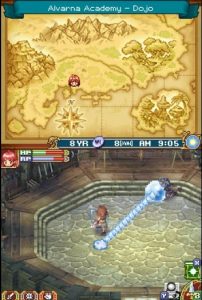 The second generation contains the same gameplay as the first, and still allows you to marry one of the town’s citizens, requires that you grow crops and so on, but also incorporates many other gameplay options not available when playing as Kyle. These options range from forging, which allows you to create your own weapons, and even upgrade your father’s rusty set of tools to make them useful once again (if you have that nostalgic streak in you), and cooking to pharmaceuticals (where you can create your own healing potions, among others) and accessory or fine jewelry creation.
All in all, while it may be bittersweet saying goodbye to the world that you knew as Kyle, and skipping ahead a generation, the game becomes much more challenging and in-depth when playing as his child, making it truly seem like you’re receiving two games for the price of one.
That two-for-one appeal is necessary when comparing the rest of the title to the first Rune Factory game, as not much has changed, even in terms of the technical aspects within the game. The graphical style is incredibly different from the cute and bubbly version found in traditional Harvest Moon games, and looks more like a work of conventional anime than anything else, with massive eyed characters and a very muted pallet of colors comprising the environments within the game.
While the graphics are visually pleasing, one aspect that is not is the surprising amount of lag that occurs when multiple characters are on screen at once. Especially during holidays, when most people are out of their homes for the majority of the day, your movement slows almost to a halt until you pass the entirety of nearby people, thereby allowing the speed to return to normal.
The soundtrack within the game is also pretty predictable, but still quite pleasing to the ear, and contains most of the RPG elements that one would expect: more upbeat and intense tracks play as you enter dungeons and battle with monsters, while more calming and overall relaxing music fills the town as you wander down its streets. Likewise, the game’s main theme song is surprisingly addictive, in the way only J-Pop can be, and had me resetting my DS just to listen to it as the game loads.
All of the aforementioned positives aside, Rune Factory 2 definitely isn’t for everyone, as any real progress and success that can be achieved within the game only occurs after allotting a certain amount of dedication and a considerable amount of time to the title. As it stands, while there are more than enough activities within the game to keep most gamers happy, each on their own is fairly predictable and even a bit mundane, and it’s only the combination of all of the tasks that makes the game shine as it does.
That being said, if you’re the type of gamer that hates routine chores, whether digital or not, there are plenty of other RPG’s out there sure to keep you entertained. However, if you’re the type who likes the idea of creating a real, greatly customizable life for yourself within a game, regardless of how many hours it may take you to reach a dominant economic status, Rune Factory 2 (or even its predecessor) is definitely something to look into.
Special thanks to Tina Casalino and Natsume for providing a copy of this title.