
Now and again I’ll have these urges to play certain games, and recently, I’ve been craving Theme Hospital. Unfortunately, I couldn’t get this 11 year-old classic to run, but I didn’t give up.
After trying to run it with DOSBox unsuccessfully on Win ME, I tried on Vista as well, only to get some of the strangest graphical errors ever. Fortunately, Vista’s compatibility mode let me run it in a Windows 95 environment and pretty much check all the boxes to disable scaling, visual themes and desktop settings, set it to a lower resolution and run it in 256 colors. Eventually, much to my delight, I got my hospital management fix.
Theme Hospital is a tycoon game where your goal is to build and manage a successful hospital. If you’re not familiar with it, the game will ask you right away if it’s your first time and takes you through a simple tutorial where you learn the basics to get started.
The interface is very simple to use, and it’s all icon-based. The big dollar sign next to your available funds is your budget and loan management, financial information is stored here. Then you have the rooms menu, corridor furnishings, room editing, and staff hiring screens, your basic hospital building tools.
Then, there is the staff management screen, which is where you check performance, tiredness, give bonuses, raise salaries or fire employees. After that, there’s the blueprint, where you go to adjust the heating, purchase another building and check how thirsty and cold everyone is.
In the drugs and treatment casebook, you can read about the different treatments and diseases, and adjust the price for each service. The research panel opens up when you have a research department, and you can adjust the percentage for each research area. Raising the drugs and treatments first is the best way to go.
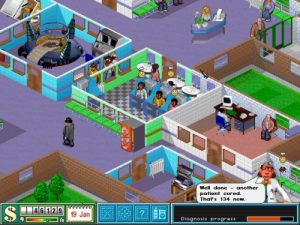 Next you have the graphs screen, where you can check your performance against the other three competing hospitals, plus how close you are to achieving your goals (number of patients cured, hospital value, reputation and balance). In the charts you can see the graphical progression of patients cured, visits, money in/out, money spent on wages and reputation.
The last menu option is where you manage when to guess at a cure, when to send patients home, your staff’s tiredness level and if they should leave the rooms to go where they are needed. Don’t check “leave the rooms”, that usually creates more chaos, with your GP leaving his office to go to one of the treatment rooms. I prefer to manually move a doctor tow here he’s needed, especially the psychiatrist, since he doesn’t always have a solid queue. In the case of surgeons, you have to make sure they are always resting after a surgery. You always need two “functional” surgeons, and they tend stress out and tire easily.
Since you are competing with other hospitals in the area, the first thing you should do is slow down time and access the staff screen. Hire the best ones right away. To make things run as smmothly as possible from the start, you will need a receptionist, two nurses, two doctors, one psychiatrist and two handymen.
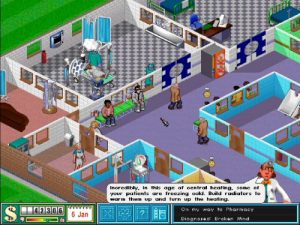 Then, you can start building. Rooms are divided into categories: diagnosis, treatment, facilities and clinics. Some of the diagnosis services include GP’s office, psychiatry, ultrasound, cardio and X-ray. The ward (which is also a diagnosis room), psychiatry and pharmacy are some of your treatment rooms. The clinics treat all sorts of wacky conditions like slack tongue, bloaty head, fractures or hairyitis by using strange machinery and hilarious processes. Facilities include bathrooms and staff rooms, which you will definitely need to keep both patients and staff happy enough.
Placement actually means a lot, in order to minimize patient queues and waiting time. The GP’s office is a patient’s first stop, followed by the diagnosis rooms, a stay at the ward, and finally the cures and treatments in the pharmacy, specialized clinics or operating theater.
Sometimes it’s not so easy to get things running perfectly due to the layout of the buildings and limited space, but many times there are extra buildings in your lot that you can purchase, if you can afford them.
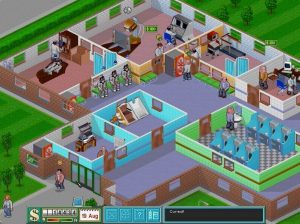 You will also have research labs and training facilities to educate your younger doctors later in the game, but these can be placed away from the main hospital area. However, they become crucial to progress in the later levels, since you will NEED to train the doctors and research a lot to get your hospital up to speed. If you don’t have competent staff nor the treatments, you will start seeing people leave without paying and even die in the hallways, Grim Reaper and all.
But it’s not just about pulling staff from one room to the other, researching new drugs and treatment options, training staff, placing enough benches and radiators all around and managing a sometimes tight budget. There are more challenges to be found in this wacky healthcare environment.
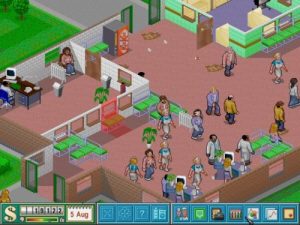 Staff will threaten to quit and demand a bonus now and again. Emergency cases will arrive in batches needing to be treated right away. VIPs will want to inspect your hospital. Earthquakes will ruin the performance of your machines or destroy them completely if the durability is already low. Epidemics require you to hunt down the contaminated people and vaccinate them within a time limit, otherwise you will have a mess in the hospital. And many times, the patients will just be littering and vomiting all over the hallways.
The receptionist does a good job alerting you to certain things, such as a VIP arrival, epidemic or emergency warning, and if staff is required in a particular room. Besides, some of her comments are hilarious: “Patients are asked not to vomit too much!” and clever “The Hospital Administrator is cheating!” (she does say it in a very snotty British accent when you enter a cheat code in the fax machine) are some of my favorites.
I really love the humor throughout. From the receptionist to the strange treatments and conditions, browsing your drug briefcase and reading the causes and symptoms for each disease is just plain hilarious! Sitting on cold stone floors causes spare ribs. Crunching up ice cubes in drinks gives you kidney beans. Iron lungs allows you to breathe fire and shout loudly underwater. If you feel like you’ve been sitting on a bag of marbles, then you surely have heaped piles. And anything unexpected causes unexpected swelling.
Ok, so it’s an 11 year-old game, you know the graphics aren’t going to be amazing. But I still enjoy the isometric view, the 2D sprites and the simple animations. The music is also varied, there are plenty of tunes in different styles, perfect for long hours of gameplay. And the sound effects are great, since you can clearly hear coughing, sneezing, some booing if you failed to cure someone, people in the bathroom farting, cheers if you successfully treated a patient, and of course, the all-knowing ever-vigilant receptionist.
I can’t tell you how glad I am to have Theme Hospital running again. It’s definitely a game worth going back to, and for fans of micromanagement titles, it would be worth tracking down a copy. Even if just for the giggles.